
Petrov Defense - Classical Variation
Counter-attack from the start — mirror White's knight, win back the pawn, and reach a rock-solid position with the Petrov's symmetrical approach
Try Interactive LessonIntroduction
Lesson Content
The King's Pawn opening — White claims the center and opens diagonals for the queen and kingside bishop. The most popular first move in chess. Black's main responses: - 1. ..e5 — Open Game, matching White's center - 1. ..c5 — Sicilian Defense, fighting for d4 asymmetrically - 1. ..e6 — French Defense, preparing ..d5 - 1. ..c6 — Caro-Kann, also preparing ..d5
Match White in the center with your own king pawn.
Black mirrors White's central claim, establishing a symmetrical pawn center. This leads to the Open Games — the oldest and most classical family of openings. The e5 pawn controls d4 and f4, limiting White's expansion options.
White develops the knight to its most natural square, attacking the e5 pawn immediately. The knight also controls d4 and prepares kingside castling. This is the most common second move, leading to a vast tree of openings including the Italian, Ruy Lopez, and Scotch.
Counter-attack! Mirror White's threat instead of defending passively.
♘︎f6 — The Petrov Defense! Instead of defending e5 with 2. ..♘︎c6, Black counter-attacks White's e4 pawn. This is a bold, principled approach — rather than passively defending, Black creates a mirror threat. The idea is that after 3. ♘︎xe5, Black does NOT recapture immediately but first plays 3. ..d6, kicking the knight back and then taking on e4. The Petrov is one of the most solid openings in chess, with a very high draw rate in master games.
Alternative Moves
White captures the e5 pawn. This is the most critical test of the Petrov. Now Black must be careful — the tempting 3. ..♘︎xe4?? is a common beginner mistake that loses material after 4. ♕︎e2! The correct response is 3. ..d6, attacking the knight and preparing to recapture the pawn.
Alternative Moves
Attack the knight first — do NOT take on e4 yet!
The correct recapture sequence begins! Black attacks the ♘︎e5, forcing it to retreat. After the knight moves, Black captures on e4 to restore material equality. Warning: 3. ..♘︎xe4?? is a famous trap — after 4. ♕︎e2! ♘︎f6 5. ♘︎c6+, White wins the queen. Always play 3. ..d6 first!
Alternative Moves
White retreats the knight to f3, its best square. The knight returns to active duty — controlling d4, supporting a future d4 push, and preparing development. The alternative retreats (4. ♘︎c4, 4. ♘︎d3) are less common. Now Black recaptures the e4 pawn, completing the symmetrical exchange.
Recapture the pawn — material is now equal.
♘︎xe4 — Black recaptures the pawn, restoring material equality. The position is now nearly symmetrical — both sides have lost a center pawn and developed a knight. But White has a slight initiative because of the first-move advantage. This knight on e4 is temporarily well-placed but will need to retreat soon as White develops.
The Classical Attack! White establishes a strong central pawn on d4, claiming space and preparing rapid development. This is the most popular and principled continuation (12,188 master games). White's plan is clear: develop the bishop to d3, castle kingside, and use the central space advantage to create pressure.
Establish your own center pawn — symmetry is your friend in the Petrov.
Black matches White's central pawn, creating a symmetrical d4/d5 pawn structure. This is the overwhelming choice in master play (11,853 games). The position now resembles a Queen's Gambit Declined structure, but with some key differences. By establishing d5, Black ensures a solid center and prepares to develop the remaining pieces harmoniously.
Alternative Moves
White develops the bishop to d3 — essentially the only move played at the master level (11,808 games). The bishop targets the kingside (h7 pawn) and supports a future c4 push to challenge Black's d5 pawn. The bishop on d3 also eyes the ♘︎e4, which will need to find a new home soon.
Develop your bishop and prepare to castle.
Black develops the bishop to a solid, classical square. ♗︎e7 prepares castling kingside and keeps the position flexible. The bishop is modest on e7 but very functional — it supports the king and can become active later. This is the traditional main line (2,592 master games). The alternatives 6. ..♘︎c6 (Mason-Showalter) and 6. ..♗︎d6 (Marshall) lead to different strategic paths.
Alternative Moves
White castles, securing the king and activating the rook. This is virtually the only move (2,656 out of 2,714 games). The king is safe on g1 and the rook enters the game on f1. White is now ready to challenge Black's center with c4, aiming to create an isolated queen's pawn (IQP) position.
Develop the knight toward the center — put pressure on d4.
Black develops the knight to its most natural square, adding pressure to the d4 pawn. This is the most popular move (1,966 games). The knight on c6 also controls e5 and b4. With ..♘︎c6, Black has three pieces developed and is ready to castle next. The position is very solid.
Alternative Moves
The Jaenisch Variation — White strikes at Black's d5 pawn with c4, the most popular continuation (3,581 games). This is a key moment: if Black takes on c4, White gets an IQP on d4 but with active piece play. If Black maintains d5, the tension persists. Kasparov, Anand, and Kramnik have all played this position extensively at the highest level.
Alternative Moves
Attack the bishop! Your knight jumps to an aggressive outpost.
♘︎b4 — A key move! The knight jumps to b4, attacking the ♗︎d3 and threatening to land on the strong c2 or d3 squares. White is forced to deal with this threat, typically by retreating the bishop to e2. This is the overwhelming choice in master play (3,152 out of 3,586 games). The knight on b4 creates concrete problems for White.
Alternative Moves
White retreats the bishop to e2 — the main line (2,820 games). The bishop is less active on e2 than d3, but White maintains a solid position and will develop with ♘︎c3 next. The alternative 9. cxd5 (Browne Attack) is sharper but less popular (269 games).
Castle to safety — complete your kingside development.
O-O — Black castles to safety — the overwhelming choice (2,518 out of 2,820 games). The king is secure, the rook enters the game, and Black is fully developed on the kingside. The position is very balanced. Both sides have castled, developed naturally, and the central tension remains. This is the hallmark of the Petrov — solid equality.
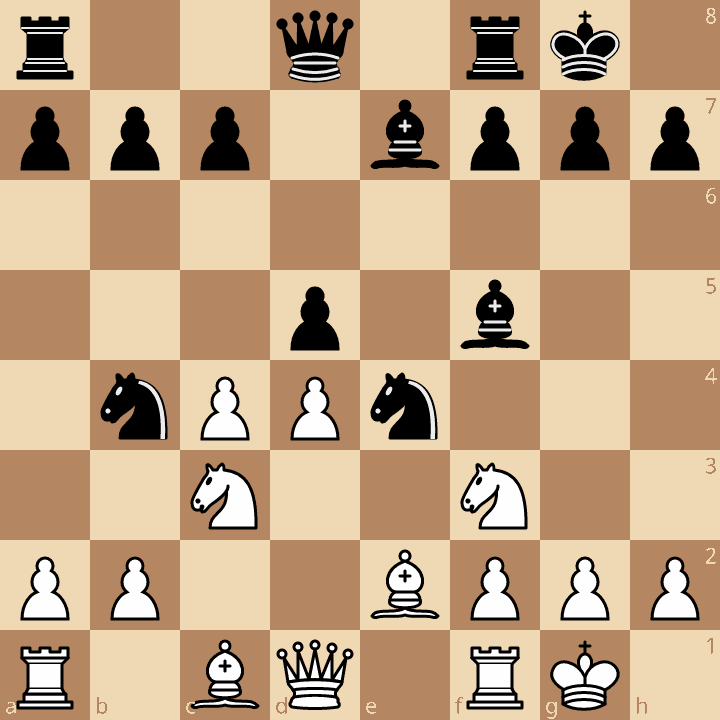
White completes development with ♘︎c3, the most popular move (2,196 games). The knight develops to its best square, supporting the center and preparing to challenge Black's ♘︎e4. The position is now a typical Petrov middlegame — White has slightly more space, but Black's position is rock-solid.
Develop your last piece to its most active square.
♗︎f5 — Black develops the last minor piece to its ideal square! The bishop on f5 is actively placed, controlling key light squares and preparing for the middlegame. This is the most popular move (1,670 games, 77.5% draw rate). From here, the typical continuation is 11. a3 ♘︎xc3 12. bxc3 ♘︎c6 with a balanced middlegame. Black's position is extremely solid — the hallmark of the Petrov Defense.
Alternative Moves
Key Takeaways
- 2...♘︎f6 counter-attacks instead of defending — the defining idea of the Petrov
- NEVER play 3...♘︎xe4?? — always 3...d6 first to avoid the ♕︎e2 trap
- 5...d5 creates a symmetrical center that is the foundation of Black's solid position
- 8...♘︎b4 is the key active move, exploiting the bishop on d3 and forcing ♗︎e2
- 10...♗︎f5 completes development — the Petrov gives Black a solid, equal position
Now play it through
Step through every move on a real board, try the wrong ones, and ask Knighty why they fail.
Related Lessons
Summary
Ready to Practice?
Next in this opening family
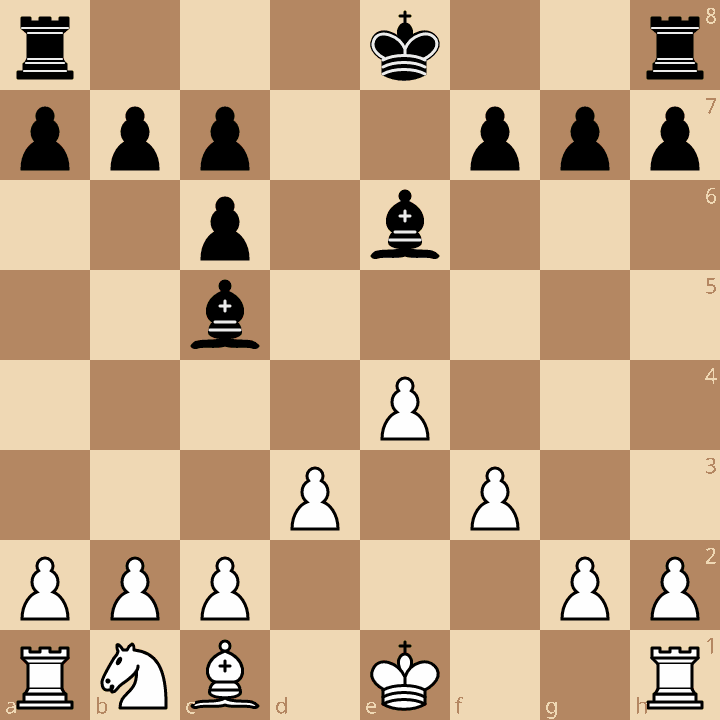
Stafford Gambit — Refutation
Take this lesson with you
Free account requiredWith every variation — opens in Lichess & ChessBase