
Stafford Gambit — Refutation
Learn how White refutes the trappy Stafford Gambit with calm development and piece trades.
Try Interactive LessonIntroduction
Lesson Content
The King's Pawn opening — White claims the center and opens diagonals for the queen and kingside bishop. The most popular first move in chess. Black's main responses: - 1. ..e5 — Open Game, matching White's center - 1. ..c5 — Sicilian Defense, fighting for d4 asymmetrically - 1. ..e6 — French Defense, preparing ..d5 - 1. ..c6 — Caro-Kann, also preparing ..d5
Black mirrors White's central claim, establishing a symmetrical pawn center. This leads to the Open Games — the oldest and most classical family of openings. The e5 pawn controls d4 and f4, limiting White's expansion options.
White develops the knight to its most natural square, attacking the e5 pawn immediately. The knight also controls d4 and prepares kingside castling. This is the most common second move, leading to a vast tree of openings including the Italian, Ruy Lopez, and Scotch.
The Petroff Defense (Russian Game) — instead of defending e5 with 2. ..Nc6, Black counter-attacks White's e4 pawn. This is a solid, well-respected opening at all levels. Black's idea: if White captures on e5, Black will recapture material or win the e4 pawn.
White captures the e5 pawn. This is the main line of the Petroff — the knight grabs the center and dares Black to respond. In the normal Petroff, Black plays 3. ..d6 to kick the knight back. But here Black has a tricky alternative...
Alternative Moves
The Stafford Gambit! Instead of the normal 3. ..d6, Black gambits the e5 pawn and attacks the knight on e5. Black hopes White will retreat (4. Nf3??) or play carelessly, falling into tactical traps involving ..Bc5, ..Ng4, and threats to f2. This gambit is objectively unsound but extremely dangerous against unprepared opponents.
Alternative Moves
The correct refutation! White captures the knight, staying a full pawn ahead. The critical point: do not retreat with 4.Nf3?? — that allows 4. ..Nxe4 with a great position for Black. 4. Nxc6 keeps the extra pawn and forces Black to prove compensation.
Alternative Moves
Black recaptures with the d-pawn, opening the d-file for the queen. This is Black's main choice — it creates immediate tactical threats with the open center and active piece development. Black will aim for rapid ..Bc5 (targeting f2) and ..Ng4 tricks.
Alternative Moves
Solid and precise. White protects the e4 pawn and prepares to develop the kingside bishop. The key principle against gambits: secure your extra material, then develop calmly. Avoid greedy moves like 5. e5?? which opens lines for Black's pieces.
Alternative Moves
Black develops the bishop to its most aggressive diagonal, targeting the f2 pawn — White's weakest point. Combined with a future ..Ng4, this creates real threats. White must develop carefully to neutralize these tactics.
Calm development. The bishop prepares to castle and, crucially, can capture on g4 if Black tries the standard ..Ng4 trick. White's plan: complete development, castle, and consolidate the extra pawn. The prophylactic 6. h3 also works, but Be2 develops a piece while addressing the Ng4 idea.
Alternative Moves
Black's main tactical idea — the knight jumps to g4, threatening Nxf2 (forking queen and rook) and supporting ..Qh4. This is the move that wins games against unprepared opponents. But White is ready for it!
Eliminate the attacker! By capturing the knight immediately, White removes the tactical threat. The bishop pair is a fair price to pay for defusing Black's initiative. The key insight: when ahead in material, trade off the attacking pieces.
Alternative Moves
Black brings the queen into the attack, threatening Qxf2# (checkmate!). This looks scary, but White has a simple defense. Black also eyes the bishop on g4 for recapture.
The queen defends f2 perfectly. White's queen on f3 blocks the mate threat and protects the g4 bishop. Now Black has no good way to continue the attack — the queen trade is inevitable. Principle: use the queen for defense when required, but avoid overusing it in the opening.
Alternative Moves
Black captures the unprotected bishop on g4. The queen trade is now forced — White's queen on f3 can recapture. Black has recovered some material but White remains a pawn up.
Trade queens! When ahead in material, simplifying the position is a powerful strategy. Without queens on the board, Black's attacking chances evaporate and White's extra pawn becomes decisive. Principle: trade pieces when you're ahead in material.
Black recaptures with the bishop, developing it to an active square. Black now has the bishop pair as partial compensation, but White's extra pawn and solid structure should prevail with accurate play.
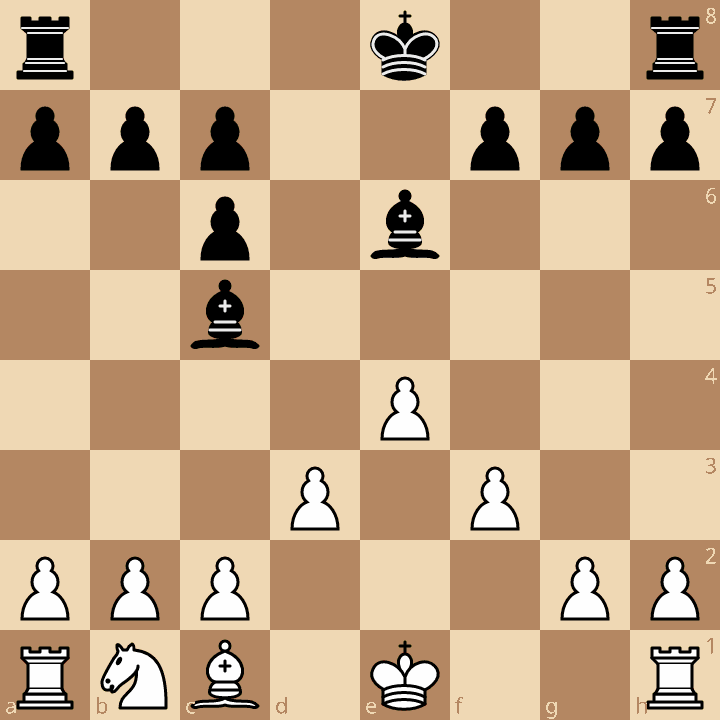
Kick the bishop! White gains a tempo by attacking the g4 bishop, which must retreat. The f3 pawn also reinforces e4 and controls the g4 square permanently. White will follow up with Be3 and Nd2, completing development.
Alternative Moves
The bishop retreats to e6, a solid square where it supports future ..c5 and ...O-O-O plans. White has successfully refuted the Stafford Gambit — an extra pawn, stable structure, and easy development ahead.
Key Takeaways
- 4.Nxc6! is the refutation — never play 4.Nf3?? which falls into the trap
- Against gambits, secure your extra material and develop calmly (d3, Be2)
- Bxg4 eliminates the attacking knight — trade off threats when ahead
- Qf3 defends f2 and forces the queen trade
- Trade pieces when ahead in material to neutralize the opponent's initiative
Now play it through
Step through every move on a real board, try the wrong ones, and ask Knighty why they fail.
Summary
Ready to Practice?
Take this lesson with you
Free account requiredWith every variation — opens in Lichess & ChessBase