
Pirc Defense - Classical Variation
A hypermodern defense where Black allows White a big center, then attacks it with the fianchettoed bishop and ...e5.
Try Interactive LessonIntroduction
Lesson Content
The King's Pawn opening — White claims the center and opens diagonals for the queen and kingside bishop. The most popular first move in chess. Black's main responses: - 1. ..e5 — Open Game, matching White's center - 1. ..c5 — Sicilian Defense, fighting for d4 asymmetrically - 1. ..e6 — French Defense, preparing ..d5 - 1. ..c6 — Caro-Kann, also preparing ..d5
The Pirc Defense begins. Black prepares ..Nf6 and ..g6, allowing White to build a full pawn center before attacking it. This hypermodern approach treats the center as a target rather than something to occupy immediately. Unlike 1. ..e5 or 1. ..c5, Black keeps maximum flexibility — the pawn structure stays uncommitted.
Alternative Moves
White builds the ideal pawn center with e4 and d4. This is exactly what Black invites in the Pirc — a big center that becomes a target.
Black develops the knight to its best square, attacking the e4 pawn and preparing ..g6. The knight on f6 is the backbone of the Pirc setup.
Alternative Moves
White defends e4 and develops naturally. The knight on c3 controls d5 and supports a future e5 advance.
The defining Pirc move — preparing to fianchetto the bishop on g7. The bishop will control the long a1-h8 diagonal, pressuring d4 and the entire queenside. This is the hypermodern approach: let White occupy the center, then attack it from the flanks.
Alternative Moves
The Classical Variation — White develops the knight to its most natural square. This is solid and principled, unlike the aggressive Austrian Attack (4. f4). White's alternatives define different systems: - 4. f4 — Austrian Attack, aggressive but committal - 4. Be3 — 150 Attack, preparing Qd2 and Bh6 - 4. Bg5 — Byrne Variation, pinning the knight
The bishop takes its powerful diagonal. From g7 it X-rays the entire a1-h8 diagonal, putting latent pressure on White's d4 pawn. This is the Pirc's main strategic asset.
The Quiet System — White develops the bishop modestly, supporting kingside castling without committing to an aggressive plan. White's alternatives here: - 5. h3 — Schlechter Variation, preventing ..Bg4 - 5. Be3 — preparing Qd2 with ideas of Bh6
Castle immediately! The king is safe and the rook moves toward the center. Black has completed the basic Pirc setup: knight on f6, bishop on g7, king castled.
White castles as well. Both sides are developed and the middlegame begins. White has the space advantage; Black has flexible piece placement.
The Parma Defense! Black pins the Nf3 — a key defender of the d4 pawn. This develops the last minor piece while creating tactical pressure on the center. Named after Slovenian GM Bruno Parma, this is Black's most active approach in the Classical Pirc.
Alternative Moves
White develops the bishop to e3, supporting d4 and preparing Qd2. The bishop connects with the queen for potential Bh6 ideas, targeting Black's fianchettoed bishop.
The knight develops to c6, adding more pressure on d4. With Bg4 pinning the Nf3 and Nc6 attacking d4, Black builds a coordinated assault on White's center.
Alternative Moves
White connects the rooks and prepares Bh6 to trade off Black's powerful dark-squared bishop. The queen on d2 also supports d4.
The thematic central break! Black challenges White's d4 pawn directly. This is the payoff of the Pirc — after building up piece pressure with Bg4, Nc6, and Bg7 all targeting d4, Black strikes. White must decide: advance with d5 (closing the center) or exchange on e5 (opening lines).
Alternative Moves
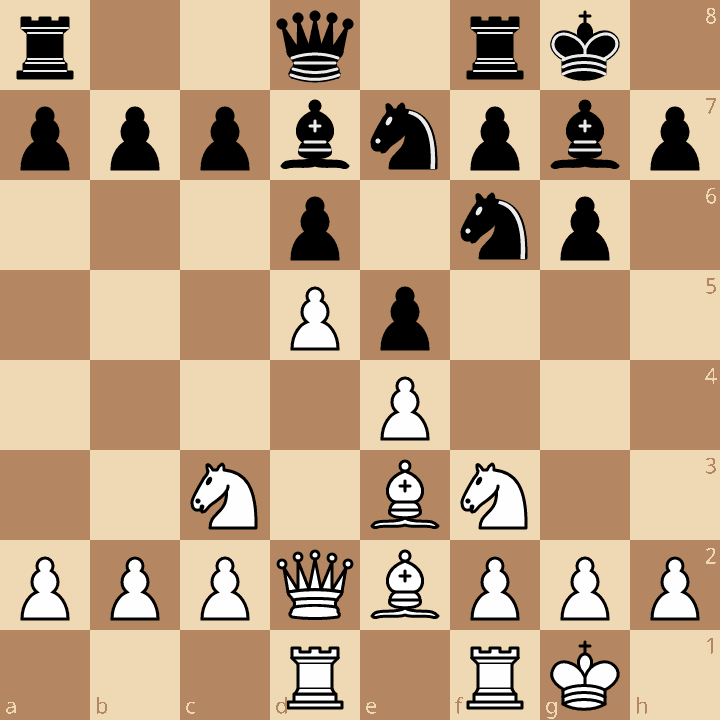
White pushes forward, gaining space but closing the center. The pawn chain e4-d5 restricts Black's knight on c6. However, Black gets counterplay with ..f5 and queenside expansion.
The knight retreats to e7, heading for better squares. From e7, it can jump to f5 (an ideal outpost), g6 for kingside play, or c8-b6 for queenside operations.
Alternative Moves
White activates the rook on the d-file, supporting the d5 pawn. A natural move completing White's development.
The bishop retreats to d7, preparing ..c6 to challenge White's d5 pawn. From d7 the bishop also supports queenside expansion with ..b5. Black's position is flexible with counterplay on both flanks.
Alternative Moves
Key Takeaways
- Let White build the center — it becomes a target, not a strength
- The Bg7 fianchetto controls the long diagonal and pressures d4
- 6...Bg4 (Parma Defense) pins the Nf3, weakening central control
- ...e5 is the key break — time it after building maximum pressure on d4
- After d5, regroup with Ne7 and Bd7 for flexible counterplay on both flanks
Now play it through
Step through every move on a real board, try the wrong ones, and ask Knighty why they fail.
Summary
Ready to Practice?
Take this lesson with you
Free account requiredWith every variation — opens in Lichess & ChessBase