
Ponziani Opening
A tricky alternative to the Italian and Scotch where White prepares d4 with c3, aiming for a strong pawn center and space advantage.
Try Interactive LessonIntroduction
Lesson Content
The King's Pawn opening — White claims the center and opens diagonals for the queen and kingside bishop. The most popular first move in chess. Black's main responses: - 1. ..e5 — Open Game, matching White's center - 1. ..c5 — Sicilian Defense, fighting for d4 asymmetrically - 1. ..e6 — French Defense, preparing ..d5 - 1. ..c6 — Caro-Kann, also preparing ..d5
Black mirrors White's central claim, establishing a symmetrical pawn center. This leads to the Open Games — the oldest and most classical family of openings. The e5 pawn controls d4 and f4, limiting White's expansion options.
White develops the knight to its most natural square, attacking the e5 pawn immediately. The knight also controls d4 and prepares kingside castling. This is the most common second move, leading to a vast tree of openings including the Italian, Ruy Lopez, and Scotch.
Black defends the e5 pawn with the most natural developing move. The knight on c6 also controls the important d4 and e5 squares. From here White's third move defines the opening: - 3. Bc4 — Italian Game - 3. Bb5 — Ruy Lopez - 3. d4 — Scotch Game - 3. Nc3 — Four Knights / Vienna hybrid
The Ponziani Opening! White plays the quiet 3. c3, preparing to build the ideal pawn center with d4 on the next move. Unlike the immediate 3. d4 (Scotch), White first supports the d4 advance so the pawn can be recaptured with a pawn. The Ponziani is a practical surprise weapon — less theoretical than the Italian or Ruy Lopez, but with real bite.
Alternative Moves
The Jaenisch Counterattack — Black develops the knight to f6, attacking White's e4 pawn and preparing to castle. This is the most popular response, played in over 900 master games. Black's main alternatives: - 3. ..d5 — striking the center immediately - 3. ..f5 — the Ponziani Countergambit, sharp but risky
Alternative Moves
The whole point of 3. c3! White pushes d4, creating a strong central pawn duo and challenging Black's position. The e4 pawn is attacked by the Nf6 and the d4 pawn attacks e5, so the position becomes dynamic. This is the defining moment of the Ponziani — White's preparation with c3 pays off.
Alternative Moves
Black captures on d4, opening the center. This is the second most popular reply, leading to sharp play. The alternative 4. ..Nxe4 is also popular, grabbing the e-pawn, but after 5. d5 White gains a strong space advantage.
Alternative Moves
Instead of recapturing on d4, White pushes e5 — a dynamic pawn sacrifice! The e5 pawn attacks Black's knight, gains space, and opens the e-file. White will recover the pawn with cxd4 next move. This advance is the key to making the Ponziani work after 4. ..exd4.
Alternative Moves
Black retreats the knight to the strong central square d5, the best response. The knight is well-placed here, controlling key squares and blocking the d-file. The alternative 5. ..Ne4 also works but is less flexible.
White recaptures the d4 pawn, establishing a powerful pawn duo on d4 and e5. These two pawns control a huge amount of central space and restrict Black's piece mobility. White's plan is clear: develop pieces, castle, and use the space advantage for a kingside attack.
Alternative Moves
Black gives check with the bishop, disrupting White's development. This is the engine's top choice — Black gains a tempo and forces White to block, which slightly slows down castling.
White blocks the check with the knight, developing a piece in the process. The knight on d2 supports e4 control and can later reroute to better squares after the bishops are traded. This is stronger than 7. Bd2, which would leave the knight on b1 undeveloped.
Alternative Moves
Black challenges White's e5 pawn, the anchor of White's space advantage. This is the most natural response, aiming to undermine the center. If White doesn't deal with the e5 pawn, Black can capture and equalize.
White asks the bishop an important question: retreat or trade? Since retreating loses time, Black will exchange on d2. White gains the bishop pair and a clear plan to develop with Bc4 or Bb5, then castle. This is the engine's top choice, winning the bishop pair without losing tempo.
Alternative Moves
Black trades the bishop, the best practical choice. Retreating with ..Ba5 or ..Be7 would lose tempo and leave Black cramped. The trade simplifies but gives White the bishop pair.
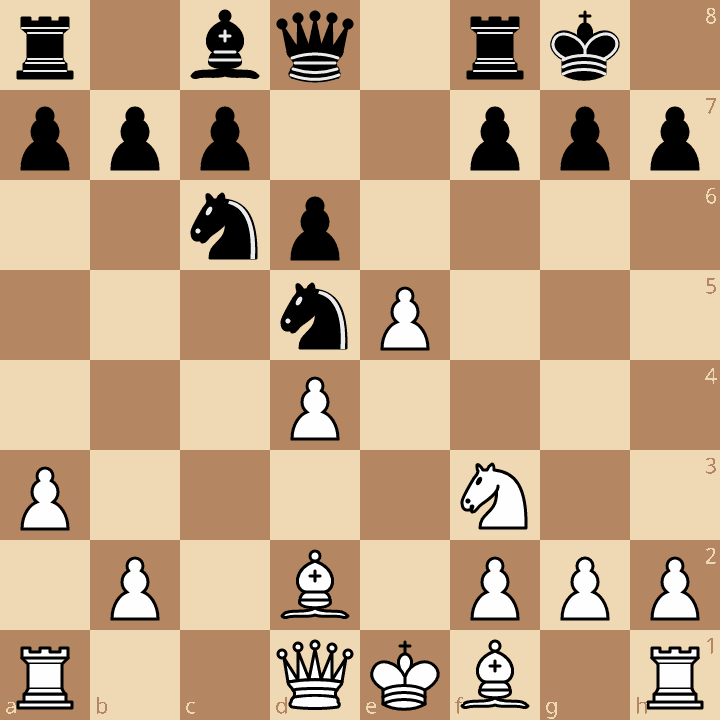
White recaptures with the bishop, maintaining active piece development. The bishop on d2 can later move to more active squares like c3 or b4. White now has the bishop pair and plans O-O followed by Bc4 or Bb5.
Black castles to safety, completing kingside development. The position is roughly equal but White has practical advantages: the bishop pair, the central d4+e5 pawn duo, and clear plans to develop with Bc4/Bb5 followed by O-O.
Key Takeaways
- 3.c3 prepares the ideal d4 pawn center — less theoretical than the Italian or Ruy Lopez
- After 4.d4 exd4 5.e5, White gains space and forces the knight to retreat
- The d4+e5 pawn duo controls the center and restricts Black's pieces
- 8.a3 wins the bishop pair, a lasting positional advantage
- White plans to develop with Bc4/Bb5, castle, and use the space advantage
Now play it through
Step through every move on a real board, try the wrong ones, and ask Knighty why they fail.
Summary
Ready to Practice?
Take this lesson with you
Free account requiredWith every variation — opens in Lichess & ChessBase