
Queen's Gambit Accepted
Accept the gambit, develop freely, and challenge the center with ...c5 to reach a classic IQP middlegame
Try Interactive LessonIntroduction
Lesson Content
The Queen's Pawn opening — White claims the center with the d-pawn, which is immediately defended by the queen. This tends to lead to more strategic, closed positions compared to 1. e4. Black's main responses: - 1. ..d5 — Queen's Gambit and Slav setups - 1. ..Nf6 — Indian Defenses (King's Indian, Nimzo-Indian, etc.) - 1. ..f5 — Dutch Defense
Black matches White in the center, leading to the Queen's Pawn Game. The symmetrical center typically results in strategic maneuvering rather than immediate tactical battles. White's most popular continuation is 2. c4 — the Queen's Gambit.
The Queen's Gambit — White offers a pawn to lure Black's d5 pawn away from the center. It's not a true gambit since Black can't hold the pawn long-term. Black's main choices: - 2. ..e6 — Queen's Gambit Declined, solid and classical - 2. ..c6 — Slav Defense, supporting d5 while keeping the bishop free - 2. ..dxc4 — Queen's Gambit Accepted, giving up the center temporarily
The Queen's Gambit Accepted — Black captures the c4 pawn, temporarily conceding the center. The idea is not to hold the pawn but to develop freely while White recaptures. Black typically follows up with ..e6 and ..c5 to challenge White's center.
White develops the knight to its natural square, controlling e5 and d4. This is the most common move, leading to the Normal Variation of the QGA. White will recover the c4 pawn after e3 and Bxc4. The main alternative is 3. e4 (Saduleto Variation), immediately seizing the center but allowing ..e5 counterplay.
Alternative Moves
Black develops the knight to its best square, controlling e4 and d5. This is the most popular response, preventing White from easily playing e4 and establishing a big center. Black's main alternatives: - 3. ..a6 — Alekhine Defense, preparing ..b5 to hold the pawn - 3. ..c5 — Gunsberg Defense, immediately challenging d4
Alternative Moves
White opens the diagonal for the bishop to recapture on c4. The pawn on e3 also supports d4. This quiet approach leads to the Normal Variation — the most popular and well-tested system in the QGA. White accepts a modest center for now, planning to recapture the pawn and develop smoothly.
Alternative Moves
The Traditional System — Black reinforces the c4 pawn with e6 while opening the diagonal for the dark-squared bishop. This is the most classical approach, preparing ..c5 to challenge the center. The pawn on e6 gives Black a solid, flexible structure with no weaknesses.
Alternative Moves
White recovers the gambit pawn with the bishop, which now sits on an excellent diagonal targeting e6 and f7. This is the whole point of the e3/Bxc4 setup — the bishop is actively placed while White maintains the d4 pawn. The position is now roughly equal, but rich in strategic possibilities.
The Classical Defense — the defining move of the QGA main line! Black challenges White's d4 pawn directly, fighting for equality in the center. This is the most principled continuation, played by Kasparov, Anand, and Carlsen. After the central exchange, an isolated queen's pawn (IQP) structure typically arises — one of the most important middlegame structures in chess.
Alternative Moves
White castles to safety before resolving the central tension. The king is secure on g1 and the rook enters the game on f1. White can now choose when and how to address the d4-c5 tension. The main alternative is 6. Qe2, maintaining the pin on the e-file and keeping more tension.
Alternative Moves
A key prophylactic move! Black prevents the bishop from retreating to b5 (after a future ..Nc6) and prepares ..b5 to gain queenside space. This small move has big implications — it's the gateway to the Classical Defense Main Line. Nearly every top-level QGA game features this move at some point.
Alternative Moves
White retreats the bishop to b3, keeping it on the active a2-g8 diagonal while avoiding ..b5 attacks. The bishop continues to eye the e6 pawn and the f7 square. This is one of the most popular continuations, preserving the bishop's scope while maintaining central tension. White's alternatives define different systems: - 7. dxc5 — Spassky/Furman Variation, exchanging immediately - 7. Qe2 — Alekhine System, developing the queen - 7. a4 — Rubinstein Variation, preventing ..b5
Alternative Moves
Black develops the last kingside piece to its most natural square. The knight on c6 pressures d4 and controls the important e5 square. This is the engine's top choice — developing naturally while increasing pressure on the center.
Alternative Moves
White develops the last minor piece, reinforcing d4 and controlling e4. Both sides now have strong development, and the central tension (d4 vs c5) is about to be resolved. This position is a key branching point — Black must decide how to handle the center.
Black captures on d4, creating the famous isolated queen's pawn (IQP) after White recaptures with the e-pawn. This exchange is strategic: Black gives White an isolated d4 pawn that can become a long-term weakness, while White gets open lines and piece activity. The IQP structure is one of the most important middlegame themes in chess — understanding it is essential for any player.
Alternative Moves
White recaptures with the e-pawn, creating the IQP on d4. This pawn is isolated (no pawns on c- or e-files to support it), but it controls the important e5 and c5 squares. White's pieces are actively placed around the isolated pawn. This is the tabiya position that both sides have been playing toward.
Black develops the bishop to a safe, flexible square. From e7, the bishop supports kingside castling and can later relocate to f6 or d6 to increase pressure on the d4 pawn. The engine confirms Be7 as the top choice — solid, natural development before committing to a specific plan.
White centralizes the rook on the open e-file, creating latent pressure against e6. The rook supports the d4 pawn indirectly and prepares tactical ideas. This was Kramnik's choice against Kasparov in their famous 2001 match. The main alternative is 10. Bf4, developing the last minor piece before the rook.
Alternative Moves
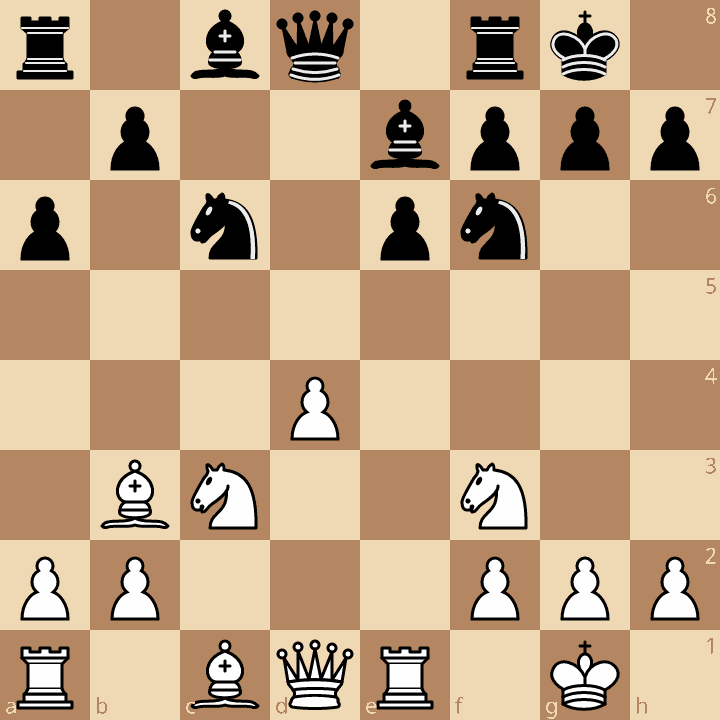
Black castles to safety, completing development. The position is balanced — White has the IQP with active pieces, Black has a solid structure targeting d4. Typical plans: Black plays ..Nb4-d5 or ..Na5-c4 to blockade d4; White aims for a kingside attack or d4-d5 breakthrough.
Key Takeaways
- 2...dxc4 accepts the gambit — Black doesn't try to hold the pawn but gains free development
- 5...c5 is the signature move of the QGA — it challenges the center and leads to the main line
- 6...a6 is a key prophylactic move preventing Bb5 and preparing queenside expansion
- After 8...cxd4 9.exd4, an isolated queen pawn arises — Black targets it, White uses active pieces
- The IQP structure is one of the most important middlegame themes: learn it here and use it everywhere
Now play it through
Step through every move on a real board, try the wrong ones, and ask Knighty why they fail.
Summary
Ready to Practice?
Take this lesson with you
Free account requiredWith every variation — opens in Lichess & ChessBase