
Rousseau Gambit
A sharp gambit where Black plays 3...f5 in the Italian Game, sacrificing a pawn for open lines and rapid counterplay.
Try Interactive LessonIntroduction
Lesson Content
The King's Pawn opening — White claims the center and opens diagonals for the queen and kingside bishop. The most popular first move in chess. Black's main responses: - 1. ..e5 — Open Game, matching White's center - 1. ..c5 — Sicilian Defense, fighting for d4 asymmetrically - 1. ..e6 — French Defense, preparing ..d5 - 1. ..c6 — Caro-Kann, also preparing ..d5
Match White in the center with your own king pawn.
Black mirrors White's central claim, establishing a symmetrical pawn center. This leads to the Open Games — the oldest and most classical family of openings. The e5 pawn controls d4 and f4, limiting White's expansion options.
White develops the knight to its most natural square, attacking the e5 pawn immediately. The knight also controls d4 and prepares kingside castling. This is the most common second move, leading to a vast tree of openings including the Italian, Ruy Lopez, and Scotch.
Defend your e5 pawn while developing a piece.
♘︎c6 — Black defends the e5 pawn with the most natural developing move. The knight on c6 also controls the important d4 and e5 squares. From here White's third move defines the opening: - 3. ♗︎c4 — Italian Game - 3. ♗︎b5 — Ruy Lopez - 3. d4 — Scotch Game - 3. ♘︎c3 — Three Knights Game
The bishop develops to c4, aiming at Black's vulnerable f7 square — the weakest point in the starting position since only the king defends it. This is the defining move of the Italian Game. White's alternatives here lead to entirely different openings: - 3. ♗︎b5 — the Ruy Lopez, pressuring the ♘︎c6 defender - 3. d4 — the Scotch Game, immediately challenging the center - 3. ♘︎c3 — the Three/Four Knights, delaying the decision
Strike at the e4 pawn with your f-pawn to seize the initiative.
f5 — The Rousseau Gambit! Black strikes at White's e4 pawn with the f-pawn, creating immediate central tension. This is a rare and aggressive alternative to the standard 3. ..♗︎c5 or 3. ..♘︎f6. The gambit half-opens the f-file for Black's rook and challenges White's center before they can consolidate. The cost is weakening the king position, but Black bets on active piece play to compensate.
Alternative Moves
White's strongest response — immediately opening the center while Black's kingside is weakened. The d4 push exploits the fact that Black's f-pawn has left, creating tactical pressure. White's alternatives: - 4. exf5 — accepting the gambit, but Black develops quickly with ..d5 - 4. d3 — quiet, but allows Black comfortable play after ..fxe4 5. dxe4 ♘︎f6
Capture the e4 pawn to gain material and half-open the f-file.
fxe4 — Black captures the e4 pawn, gaining material and clearing the f-file. The e4 pawn was the backbone of White's center — removing it creates imbalances Black can exploit. Now the position becomes sharp: White has more central space with the d4 pawn, but Black has an extra pawn and the half-open f-file as a future attacking resource.
Alternative Moves
White captures the e5 pawn with the knight, centralizing powerfully. The knight on e5 is a monster — it attacks c6, d7, and f7, creating multiple tactical threats. White removes a defender of d4 to place the knight on this dominant outpost, counting on the tactical pressure to make up for it.
Push the pawn to attack the bishop and claim the center.
Black fights back in the center! The d5 push attacks the ♗︎c4, gaining a tempo while establishing a strong central pawn. This is the key move to make the gambit work. Material is level and Black has central presence, though White's knight on e5 and lead in development give White the better game.
Alternative Moves
White retreats the bishop to b5, pinning the ♘︎c6 to the king. This is the most critical continuation — the pin creates tactical pressure that limits Black's coordination. White threatens to exchange on c6 and damage Black's pawn structure, which would create long-term weaknesses to target.
Bring the queen to d6 to defend the knight and stay active.
♕︎d6 — The queen develops to d6, defending the knight on c6 and preparing to centralize. The queen also attacks the knight on e5. This is a multipurpose move: it protects the knight, prepares ..♘︎f6 development, and keeps the queen active in the center where it can influence both flanks.
Alternative Moves
White castles, bringing the king to safety. With the center open, getting the king off the e-file is essential. White's rook now sits behind the f2 pawn on the f-file (ironic — the file Black half-opened!) and White's development lead becomes more concrete.
Develop the knight to its natural square.
♘︎f6 — Black develops the knight to f6, a key developing move that defends d5 and prepares kingside castling. The knight also supports the e4 pawn. With this move, Black has two minor pieces developed and is approaching readiness to castle. The position remains complex with chances for both sides.
White strikes at Black's d5 pawn, undermining the center. The c4 push challenges Black's central control and opens lines for White's pieces on the queenside. Combined with the knight on e5 and the pin from ♗︎b5, this creates significant pressure that Black must handle carefully.
Challenge the bishop — force it to make a decision.
a6 — Black challenges the ♗︎b5 directly, forcing a decision. White must either retreat or exchange on c6. This is the most principled response — Black wants to resolve the pin before developing further. If White exchanges, Black gets the bishop pair and half-open b-file, despite doubled c-pawns.
Alternative Moves
White exchanges the bishop for the knight, doubling Black's c-pawns. While this gives up the bishop pair, the damaged pawn structure on c6 and c7 creates lasting weaknesses. The check also forces Black to recapture in a specific way, maintaining White's structural advantage.
Recapture toward the center.
bxc6 — Recapturing toward the center is the best recapture. Black now has doubled c-pawns but gains the half-open b-file for the rook. The pawn structure is damaged but Black has compensation: the bishop pair, the half-open b-file, and the advanced e4 pawn. The position offers dynamic counterplay.
White develops the knight to c3, targeting the e4 pawn and the d5 pawn. The knight joins the attack on Black's center, increasing the pressure. With both knights developed and the king safe, White has a clear development advantage. The ♘︎e5 and ♘︎c3 together dominate the center.
Develop the bishop and prepare to castle.
♗︎e7 — Black develops the bishop to e7, preparing to castle and completing kingside development. The bishop is modestly placed but functional — it supports castling and keeps the position solid. Getting the king to safety is now Black's top priority. Once castled, Black can activate the rooks and start using the open files.
Alternative Moves
White develops the last minor piece, lining up against Black's queen on d6 behind the e5 knight. The bishop on f4 is very active — it x-rays d6, controls the c1-h6 diagonal, and supports the central knight. This threatens a discovered attack on Black's queen, gaining another tempo for White's already superior development.
Move the queen to e6 to stay active and protect the center.
♕︎e6 — The queen retreats to e6, maintaining central presence while staying connected to the defense. From e6, the queen eyes the kingside and keeps d5 protected. Black is ready to castle on the next move. Despite being under pressure, the position remains rich with possibilities — the e4 pawn and bishop pair offer long-term compensation.
Key Takeaways
- 3...f5 immediately challenges White's e4 center and half-opens the f-file
- 4...fxe4 followed by 5...d5 is the key sequence to activate Black's pieces
- The queen on d6 is a multipurpose defender and attacker
- Accept doubled c-pawns for the bishop pair and half-open b-file
- Castle quickly — Black's king is vulnerable in the center
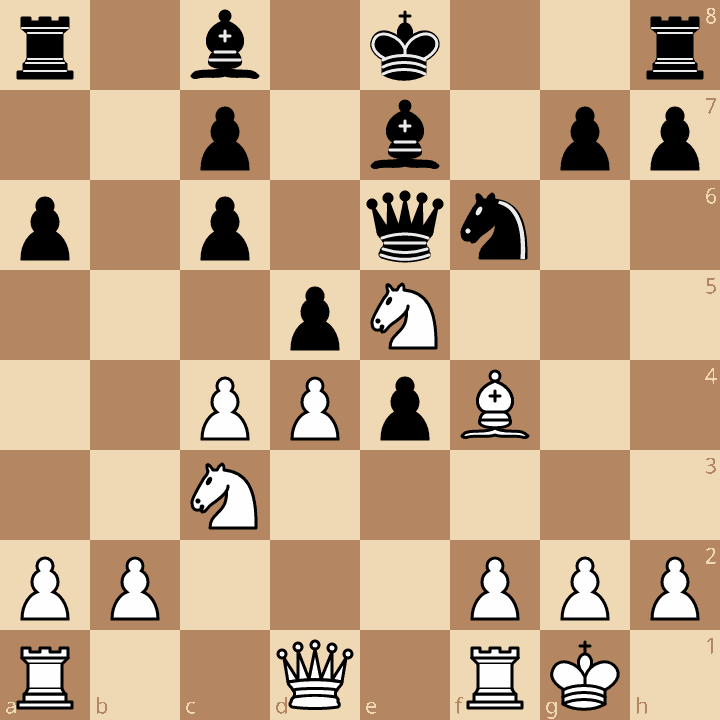
Now play it through
Step through every move on a real board, try the wrong ones, and ask Knighty why they fail.
Related Lessons
Summary
Ready to Practice?
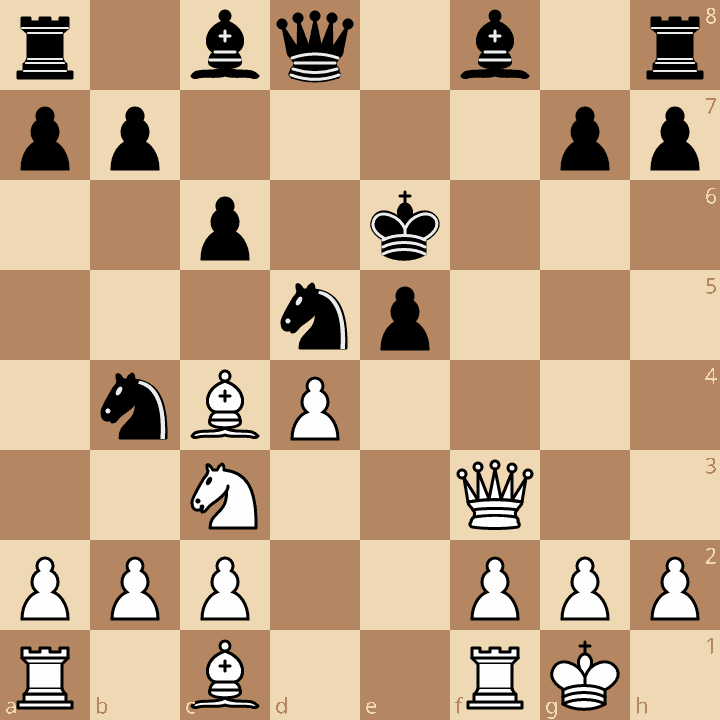
Next in this opening family
Fried Liver Attack
Take this lesson with you
Free account requiredWith every variation — opens in Lichess & ChessBase