
Ruy Lopez - Berlin Defense
The ultimate fortress — trade queens early, survive the endgame, and grind with the bishop pair in the famous 'Berlin Wall' that dethroned Kasparov
Try Interactive LessonIntroduction
Lesson Content
The King's Pawn opening — White claims the center and opens diagonals for the queen and kingside bishop. The most popular first move in chess. Black's main responses: - 1. ..e5 — Open Game, matching White's center - 1. ..c5 — Sicilian Defense, fighting for d4 asymmetrically - 1. ..e6 — French Defense, preparing ..d5 - 1. ..c6 — Caro-Kann, also preparing ..d5
Black mirrors White's central claim, establishing a symmetrical pawn center. This leads to the Open Games — the oldest and most classical family of openings. The e5 pawn controls d4 and f4, limiting White's expansion options.
White develops the knight to its most natural square, attacking the e5 pawn immediately. The knight also controls d4 and prepares kingside castling. This is the most common second move, leading to a vast tree of openings including the Italian, Ruy Lopez, and Scotch.
Black defends the e5 pawn with the most natural developing move. The knight on c6 also controls the important d4 and e5 squares. From here White's third move defines the opening: - 3. Bc4 — Italian Game - 3. Bb5 — Ruy Lopez - 3. d4 — Scotch Game - 3. Nc3 — Four Knights / Vienna hybrid
The Ruy Lopez (Spanish Game) — one of the deepest and most respected openings. White puts pressure on the Nc6 — the key defender of e5. If Black later moves the d7 pawn, the knight becomes pinned to the king. The idea is not to capture immediately but to maintain long-term pressure. Black's main responses: - 3. ..a6 — Morphy Defense (most popular), challenging the bishop - 3. ..Nf6 — Berlin Defense, solid and drawish - 3. ..d6 — Steinitz Defense, passive but solid
The Berlin Defense! Instead of the popular 3. ..a6 (Morphy Defense), Black develops the knight to attack e4 directly. This is the move that changed modern chess — Kramnik used it to defeat Kasparov in the 2000 World Championship. The Berlin leads to a unique queenless middlegame after the forced sequence 4.O-O Nxe4 5. d4 Nd6 6. Bxc6 dxc6 7. dxe5 Nf5 8. Qxd8+ Kxd8. Black loses castling rights but gains the bishop pair and an extremely solid position.
Alternative Moves
White castles, the most critical test of the Berlin. By castling before dealing with the e4 threat, White essentially gambits the e4 pawn — but it's temporary. After 4. ..Nxe4 5. d4, White will regain the pawn with a lead in development. The alternative 4. d3 (Anti-Berlin) avoids the Berlin Wall endgame entirely and is increasingly popular at the top level (12,422 games).
Alternative Moves
Black captures the e4 pawn. This is the overwhelming choice in master play (16,728 games, 71% draw rate) and the engine's top pick. The knight on e4 is temporary — it will retreat to d6 after White plays d4. The key point: Black is not trying to hold the extra pawn. The plan is to exchange queens and reach a favorable endgame.
Alternative Moves
White strikes at the center with d4, the most popular continuation (10,882 games). This attacks both the e5 pawn and prepares to regain the pawn on e4. The position is opening up rapidly. White's plan: after ..Nd6, capture on c6 to double Black's pawns, then trade queens and play the endgame with a slight edge.
Alternative Moves
The only good square for the knight! From d6, the knight attacks the Bb5 and prepares to reroute to f5 after the upcoming exchanges. This is the engine's top choice and virtually the only move played (10,061 games). Warning: 5. ..Be7? is weak — after 6. dxe5 Nd6 7. Bc6+ bxc6, White has a clear advantage with the better pawn structure.
Alternative Moves
White captures the knight, doubling Black's pawns on the c-file. This is a key strategic decision — White gives up the bishop pair but damages Black's pawn structure. The doubled c-pawns are a permanent weakness. This is the overwhelming choice (9,094 out of 10,061 games). The alternatives dxe5 and Ba4 are much rarer.
Black recaptures toward the center — essential! Taking with the d-pawn opens the d-file for the queen and keeps the pawn structure as compact as possible. This is near-universal (9,075 out of 9,094 games). Never play bxc6? — only 19 games, and White scores 53% wins. Recapturing with the d-pawn is critical for the Berlin's strategic logic.
Alternative Moves
White captures the e5 pawn, the only move played at the master level (9,052 games). White now has a 2-to-1 central pawn majority (e5 vs c6) and the e5 pawn restricts Black's pieces. The position is heading toward the critical queen exchange.
The knight jumps to its ideal outpost on f5! From here it eyes d4, e3, g3, and h4. This is the engine's top choice and essentially the only move (8,878 games). The knight is beautifully centralized and cannot easily be challenged. Now White will exchange queens with Qxd8+, entering the famous Berlin Wall endgame.
Alternative Moves
The defining moment of the Berlin Defense! White exchanges queens, entering the famous endgame. This is the overwhelming choice (8,758 games) and the engine's top pick. The queen trade removes Black's most powerful piece but also eliminates White's attacking chances. After Kxd8, Black loses the right to castle — but this turns out to be less important than it seems because the queens are off the board.
The only legal move — Black recaptures the queen with the king. Welcome to the Berlin Wall! Black has lost castling rights, but in return has the bishop pair and a structure that is extremely hard to crack. The king on d8 will quickly march to e8 and potentially to e7, where it becomes an active piece in the endgame. Without queens, the exposed king is not a liability.
White develops the knight to its natural square, completing development of the minor pieces. This is the most popular continuation (5,963 games). The knight on c3 supports the e5 pawn and controls key central squares. The alternative 9. Rd1+ (1,048 games) gives an immediate check, but after ..Ke8 the positions often transpose. 9. h3 (1,546 games) is the modern approach favored by Caruana and the very top players.
Alternative Moves
The king marches toward safety! Moving to e8 prepares to reroute to e7 (or even f6 in some lines), where it becomes an active piece in the endgame. This is the most popular choice (2,313 games, 72% draw rate). A key idea: without queens, the king is a fighting piece. In the Berlin endgame, the king often plays an active role on e7, d6, or even c5.
Alternative Moves
A key prophylactic move! White prevents ..Bg4, which would pin the Nf3 and increase pressure on the e5 pawn. This is the most popular continuation (1,619 games) and has been played in countless top-level encounters. The move also creates the option of a future g4 to challenge the Nf5, though Black can counter this with ..h5.
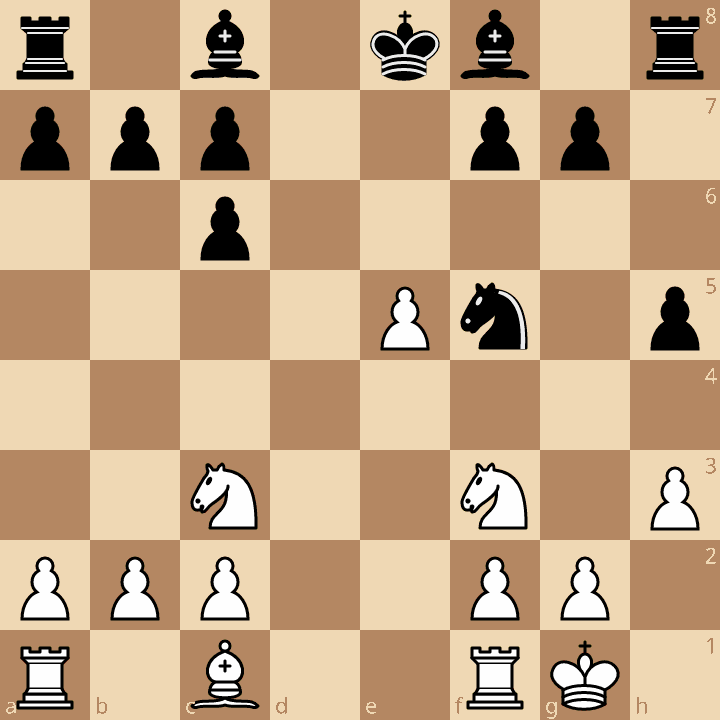
A sophisticated prophylactic response! Black plays ..h5 to prevent White from playing g4, which would kick the powerful Nf5 from its outpost. This is the top choice in master play (1,008 games, 79% draw rate) and was played by Anand against Carlsen in the 2014 World Championship. With ..h5, Black secures the knight on f5 permanently and can later develop with ..Be7, ..Be6, and ..Ke7 to complete the setup. The Berlin Wall stands firm.
Alternative Moves
Key Takeaways
- 3...Nf6 enters the Berlin — counter-attacking e4 instead of the traditional 3...a6
- 5...Nd6 is the only good retreat — always recapture on c6 with the d-pawn (dxc6, never bxc6)
- 8.Qxd8+ Kxd8 defines the Berlin Wall — Black loses castling but gains the bishop pair in a queenless game
- 9...Ke8 begins the king march — without queens, the king becomes an active endgame piece
- 10...h5 is key prophylaxis — prevent g4 to secure the knight on f5 permanently
Now play it through
Step through every move on a real board, try the wrong ones, and ask Knighty why they fail.
Summary
Ready to Practice?
Take this lesson with you
Free account requiredWith every variation — opens in Lichess & ChessBase