
Ruy Lopez - Closed (Chigorin)
White's classical blueprint — build a strong center with c3/d4, maneuver pieces behind the pawn chain, and prepare a kingside attack in one of chess's deepest openings
Try Interactive LessonIntroduction
Lesson Content
Start by controlling the center with your king pawn.
e4 — The King's Pawn opening — White claims the center and opens diagonals for the queen and kingside bishop. The most popular first move in chess. Black's main responses: - 1. ..e5 — Open Game, matching White's center - 1. ..c5 — Sicilian Defense, fighting for d4 asymmetrically - 1. ..e6 — French Defense, preparing ..d5 - 1. ..c6 — Caro-Kann, also preparing ..d5
Black mirrors White's central claim, establishing a symmetrical pawn center. This leads to the Open Games — the oldest and most classical family of openings. The e5 pawn controls d4 and f4, limiting White's expansion options.
Develop your knight toward the center while attacking the e5 pawn.
♘︎f3 — White develops the knight to its most natural square, attacking the e5 pawn immediately. The knight also controls d4 and prepares kingside castling. This is the most common second move, leading to a vast tree of openings including the Italian, Ruy Lopez, and Scotch.
Black defends the e5 pawn with the most natural developing move. The knight on c6 also controls the important d4 and e5 squares. From here White's third move defines the opening: - 3. ♗︎c4 — Italian Game - 3. ♗︎b5 — Ruy Lopez - 3. d4 — Scotch Game - 3. ♘︎c3 — Three Knights Game
Pressure the knight that defends the e5 pawn.
♗︎b5 — The Ruy Lopez (Spanish Game) — one of the deepest and most respected openings. White puts pressure on the ♘︎c6 — the key defender of e5. If Black later moves the d7 pawn, the knight becomes pinned to the king. The idea is not to capture immediately but to maintain long-term pressure. Black's main responses: - 3. ..a6 — Morphy Defense (most popular), challenging the bishop - 3. ..♘︎f6 — Berlin Defense, solid and drawish - 3. ..d6 — Steinitz Defense, passive but solid
The Morphy Defense — Black immediately questions the bishop's position. White must decide: retreat (4. ♗︎a4, maintaining tension) or exchange (4. ♗︎xc6, doubling pawns but ceding the bishop pair). 4. ♗︎a4 is the main line, keeping the pressure and the option to exchange later.
Retreat the bishop while keeping pressure on the knight.
♗︎a4 — White retreats the bishop to a4, maintaining the pressure on the ♘︎c6 and keeping the option to exchange later. This is far more popular than 4. ♗︎xc6 (94,188 vs 624 master games), preserving the bishop pair while keeping the pressure. The bishop on a4 continues to eye c6, and White can later retreat to b3 where it targets f7.
Alternative Moves
Black develops the knight to its most natural square, attacking White's e4 pawn. This creates immediate tension — White must defend e4 or accept the Open Ruy Lopez after 5.O-O ♘︎xe4. The knight also prepares kingside castling. Other options like 4. ..d6 (Steinitz Deferred) or an early 4. ..b5 lead to different character entirely.
Alternative Moves
Castle to safety — you can afford to let Black take e4 temporarily.
O-O — White castles, prioritizing king safety over defending e4. This seemingly allows 5. ..♘︎xe4 (the Open Defense), but White gets rapid piece activity with d4 in return. The most popular and principled continuation (82,405 master games). Castling also prepares ♖︎e1 to bolster the e4 pawn.
Alternative Moves
The Closed Defense — Black develops the bishop modestly to e7, maintaining the tension in the center. This is the starting point for the Closed Ruy Lopez, one of the most strategically complex systems in chess. Alternatives define entirely different openings: - 5. ..♘︎xe4 — Open Defense, sharp and tactical - 5. ..b5 followed by ...Bc5 — Neo-Arkhangelsk, aggressive - 5. ..b5 6.Bb3 Bb7 — Arkhangelsk Variation
Alternative Moves
Reinforce the e4 pawn — the rook will be powerful on the e-file.
White reinforces the e4 pawn with the rook. Now the threat of ♗︎xc6 followed by ♘︎xe5 becomes real, since the rook backs up the e-pawn. The rook also stands well on the e-file, which may open later. The modern alternative 6. d3 (the Anti-Marshall) has gained popularity, but ♖︎e1 is the classical mainline approach.
Alternative Moves
Black gains queenside space and forces the bishop to retreat. This is the universal move in the Closed Ruy Lopez — played in virtually every game at this point. The pawn on b5 also prepares the future ..♘︎a5-c4 maneuver. The timing is precise: after ♖︎e1, ..b5 meets the threat of ♗︎xc6 followed by ♘︎xe5.
Retreat the bishop to the strong a2-g8 diagonal.
♗︎b3 — The bishop retreats to b3, a powerful diagonal targeting f7. From b3, the bishop also supports a future d4-d5 advance and can later retreat to c2 to form a battery with the queen. White has maintained the bishop pair and the long-term initiative — the Ruy Lopez's hallmark positional advantage.
Black solidifies the e5 pawn and creates the characteristic Closed Ruy Lopez pawn chain (e5-d6). The d6 pawn is essential — it supports e5 and prevents White from easily advancing in the center. Some players prefer 7...O-O first (the Marshall Attack move order), but d6 is the traditional Closed Defense approach.
Alternative Moves
Prepare the d4 advance by supporting it with the c-pawn.
The key preparatory move! White plans the central break d4, and c3 provides pawn support for it. This is the overwhelming favorite in master play. With c3, White also creates the option of retreating the bishop to c2 if needed, and the c3 pawn will be a solid anchor for the d4 push.
Alternative Moves
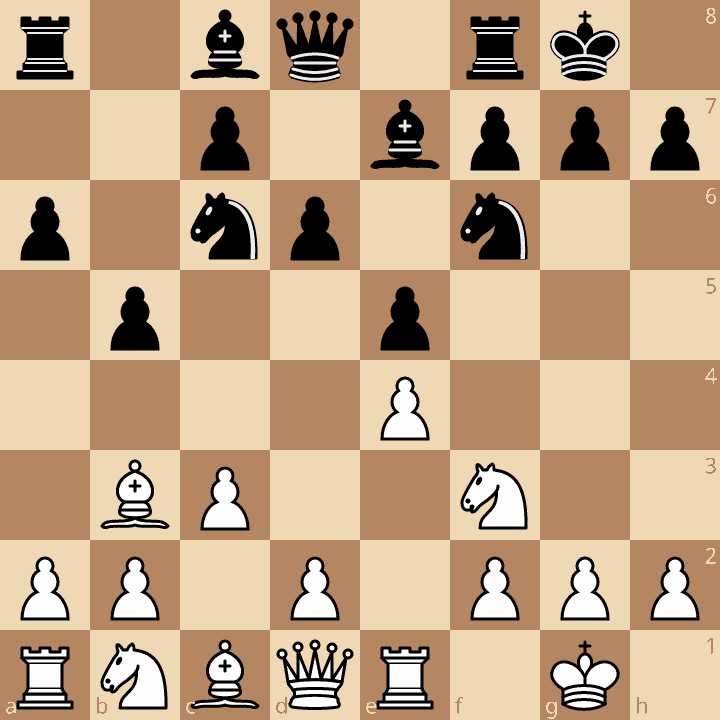
Black castles, reaching the tabiya (standard starting position) of the Closed Ruy Lopez. From this position, the game branches into many famous systems depending on Black's next move. This is one of the most analyzed positions in all of chess — with over 28,000 master games reaching this exact setup.
Prevent ...Bg4 before launching the central break.
A crucial prophylactic move! White prevents ..♗︎g4, which would pin the ♘︎f3 and make the d4 advance difficult. The pawn on h3 also creates luft for the king and supports a future g4 advance in some lines. This is the universal move in the Closed Ruy Lopez (ECO C92). Now Black must choose a defensive system.
Alternative Moves
The Chigorin Defense! Named after Mikhail Chigorin, this is the most popular system in the Closed Ruy Lopez (9,880 master games). The knight heads for c4 via a5, targeting the b2 and d2 squares. Black's plan: ..♘︎a5, ..c5, and ..♕︎c7, creating a strong queenside presence while maintaining the solid e5-d6 pawn chain. Alternative 9th-move systems: - 9. ..♘︎b8 — Breyer Defense, rerouting the knight to d7 - 9. ..♗︎b7 — Flohr System, fianchettoing the bishop - 9. ..♘︎d7 — Karpov Variation, flexible piece play
Alternative Moves
Retreat the bishop to form a battery aimed at the kingside.
White retreats the bishop to c2, the only real choice (9,873 out of 9,880 games). From c2, the bishop aims down the b1-h7 diagonal at h7 — a potential kingside attacking resource. The ♗︎c2/♕︎d3 battery is a hallmark of the Ruy Lopez. White can later use this diagonal to support a kingside attack with ♘︎bd2-f1-g3.
Black establishes a queenside pawn chain with ..c5, the overwhelming choice (9,566 out of 9,881 games). This move fights for control of d4, supports the ♘︎a5 which can later come to c4, and prepares ..♕︎c7. The alternative 10. ..d5 (Gajewski Gambit) is a sharp modern try but far less tested (282 games).
Alternative Moves
Launch the central break you prepared — open the position!
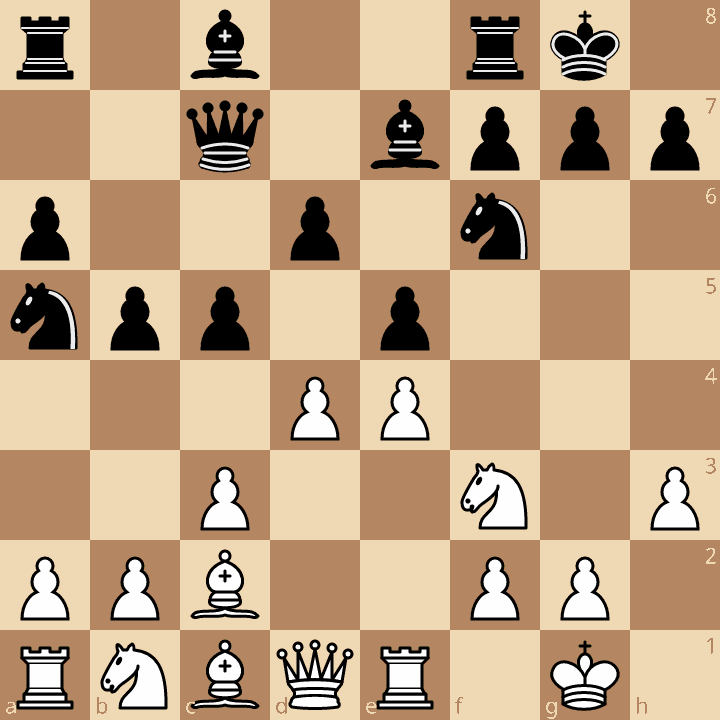
The central break White has been preparing since 8. c3! This is the critical moment — White opens the position to activate the pieces and fight for the initiative. Played in 9,395 out of 9,589 games reaching this position. After d4, the center is in flux. Black must decide how to handle the tension: ..♕︎c7 (the main Chigorin tabiya), ..cxd4 (releasing tension), or ..♘︎d7 (Keres Defense).
Alternative Moves
The main Chigorin tabiya! The queen moves to c7, defending the e5 pawn indirectly and preparing ..♗︎d7 or ..♘︎c4 development. This is the most popular response (6,377 out of 9,401 games) and leads to incredibly rich strategic battles. From here, typical plans are: - White: ♘︎bd2-f1-g3 (knight maneuver toward the kingside), d5 (closing the center for a kingside attack), or dxe5 followed by piece activity - ♗︎lack: ..♘︎c4, ..♗︎d7, ..♖︎ac8, and counterplay on the c-file and queenside
Alternative Moves
Key Takeaways
- 4.♗︎a4 maintains long-term pressure — the Ruy Lopez is about slow, strategic build-up
- c3 + d4 is the central plan — prepare it carefully before executing
- 9.h3 is essential prophylaxis — always prevent ...♗︎g4 before the d4 break
- 9...♘︎a5 defines the Chigorin — the knight targets c4 for queenside counterplay
- The ♗︎c2 + ♕︎d3 battery is a powerful kingside resource aimed at h7
Now play it through
Step through every move on a real board, try the wrong ones, and ask Knighty why they fail.
Related Lessons
Summary
Ready to Practice?
Next in this opening family
Ruy Lopez - Morphy Defense Main Line
Take this lesson with you
Free account requiredWith every variation — opens in Lichess & ChessBase