
Scandinavian Defense - Main Line
Learn the Scandinavian Defense where Black immediately challenges e4 with 1...d5, developing the bishop before locking it in with ...e6.
Try Interactive LessonIntroduction
Lesson Content
The King's Pawn opening — White claims the center and opens diagonals for the queen and kingside bishop. The most popular first move in chess.
The Scandinavian Defense! Black immediately challenges White's e4 pawn rather than preparing ..d5 with a supporting move. This is the most direct response possible — if White doesn't capture, Black takes on e4 with a great center. The key advantage over the French and Caro-Kann: the light-squared bishop won't be blocked behind the pawn chain.
Alternative Moves
White captures, the overwhelmingly most popular response. Declining with 2. e5 or 2. Nc3 gives Black an easy game since ..d5 has already equalized in the center.
Black recaptures with the queen — the signature move of the Scandinavian. Developing the queen this early violates a general principle, but it's justified because Black regains the pawn and will gain tempi by retreating the queen to a useful square. Black's main alternatives: - 2. ..Nf6 — the Modern Scandinavian, recapturing the pawn later - 2. ..c6 — the Blackburne-Kloosterboer Gambit, very rare
Alternative Moves
White develops with tempo, attacking the queen. This is the main line — Black must retreat, which is the 'cost' of the early queen sortie.
The main line retreat — the queen goes to a5 where it's safe, putting pressure on the Nc3 along the a5-e1 diagonal (the pin becomes real once d4 is played), and keeps an eye on d2 and e5. This is the Mieses Variation, the most popular at all levels. Black's alternatives: - 3. ..Qd6 — Gubinsky-Melts Defense, Carlsen's favorite - 3. ..Qd8 — Valencian Variation, ultra-solid but passive
Alternative Moves
White builds the ideal pawn center with pawns on d4 and (formerly) e4. The d4 pawn controls key central squares and opens a line for the dark-squared bishop.
Black develops the knight to its best square, controlling e4 and d5. This is the natural developing move — the knight is well-placed on f6 in virtually every Scandinavian variation.
Alternative Moves
White develops the second knight to its natural square, supporting d4 and preparing to castle kingside. The position is a key branching point for Black.
A multi-purpose pawn move: it supports a future ..d5 outpost (if the knight or queen lands there), controls the b5 square to prevent Nb5 or Bb5+ tricks, and prepares the typical Scandinavian setup with ..Bf5, ..e6, and ..Be7. The move order 5. ..Bf5 first is also popular, but 5. ..c6 is slightly more flexible.
Alternative Moves
White develops the bishop to its most aggressive square, aiming at the f7 weakness. The bishop on c4 pressures the e6 square and discourages Black from castling kingside too quickly.
The key Scandinavian idea! Black develops the light-squared bishop outside the pawn chain before playing ..e6. This is the whole point of choosing the Scandinavian over the French Defense — in the French, this bishop gets stuck behind the e6 pawn. The bishop on f5 controls key light squares, eyes the c2 pawn, and is well-placed for the long game.
Alternative Moves
White develops the dark-squared bishop, connecting the queen to the queenside and preparing to castle. The bishop on d2 also supports the Nc3 and eyes the a5 queen.
Now that the bishop is safely on f5, Black plays ..e6 to solidify the pawn structure. The pawn supports d5 and opens a diagonal for the dark-squared bishop to develop to e7 or b4. This is the ideal move order: bishop out first, then ..e6. In the French Defense, Black plays ..e6 first and the bishop gets stuck.
Alternative Moves
The critical test of Black's setup! White plants a powerful knight on d5, exploiting the fact that no Black pawn can challenge it (c6 supports d5 from the wrong side and ..e6 blocks ..e5). This is the most popular and aggressive continuation. Black must handle this correctly — the only good response is to retreat the queen and allow the knight exchange.
The queen retreats to d8 — the only good square. The queen has traveled d8→d5→a5→d8, seemingly losing time, but this is theory: the queen sortie forced White to spend time chasing it, and Black has developed Nf6, Bf5, and played ..c6 and ..e6 in the process. Black is fine here — the position will simplify after the knight exchange.
Alternative Moves
White exchanges the powerful d5 knight for the f6 knight with check. This is forced in a sense — the knight on d5 has no better future than this trade, and it gains a tempo with the check.
Recapturing with the queen is the main line, maintaining a clean pawn structure. The queen is well-placed on f6, overlooking the center and kingside. The alternative 9. ..gxf6 is also very popular — it opens the g-file for the rook and keeps the queen flexible, but doubles the f-pawns.
Alternative Moves
White centralizes the queen, connecting the rooks and supporting both castling options. The queen on e2 also prepares O-O-O in some lines.
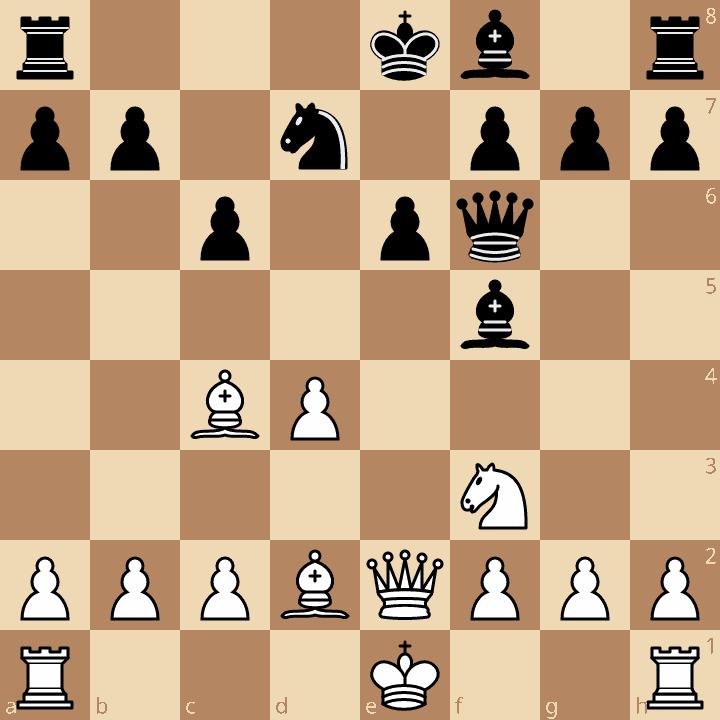
Black develops the last minor piece, preparing to castle and potentially reroute the knight to better squares via b6 or f8-g6. Black has a solid, harmonious position — the bishop pair, no weaknesses, and flexible development. Black will typically continue with ..Be7 and ...O-O, reaching a comfortable middlegame.
Alternative Moves
Key Takeaways
- Develop the bishop to f5 BEFORE playing ...e6 — this is the whole point of the Scandinavian
- The queen journey (d8→d5→a5→d8) costs time but gains useful development
- ...c6 supports d5 and prevents Bb5+/Nb5 tricks
- After Nd5 Qd8 Nxf6+ Qxf6, Black has the bishop pair and no weaknesses
- The Scandinavian gives solid, low-risk positions — ideal as a surprise weapon
Now play it through
Step through every move on a real board, try the wrong ones, and ask Knighty why they fail.
Summary
Ready to Practice?
Take this lesson with you
Free account requiredWith every variation — opens in Lichess & ChessBase