
Scotch Gambit
White combines the Scotch's direct 3.d4 with 4.♗︎c4, keeping the pawn tension and aiming for rapid development with e5.
Try Interactive LessonIntroduction
Lesson Content
Start by controlling the center with your king pawn.
e4 — The King's Pawn opening — White claims the center and opens diagonals for the queen and kingside bishop. The most popular first move in chess. Black's main responses: - 1. ..e5 — Open Game, matching White's center - 1. ..c5 — Sicilian Defense, fighting for d4 asymmetrically - 1. ..e6 — French Defense, preparing ..d5 - 1. ..c6 — Caro-Kann, also preparing ..d5
Black mirrors White's central claim, establishing a symmetrical pawn center. This leads to the Open Games — the oldest and most classical family of openings. The e5 pawn controls d4 and f4, limiting White's expansion options.
Develop your knight toward the center while attacking the e5 pawn.
♘︎f3 — White develops the knight to its most natural square, attacking the e5 pawn immediately. The knight also controls d4 and prepares kingside castling. This is the most common second move, leading to a vast tree of openings including the Italian, Ruy Lopez, and Scotch.
Black defends the e5 pawn with the most natural developing move. The knight on c6 also controls the important d4 and e5 squares. From here White's third move defines the opening: - 3. ♗︎c4 — Italian Game - 3. ♗︎b5 — Ruy Lopez - 3. d4 — Scotch Game - 3. ♘︎c3 — Three Knights Game
Strike at the center immediately.
d4 — The Scotch Game — White immediately strikes at the center. This is more direct than the Italian or Ruy Lopez, leading to open positions where both sides must develop quickly. After 3. ..exd4 4. ♘︎xd4, White has a slight lead in development but Black has free piece play.
Black captures the d4 pawn, the most natural response. The position opens up and White must decide how to recapture — or whether to recapture at all. The key moment: 4. ♘︎xd4 is the standard Scotch Game, but 4. ♗︎c4 is the Scotch Gambit!
Develop your bishop to target f7 instead of recapturing.
♗︎c4 — The Scotch Gambit! Instead of recapturing with 4. ♘︎xd4, White develops the bishop to the aggressive c4 square, targeting f7. White temporarily sacrifices the d4 pawn for rapid piece development and attacking chances. This move combines the directness of the Scotch with the tactical ideas of the Italian Game.
Alternative Moves
Black develops the knight, counterattacking the e4 pawn. This is a natural and strong response, putting immediate pressure on White's center. Black's main alternatives: - 4. ..♗︎c5 — develops but allows 5. c3 with a gambit - 4. ..♗︎b4+ — checks but White gets easy development after 5. c3
Alternative Moves
Push the e-pawn to attack the knight and gain space.
White pushes the e-pawn forward, attacking the ♘︎f6 and gaining space. This is the main line of the Scotch Gambit — White trades central presence for a space advantage and forces Black into a complex pawn structure. The e5 pawn restricts Black's kingside pieces and opens lines for White's attack.
Alternative Moves
Black counter-attacks the ♗︎c4 before moving the knight. This pawn advance gains tempo on the bishop and secures central space for Black. The position becomes a battle of mutual pawn advances — White owns e5, Black controls d5.
Alternative Moves
Move the bishop to b5, pinning the knight.
♗︎b5 — White moves the bishop to b5, pinning the ♘︎c6 to the king. This is the strongest continuation — the bishop stays active on the a4-e8 diagonal while preparing to exchange on c6, damaging Black's pawn structure. White keeps pressure on the center rather than retreating passively to e2 or d3.
Alternative Moves
The knight jumps to e4, the best square available. On e4 the knight is centralized, avoids the e5 pawn, and maintains influence over key squares (d2, f2, c5, d6). The knight will be displaced later by f3 but remains active throughout.
Recapture the pawn with the knight, centralizing it.
♘︎xd4 — White recaptures the d4 pawn, centralizing the knight powerfully. The ♘︎d4 attacks c6 and e6. White has regained the gambit pawn and has an excellent central position. The gambit has paid off — White recovered material while maintaining piece activity.
Black develops the bishop to d7, breaking the pin on the ♘︎c6. This is the strongest move — the bishop develops naturally and prepares to castle. The position remains balanced with chances for both sides.
Alternative Moves
Capture the knight to damage Black's pawn structure.
♗︎xc6 — White exchanges the bishop for the knight, doubling Black's c-pawns. This is the strategic payoff of 6. ♗︎b5 — Black's pawn structure is permanently compromised with doubled c-pawns, while White retains a strong knight on d4. The bishop pair is given up, but the structural damage to Black's queenside outweighs it.
Alternative Moves
Black recaptures with the b-pawn. The doubled c-pawns are a long-term weakness — they can't protect each other and the c6 pawn blocks the c7 pawn. However, Black gains the half-open b-file for counterplay.
Castle to secure your king and activate your rook.
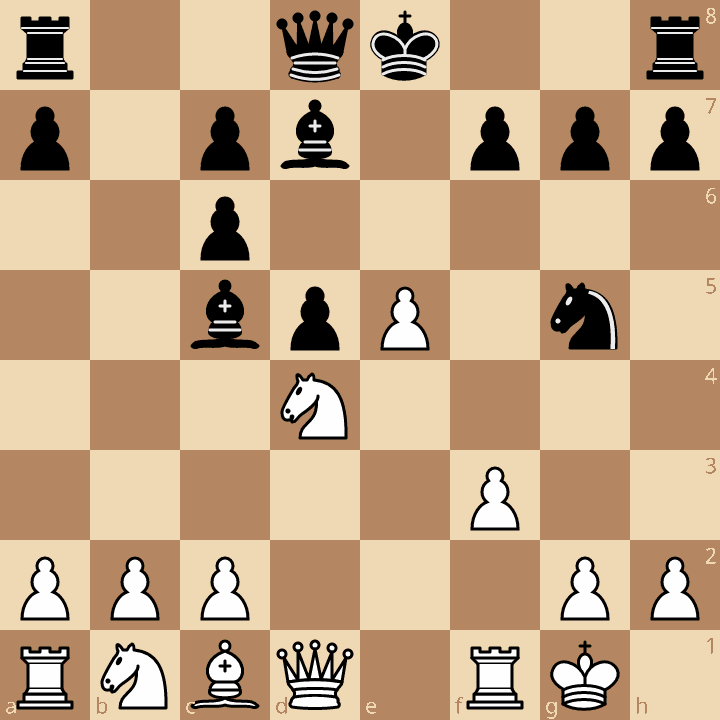
O-O — White castles to safety, completing kingside development. The king is secure and the rook enters the game on f1, supporting a future f3 push to challenge the ♘︎e4. With the structural advantage and better development, White has a comfortable position.
Black develops the bishop to its most active diagonal, targeting the centralized ♘︎d4. The bishop on c5 challenges the knight, with the f2 square near the castled king behind it. Black is catching up in development.
Challenge the centralized knight with a pawn.
White kicks the ♘︎e4, forcing it to retreat. The f3 pawn also prepares f4, building a strong pawn chain. After the knight moves, White can develop with ♗︎e3 or ♔︎h1 + f4. This move solidifies White's space advantage and prepares to seize the initiative.
Alternative Moves
The knight retreats to g5, maintaining an aggressive posture. From g5 the knight eyes f3, e6, and h3, keeping tactical threats alive. The position is roughly balanced — White has better structure and space, Black has the bishop pair and piece activity.
Key Takeaways
- 4.♗︎c4 instead of 4.♘︎xd4 — develop first, recapture later
- 5.e5 gains space and forces Black into a double-edged pawn fight
- 6.♗︎b5 pins the knight and prepares to inflict doubled c-pawns
- 7.♘︎xd4 recovers the gambit pawn with a powerful centralized knight
- f3 evicts Black's knight and supports the e5 space advantage
Now play it through
Step through every move on a real board, try the wrong ones, and ask Knighty why they fail.
Related Lessons
Summary
Ready to Practice?
Next in this opening family
Scotch Game - Main Line
Take this lesson with you
Free account requiredWith every variation — opens in Lichess & ChessBase