
Scotch Game - Main Line
Open the center early with d4 for active piece play
Try Interactive LessonIntroduction
Lesson Content
The King's Pawn opening — White claims the center and opens diagonals for the queen and kingside bishop. The most popular first move in chess. Black's main responses: - 1. ..e5 — Open Game, matching White's center - 1. ..c5 — Sicilian Defense, fighting for d4 asymmetrically - 1. ..e6 — French Defense, preparing ..d5 - 1. ..c6 — Caro-Kann, also preparing ..d5
Alternative Moves
Black mirrors White's central claim, establishing a symmetrical pawn center. This leads to the Open Games — the oldest and most classical family of openings. The e5 pawn controls d4 and f4, limiting White's expansion options.
White develops the knight to its most natural square, attacking the e5 pawn immediately. The knight also controls d4 and prepares kingside castling. This is the most common second move, leading to a vast tree of openings including the Italian, Ruy Lopez, and Scotch.
Alternative Moves
Black defends the e5 pawn with the most natural developing move. The knight on c6 also controls the important d4 and e5 squares. From here White's third move defines the opening: - 3. Bc4 — Italian Game - 3. Bb5 — Ruy Lopez - 3. d4 — Scotch Game - 3. Nc3 — Four Knights / Vienna hybrid
The Scotch Game — White immediately strikes at the center. This is more direct than the Italian or Ruy Lopez, leading to open positions where both sides must develop quickly. After 3. ..exd4 4. Nxd4, White has a slight lead in development but Black has free piece play.
Alternative Moves
Black has no good alternative to capturing. Taking opens the center, which is exactly what the Scotch Game is about — immediate central confrontation rather than slow maneuvering.
Alternative Moves
White recaptures with the knight, centralizing it powerfully on d4 where it controls key squares (c6, e6, f5, b5). Recapturing with the queen (4. Qxd4) would invite tempo loss after ..Nc6, harassing the queen.
Alternative Moves
Black develops the knight to its best square, simultaneously attacking the e4 pawn. This creates immediate tactical tension — White must address the threat to the center.
The main line exchange. White trades the centralized knight for Black's defender, doubling Black's c-pawns. Black gets the open b-file in compensation, creating a classic structural imbalance.
Alternative Moves
Black recaptures toward the center, accepting the doubled c-pawns. The b-file opens for Black's rook, and the c6-c7 pawns control the d5 square. A classic structural imbalance in the Scotch.
A key advance — White gains space in the center and kicks the Nf6 with tempo. The e5 pawn restricts Black's development options and creates a lasting spatial advantage.
Alternative Moves
Black pins the e5 pawn against the White king, preventing it from advancing further. The queen also supports a future ..d6 or ..d5 break to challenge White's center.
White defends e5 and unpins the pawn. The queen on e2 also prepares long castling (O-O-O), setting up opposite-side attacking chances.
Alternative Moves
The knight leaps to a powerful central outpost. On d5 it hits c3, e3, and b4 — White needs to challenge this knight or it will dominate the position.
Attacking the Nd5 directly and gaining more queenside space. White aims to push the knight away while expanding the pawn front. This is the most ambitious approach.
Alternative Moves
Black develops the bishop with tempo, pressuring the c4 pawn. The bishop is well-placed on a6 where it targets the queenside light squares and creates tactical possibilities.
Defending c4 solidly while preparing Ba3 or Bb2. The fianchetto plan allows White to trade dark-squared bishops, which would weaken Black's dark squares around the king.
Alternative Moves
Black prepares to fianchetto the dark-squared bishop to g7, where it will pressure the center and protect the king. This is the standard development plan in this structure.
White offers to trade dark-squared bishops. If Black accepts, the dark squares around Black's king become vulnerable — especially f6, g7, and h6 after the g6 weakening.
Alternative Moves
A tactical counterblow! The knight jumps to b4, threatening Nc2+ forking king and rook. Black uses the initiative to create concrete threats while White's pieces are still developing.
White retreats the bishop to b2, where it still exerts long-diagonal pressure. The bishop eyes the g7 square and supports the e5 pawn from a distance.
Alternative Moves
Black completes the fianchetto, and the bishop on g7 becomes a powerful piece on the long diagonal. It also prepares castling kingside, getting the king to safety.
White forces the knight to commit. The knight on b4 can't stay — it must retreat or move elsewhere. This gains time for White's development.
Alternative Moves
The knight returns to d5, its strongest central outpost. Despite the tempo spent, the knight on d5 is perfectly placed and difficult to dislodge without weakening White's pawn structure.
White develops the last minor piece, preparing to castle queenside. The knight on d2 can later go to e4 or f3, supporting the e5 pawn and kingside play.
Alternative Moves
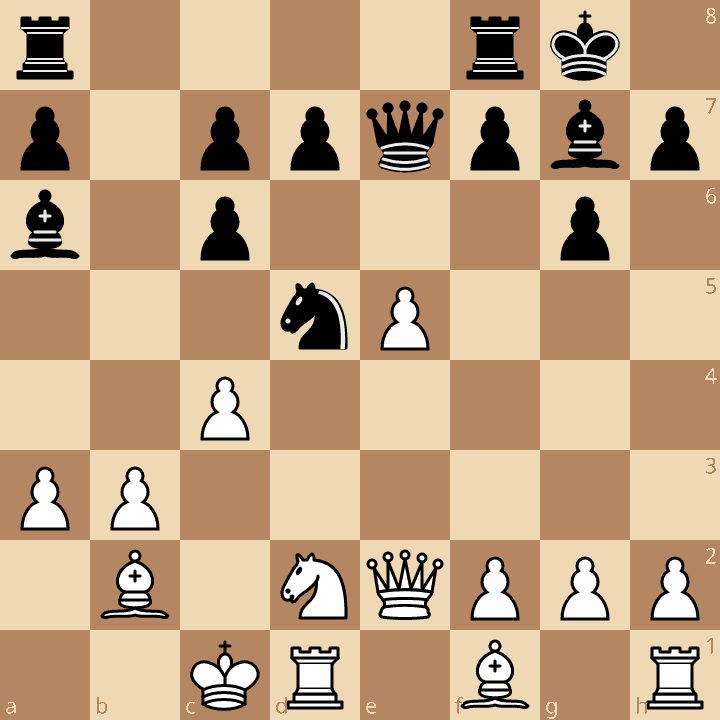
Black castles kingside, completing development and getting the king to safety. Both sides are now fully developed and ready for the middlegame battle.
White castles queenside, creating a classic opposite-side castling position. Both sides will launch pawn storms against the opposing king — White pushes on the kingside, Black on the queenside.
Alternative Moves
Key Takeaways
- d4 opens the center immediately—the Scotch trademark
- Nxc6 doubles Black's pawns but gives Black the b-file
- e5 gains space and restricts Black's knight
- Opposite-side castling creates sharp attacking play
- Both sides have imbalances to play for
Now play it through
Step through every move on a real board, try the wrong ones, and ask Knighty why they fail.
Summary
Ready to Practice?
Take this lesson with you
Free account requiredWith every variation — opens in Lichess & ChessBase