
Semi-Slav Defense
Combine the solid Slav pawn structure with the active Meran plan — capture on c4, push ...b5, and counterattack with ...c5
Try Interactive LessonIntroduction
Lesson Content
The Queen's Pawn opening — White claims the center with the d-pawn, which is immediately defended by the queen. This tends to lead to more strategic, closed positions compared to 1. e4. Black's main responses: - 1. ..d5 — Queen's Gambit and Slav setups - 1. ..Nf6 — Indian Defenses (King's Indian, Nimzo-Indian, etc.) - 1. ..f5 — Dutch Defense
Black matches White in the center, leading to the Queen's Pawn Game. The symmetrical center typically results in strategic maneuvering rather than immediate tactical battles. White's most popular continuation is 2. c4 — the Queen's Gambit.
The Queen's Gambit — White offers a pawn to lure Black's d5 pawn away from the center. It's not a true gambit since Black can't hold the pawn long-term. Black's main choices: - 2. ..e6 — Queen's Gambit Declined, solid and classical - 2. ..c6 — Slav Defense, supporting d5 while keeping the bishop free - 2. ..dxc4 — Queen's Gambit Accepted, giving up the center temporarily
The Slav Defense — Black supports d5 without blocking the light-squared bishop. This is a key advantage over the QGD (2. ..e6). The bishop can develop to f5 or g4. The Slav is one of the most reliable defenses to the Queen's Gambit.
White develops the knight to its most natural square, controlling e5 and d4. This is the most popular move, with over 67,000 master games. The alternative 3. Nc3 is also very popular and leads to similar positions. White keeps options open — the specific variation depends on Black's next moves.
Black develops the knight to its best square, controlling e4 and d5. This is the most natural developing move, preparing to enter the Semi-Slav with ..e6 next. The engine's top choice is 3. ..dxc4 (Slav proper), but 3. ..Nf6 is the gateway to the Semi-Slav and equally sound — played by Kasparov, Kramnik, and Carlsen.
Alternative Moves
White develops the second knight, supporting the e4 push and reinforcing c4. This is the engine's top choice and the most natural continuation. Now Black faces the critical decision: 4. ..e6 enters the Semi-Slav, while 4. ..dxc4 stays in the pure Slav.
The defining move of the Semi-Slav! Black plays both ..c6 and ..e6, creating a fortress-like pawn structure on d5. The downside is that the light-squared bishop is temporarily blocked — but the Meran plan (..dxc4, ..b5, ..Bb7) solves this elegantly. This position (D43) has over 55,000 master games. White's main choices: - 5. Bg5 — Anti-Meran, the most popular - 5. e3 — Meran Variation, the classical main line
Alternative Moves
White plays the Meran move order — solidifying the center and preparing Bd3. The e3 pawn supports d4 and opens the diagonal for the bishop. This is the engine's top choice in the position. The main alternative is 5. Bg5 (Anti-Meran/Botvinnik System), which leads to extremely sharp positions including the famous Botvinnik Variation with 5. ..dxc4.
Alternative Moves
The engine's top choice and the overwhelming favorite in master play (34,000+ games). The knight develops to d7 where it supports the ..dxc4 and ..b5 plan. From d7, the knight can reroute to b6 or f8, and it avoids blocking the c-pawn. This is the start of the Meran setup — Black prepares the thematic pawn break sequence.
Alternative Moves
White develops the bishop to its most active square, aiming at the kingside. The bishop on d3 eyes the h7 pawn and prepares for a kingside attack after e4. This is the engine's top choice. The main alternative is 6. Qc2 (Stoltz Variation), which is even more popular in master play and prevents ..dxc4 ideas by keeping the queen on the c-file.
Alternative Moves
The key moment! Black captures on c4, triggering the Meran Variation. This is not about winning a pawn — White recaptures immediately — but about gaining a tempo to push ..b5 and solve the light-squared bishop problem. After Bxc4, Black plays ..b5, attacking the bishop again and gaining more time for development.
White recaptures, placing the bishop on the strong a2-g8 diagonal targeting f7 and e6. But Black is ready to challenge it immediately with ..b5, gaining queenside space and development tempo. This position is classified as D47 — the Semi-Meran Variation.
The signature move of the Meran Variation! Black attacks the bishop with ..b5, gaining a tempo while seizing queenside space. This pawn push is the whole point of the ..dxc4 exchange — it forces the bishop back and prepares ..Bb7, finally developing the problem piece. This move has been played in nearly 10,000 master games — it is the only serious continuation here.
White retreats the bishop to d3, where it still eyes the kingside (h7 pawn) and supports the future e4 push. This is the most popular retreat (8,100+ games), keeping the bishop on an active diagonal. Alternatives: - 8. Be2 — safer retreat, less ambitious but solid (Kramnik played this vs Kasparov and Topalov) - 8. Bb3 — keeps pressure on the a2-g8 diagonal
Alternative Moves
The light-squared bishop finally develops to its ideal square! This was the whole point of the Meran sequence: ..dxc4, ..b5, ..Bb7. The bishop is now perfectly placed on the long diagonal, controlling e4 and putting pressure on White's center. Black has completely solved the bishop problem that arose from playing ..e6.
Alternative Moves
White castles to safety — the engine's top choice. The king is secure on g1, and the rook enters the game on f1 to support the coming e4 push. Kasparov, Karpov, and Anand have all played this position as White. The stage is set for the critical middlegame battle around White's e4 advance.
A crucial prophylactic move! Black prevents Nb5 (which could target c7 or d6) and prepares the ..c5 pawn break. The a6 pawn also supports ..b4 if needed and takes away key squares from White's pieces. This is the engine's top choice — played by Kasparov, Kramnik, and Carlsen in this exact position.
White seizes the center with e4 — the move the entire setup was building toward. White now has a powerful pawn duo on d4+e4, but Black is ready to challenge it immediately with ..c5. This is the critical moment of the Meran — White has the center, but Black has active pieces and the ..c5 break.
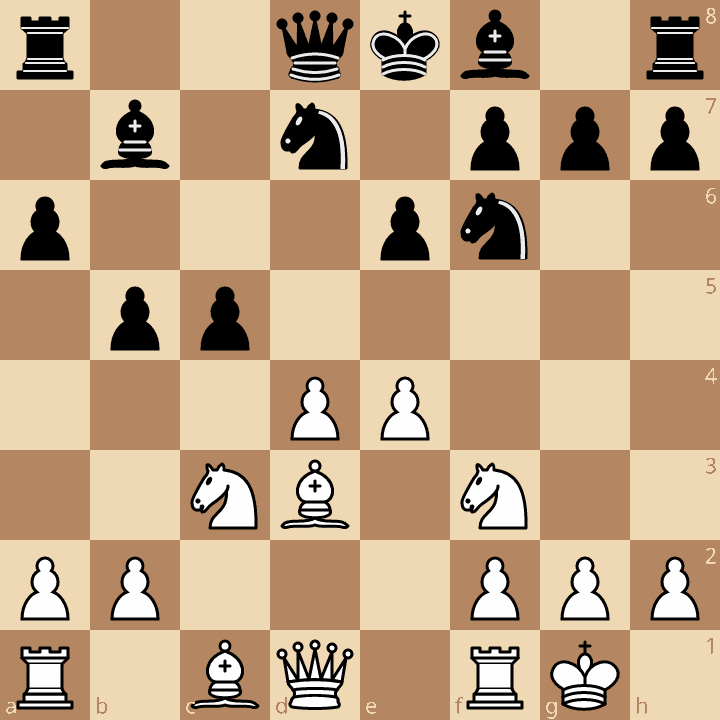
The thematic counter-strike! Black challenges White's center directly with ..c5, attacking the d4 pawn. This creates immediate tension — after d5 or dxc5, sharp tactical play follows. The Bb7 is now a monster on the long diagonal, and Black has active play on both flanks. This position has been tested in thousands of master games at the highest level, including Kasparov-Kramnik, Karpov-Anand, and many world championship matches.
Key Takeaways
- 4...e6 defines the Semi-Slav — combining Slav solidity (c6) with central reinforcement (e6)
- The Meran sequence (...dxc4, ...b5, ...Bb7) solves the light-squared bishop problem elegantly
- 7...b5 is the signature move — attacking the bishop while gaining space and tempo
- 9...a6 is a key prophylactic move preventing Nb5 before launching the ...c5 counter-strike
- 10...c5 challenges White's center at the perfect moment, when the Bb7 is fully active
Now play it through
Step through every move on a real board, try the wrong ones, and ask Knighty why they fail.
Summary
Ready to Practice?
Take this lesson with you
Free account requiredWith every variation — opens in Lichess & ChessBase