
Slav Defense - Main Line
Solid defense where Black keeps the c8-bishop's diagonal open
Try Interactive LessonIntroduction
Lesson Content
The Queen's Pawn opening — White claims the center with the d-pawn, which is immediately defended by the queen. This tends to lead to more strategic, closed positions compared to 1. e4. Black's main responses: - 1. ..d5 — Queen's Gambit and Slav setups - 1. ..Nf6 — Indian Defenses (King's Indian, Nimzo-Indian, etc.) - 1. ..f5 — Dutch Defense
Alternative Moves
Black matches White in the center, leading to the Queen's Pawn Game. The symmetrical center typically results in strategic maneuvering rather than immediate tactical battles. White's most popular continuation is 2. c4 — the Queen's Gambit.
The Queen's Gambit — White offers a pawn to lure Black's d5 pawn away from the center. It's not a true gambit since Black can't hold the pawn long-term. Black's main choices: - 2. ..e6 — Queen's Gambit Declined, solid and classical - 2. ..c6 — Slav Defense, supporting d5 while keeping the bishop free - 2. ..dxc4 — Queen's Gambit Accepted, giving up the center temporarily
Alternative Moves
The Slav Defense — Black supports d5 without blocking the light-squared bishop. This is a key advantage over the QGD (2. ..e6). The bishop can develop to f5 or g4. The Slav is one of the most reliable defenses to the Queen's Gambit.
White develops the knight to its most natural square, controlling e5 and d4. In the Slav, White typically plays Nf3 before Nc3 to remain flexible — the move order matters because after Nc3 dxc4, White can't play the a4 line as easily.
Alternative Moves
Black develops the knight, controlling e4 and preparing the key Slav idea: ..dxc4 followed by ..Bf5, developing the bishop outside the pawn chain before playing ..e6.
White adds more pressure on d5 with the second knight. Now Black faces the critical decision: maintain the tension with ..e6 (entering the Semi-Slav) or capture with ..dxc4 (the main Slav).
Alternative Moves
Black captures the c4 pawn — this is the signature Slav move order. By taking now (before ..e6), Black keeps the c8-bishop's diagonal open. The whole point of the Slav is solving the light-squared bishop problem.
A critical prophylactic move! White prevents ..b5, which would defend the extra c4 pawn. Without a4, Black could consolidate the material advantage with a queenside pawn chain.
Alternative Moves
The key Slav idea executed! The bishop develops to f5 BEFORE ..e6 blocks it. Compare this to the Queen's Gambit Declined (2. ..e6), where the bishop gets stuck behind the pawn chain. This is why Black played ..c6 first.
White prepares to develop the bishop to c4, recapturing the pawn. The e3 pawn also supports d4 solidly. White doesn't mind being patient — the pawn on c4 will be recovered shortly.
Alternative Moves
NOW Black plays ..e6, reinforcing d5 and preparing ..Bb4 or ..Be7. The bishop is already on f5 — this is the ideal Slav move order. The light-squared bishop is active while the pawn structure remains solid.
White recaptures the pawn while developing the bishop to an active diagonal. The bishop on c4 targets e6 and the a2-g8 diagonal, creating tactical potential. Material is now equal with both sides well-developed.
Alternative Moves
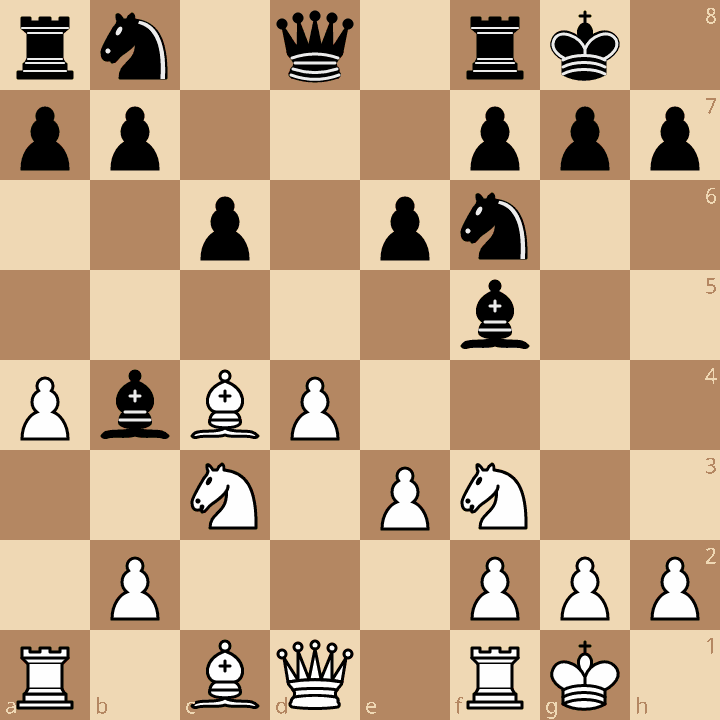
Black pins the Nc3 against the king, creating pressure and preparing to castle. The bishop on b4 is aggressive and may later be exchanged for the knight, doubling White's pawns — a common Nimzo-Indian theme applied in the Slav.
White castles kingside, bringing the king to safety and connecting the rooks. With the center stable and pieces developed, this is the natural next step. King safety comes before launching any middlegame plans.
Alternative Moves
Black castles as well, completing kingside development. Both sides have reached a solid, well-known middlegame position where understanding the pawn structure and piece placement matters more than memorized theory.
Key Takeaways
- ...c6 before ...e6 keeps the bishop diagonal open
- ...Bf5 develops the bishop BEFORE it gets blocked
- a4 prevents Black from holding c4 with ...b5
- Both sides play classical, solid chess
- The Slav solves the "bad bishop" problem elegantly
Now play it through
Step through every move on a real board, try the wrong ones, and ask Knighty why they fail.
Summary
Ready to Practice?
Take this lesson with you
Free account requiredWith every variation — opens in Lichess & ChessBase