
Sicilian Dragon - Yugoslav Attack
Learn the fiery Dragon Variation where Black fianchettoes the bishop and faces White's sharpest try — the Yugoslav Attack with opposite-side castling.
Try Interactive LessonIntroduction
Lesson Content
The King's Pawn opening — White claims the center and opens diagonals for the queen and kingside bishop. The most popular first move in chess. Black's main responses: - 1. ..e5 — Open Game, matching White's center - 1. ..c5 — Sicilian Defense, fighting for d4 asymmetrically - 1. ..e6 — French Defense, preparing ..d5 - 1. ..c6 — Caro-Kann, also preparing ..d5
The Sicilian Defense — Black's most popular and ambitious reply to 1. e4. Rather than matching White in the center with ..e5, Black fights for the d4 square asymmetrically. The Sicilian leads to unbalanced positions where both sides have chances. White typically gets a kingside attack; Black gets queenside counterplay and the c-file.
Alternative Moves
The Open Sicilian begins. White develops naturally and prepares d4, which will open the position. This is the most principled approach against the Sicilian. Black's main responses determine the specific variation: - 2. ..d6 — Najdorf, Dragon, Classical - 2. ..Nc6 — Sveshnikov, Kalashnikov, Classical - 2. ..e6 — Kan, Taimanov, Scheveningen
Black supports a future ..Nf6 without allowing e5, and keeps the option of a Dragon or Najdorf setup. The d6 pawn controls e5, preventing White from pushing the e-pawn forward. This is the gateway to both the Dragon (..g6) and the Najdorf (..a6) — Black's most popular Sicilian systems.
Alternative Moves
White opens the center immediately. After the exchange on d4, the position transforms — White gets a central knight on d4 and a space advantage, while Black gets the semi-open c-file for counterplay.
Black captures, opening the c-file — the lifeline of the Sicilian. The half-open c-file will become Black's main avenue of counterplay, especially after castling queenside. This exchange is practically forced; declining allows White too strong a center.
Alternative Moves
White recaptures with the knight, placing it powerfully in the center. From d4, the knight controls key squares (c6, e6, f5, b5) and keeps options to jump to various outposts.
Black develops the knight to its most natural square, attacking the e4 pawn and preparing to castle. This is the most common move in the Open Sicilian, played in the Dragon, Najdorf, and Classical systems alike.
Alternative Moves
White defends the e4 pawn and develops the queenside knight. Now Black must commit to a specific Sicilian system — the Dragon with 5. ..g6, the Najdorf with 5. ..a6, or the Classical with 5. ..Nc6.
The Dragon Variation! Black prepares to fianchetto the dark-squared bishop on g7, creating the signature "dragon formation." The bishop on g7 will be enormously powerful, raking along the h8-a1 diagonal and pressuring White's queenside. The name comes from the pawn structure's resemblance to the constellation Draco.
Alternative Moves
The start of the Yugoslav Attack — White's most aggressive and principled system against the Dragon. The bishop develops to e3, supporting d4 and preparing the queen to go to d2. White's plan: f3, Qd2, Bc4, O-O-O, then h4-h5-g4 to rip open Black's kingside. This is the sharpest anti-Dragon weapon.
The dragon bishop takes its throne. From g7, it commands the long h8-a1 diagonal, pressuring White's entire queenside — especially the c3 knight and the a1 rook once the c-file opens. This bishop is the heart of Black's position. If it's traded or blocked, Black's counterplay often dries up.
A key Yugoslav Attack move. The f3 pawn supports e4, prevents ..Ng4 harassing the Be3, and prepares for the eventual g4-g5 pawn storm against Black's kingside. This is more aggressive than 7. Be2 (the Classical Variation), signaling White's intention to castle queenside and attack.
Black castles into the storm — but this is correct. The king needs safety, and the f8-rook can later join the c-file or support ..f5 breaks. Delaying castling is too risky with White's center so solid. The opposite-side castling race is now set: both sides will attack the enemy king.
Alternative Moves
The queen connects with the Be3, preparing the Bh6 exchange (trading Black's precious dragon bishop) and supporting queenside castling. After O-O-O, the d1-rook will be centralized on the d-file. The Qd2+Bh6 battery is one of White's most dangerous ideas in the Yugoslav Attack.
Developing the last minor piece and pressuring the d4 knight. The knight on c6 also supports the ..Ne5 maneuver (after White plays Bc4) and helps control the center. This is the most natural move, though the immediate 8. ..d5 is a sharp alternative tried by some players.
Alternative Moves
The bishop takes aim at f7, the weakest point near Black's king. Combined with the Yugoslav Attack setup, the Bc4 adds pressure to Black's kingside and supports a future Nd5. White's alternatives: - 9. O-O-O — the Modern Line, castling immediately - 9. g4 — the Panov Variation, an immediate pawn storm
The standard developing move, connecting the rooks and preparing ..Rc8 to pressure the c-file. The bishop on d7 supports a future ..Ne5 (after which ..Nc4 can be devastating) and keeps the option of ..b5 expansion. Played by Carlsen and Kasparov in their Dragon games against the world's best.
Alternative Moves
White castles queenside — the battle lines are drawn. With kings on opposite sides, both players will attack the enemy king with no defensive obligations on their attacking wing. White's plan: h4-h5 (or g4-g5) to pry open Black's kingside. Black's plan: ..Rc8, ..Ne5, and pressure down the c-file.
The rook seizes the semi-open c-file — Black's main highway for counterplay. The c2 pawn and the c3 knight are now under latent pressure. Combined with the dragon bishop on g7, this creates threats along two diagonals and the c-file simultaneously. This is the engine's top choice and the most popular master move.
Alternative Moves
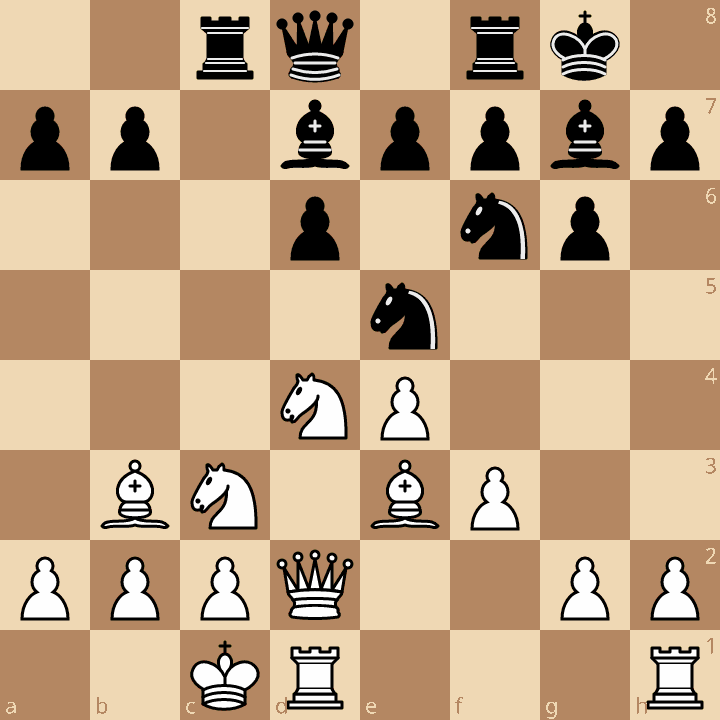
White retreats the bishop from c4 to the safer b3 square, dodging potential ..Na5 or ..Ne5-c4 attacks. The bishop still eyes f7 and stays out of tactical tricks on the c-file. Alternatives like 11. h4 (immediate pawn storm) are also popular at the highest level.
A classic Dragon regrouping! The knight heads to e5, eyeing the powerful c4 outpost. From c4, the knight would attack White's queen, bishop, and the e3 bishop — a devastating position. Black threatens ..Nc4, forcing White to deal with the knight invasion. This is the most popular move in this position, played by Carlsen and Radjabov against the world's elite.
Alternative Moves
Key Takeaways
- The dragon bishop on g7 is the heart of Black's position — never trade it lightly
- The c-file is Black's main counterplay: ...Rc8 and ...Nc4 create pressure on White's queenside
- Opposite-side castling means both sides attack — speed and accuracy are everything
- Ne5-c4 is a key Dragon maneuver, targeting White's queen and bishop simultaneously
- White's Yugoslav Attack (Be3, f3, Qd2, Bc4, O-O-O) is the sharpest anti-Dragon weapon
Now play it through
Step through every move on a real board, try the wrong ones, and ask Knighty why they fail.
Summary
Ready to Practice?
Take this lesson with you
Free account requiredWith every variation — opens in Lichess & ChessBase