
Sicilian Scheveningen
A flexible Sicilian setup where Black builds a small pawn center with ...d6 and ...e6, preparing dynamic counterplay.
Try Interactive LessonIntroduction
Lesson Content
The King's Pawn opening — White claims the center and opens diagonals for the queen and kingside bishop. The most popular first move in chess. Black's main responses: - 1. ..e5 — Open Game, matching White's center - 1. ..c5 — Sicilian Defense, fighting for d4 asymmetrically - 1. ..e6 — French Defense, preparing ..d5 - 1. ..c6 — Caro-Kann, also preparing ..d5
The Sicilian Defense — Black's most popular and ambitious reply to 1. e4. Rather than matching White in the center with ..e5, Black fights for the d4 square asymmetrically. The Sicilian leads to unbalanced positions where both sides have chances. White typically gets a kingside attack; Black gets queenside counterplay and the c-file.
The Open Sicilian begins. White develops naturally and prepares d4, which will open the position. This is the most principled approach against the Sicilian. Black's main responses determine the specific variation: - 2. ..d6 — Najdorf, Dragon, Classical - 2. ..Nc6 — Sveshnikov, Kalashnikov, Classical - 2. ..e6 — Kan, Taimanov, Scheveningen
Black plays 2. ..d6, controlling the e5 square and preparing to develop the knight to f6. This move order is more flexible than 2. ..e6 because it avoids the Keres Attack (6. g4) that White can employ against an early ..e6. From here, Black will aim for the Scheveningen setup with a later ..e6, creating the characteristic "small center."
White strikes at the center — the defining move of the Open Sicilian. By pushing d4, White aims to open the position and use the lead in development. Black must capture, conceding the center temporarily but gaining the half-open c-file.
Black captures the d4 pawn, opening the c-file for future rook activity. This is the fundamental Sicilian exchange — Black trades a flank pawn (c5) for White's central pawn (d4), creating an asymmetric pawn structure. The open c-file will become a key asset for Black's queenside counterplay.
White recaptures with the knight, centralizing it powerfully on d4. The knight controls key squares (b5, c6, e6, f5) and can later retreat to b3 or f3 depending on the variation. This position is the starting point of the Open Sicilian — the most theoretically rich family of chess openings.
Black develops the knight to its most natural square, counterattacking the e4 pawn. The knight on f6 is a cornerstone of Black's position in nearly every Open Sicilian variation. This move also prepares kingside castling and controls the d5 square — a potential outpost for Black later.
White defends e4 and develops the knight to its natural square. Now Black's next move determines the specific Sicilian variation: - 5. ..e6 — Scheveningen or Kan/Taimanov - 5. ..g6 — Dragon - 5. ..a6 — Najdorf - 5. ..Nc6 — Classical Sicilian
The Scheveningen move! Black builds the characteristic "small center" with pawns on d6 and e6. This structure is incredibly flexible — the e6 pawn supports a future ..d5 break, while the d6 pawn keeps ..e5 as an option. The downside: the light-squared bishop is somewhat restricted behind the pawn chain, and White has extra space. But Black's solid center and piece activity compensate.
Alternative Moves
The Classical Variation — White develops the bishop modestly to e2, preparing to castle kingside. This is a solid, positional approach compared to the aggressive alternatives. White's other sixth-move options lead to very different games: - 6. g4 — the Keres Attack, an aggressive pawn storm - 6. Be3 — the English Attack, preparing Qd2 and O-O-O - 6. f4 — direct kingside expansion
Alternative Moves
A multi-purpose prophylactic move — Black prevents Nb5 (which would target d6) and prepares the ..b5 queenside expansion. This is a signature Sicilian move seen across many variations. The ..b5 push will challenge White's control of d5 and activate the queenside majority.
Alternative Moves
White castles kingside, securing the king and connecting the rooks. In the Classical Scheveningen, White's king is safe on the kingside while the f-pawn advances to support a central or kingside attack. White's plan now revolves around f4 followed by ideas like f5 or e5.
Black develops the bishop to a solid, flexible square. On e7, the bishop defends the kingside, supports ...O-O, and can later redeploy to f6 or d8 depending on the position. This is the classical Scheveningen bishop placement — less aggressive than ..Bc5 or a fianchetto, but very reliable.
Alternative Moves
White advances the f-pawn, gaining more space and preparing a kingside or central attack. The pawn on f4 supports a future e5 push and controls the e5 and g5 squares. This is the hallmark of the Classical Scheveningen — White builds a strong pawn front (e4 + f4) while Black must time counterplay carefully.
Black castles to safety — essential before White's kingside pawn storm becomes too dangerous. The king on g8 is well-defended by the Be7 and Nf6, and the rook is activated on f8. With both sides castled, the middlegame battle lines are drawn: White attacks on the kingside, Black counters on the queenside.
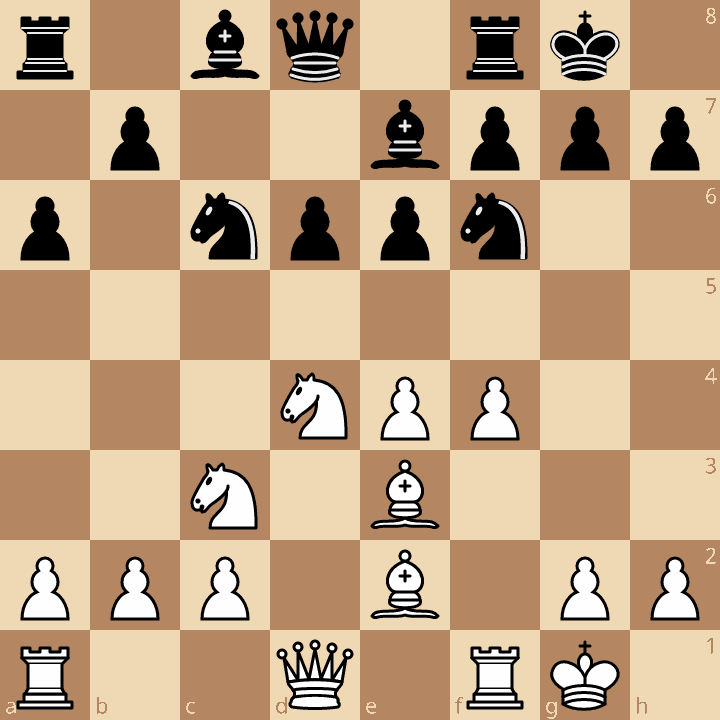
White develops the last minor piece, aiming the bishop at the a7-g1 diagonal. The bishop on e3 supports the d4 knight, controls key dark squares, and prepares Qd2 to connect the rooks. This is the main line of the Classical Scheveningen (ECO B85). White's setup is now complete — the question is how to break through.
Black develops the last minor piece, challenging White's centralized knight on d4. The knight on c6 puts pressure on d4 and e5, and may reroute to b4 or a5 to support queenside play. Black's position is solid and flexible. Key plans include: - ..Qc7 + ...b5 — queenside expansion - ..e5 — central counter-strike - ..Nxd4 + ...b5 — exchange to weaken White's center
Alternative Moves
Key Takeaways
- The ...d6 + ...e6 pawn center is flexible — it supports both ...d5 and ...e5 breaks
- 2...d6 before ...e6 avoids the aggressive Keres Attack (6.g4)
- ...a6 is multi-purpose: prevents Nb5, prepares ...b5 queenside expansion
- White plays for a kingside attack with f4-f5; Black counters on the queenside with ...b5
- The Classical Be2 setup is solid and strategic — less sharp than the English Attack or Keres
Now play it through
Step through every move on a real board, try the wrong ones, and ask Knighty why they fail.
Summary
Ready to Practice?
Take this lesson with you
Free account requiredWith every variation — opens in Lichess & ChessBase