
Sicilian Najdorf - Main Line
Black's most ambitious weapon against 1.e4. The Najdorf creates deeply complex positions with opposite-side castling and mutual attacks.
Try Interactive LessonIntroduction
Lesson Content
The King's Pawn opening — White claims the center and opens diagonals for the queen and kingside bishop. The most popular first move in chess. Black's main responses: - 1. ..e5 — Open Game, matching White's center - 1. ..c5 — Sicilian Defense, fighting for d4 asymmetrically - 1. ..e6 — French Defense, preparing ..d5 - 1. ..c6 — Caro-Kann, also preparing ..d5
Fight for the d4 square with your c-pawn.
c5 — The Sicilian Defense: Black's most popular and ambitious reply to 1. e4. Rather than matching White in the center with ..e5, Black fights for the d4 square asymmetrically. The Sicilian leads to unbalanced positions where both sides have chances. White typically gets a kingside attack; Black gets queenside counterplay and the c-file.
Alternative Moves
The Open Sicilian begins. White develops naturally and prepares d4, which will open the position. This is the most principled approach against the Sicilian. Black's main responses determine the specific variation: - 2. ..d6 — Najdorf, Dragon, Classical - 2. ..♘︎c6 — Sveshnikov, Kalashnikov, Classical - 2. ..e6 — Kan, Taimanov, Scheveningen
Support e5 control and keep your options open.
Black supports a future ..♘︎f6 without allowing e5, and keeps the option of a Najdorf or Dragon setup. The d6 pawn controls e5, preventing White from pushing the e-pawn forward. This is the gateway to both the Najdorf (..a6) and the Dragon (..g6) — Black's two most popular Sicilian systems.
Alternative Moves
White opens the center immediately. After the trade on d4, the position transforms — White gets a central knight on d4 and a space advantage, while Black gets the semi-open c-file for counterplay.
Capture to half-open the c-file for your future rook.
cxd4 — Black captures, half-opening the c-file — the lifeline of the Sicilian. The half-open c-file will become Black's main avenue of counterplay, especially after placing a rook on c8. This trade is practically forced; declining allows White too strong a center.
Alternative Moves
White recaptures with the knight, placing it powerfully in the center. From d4, the knight controls key squares (c6, e6, f5, b5) and keeps options to jump to various outposts.
Develop your knight to attack the e4 pawn.
♘︎f6 — Black develops the knight to its most natural square, attacking the e4 pawn and preparing to castle. This is standard in all major Open Sicilian systems — Najdorf, Dragon, and Classical alike.
Alternative Moves
White defends the e4 pawn and develops the queenside knight. Now Black must commit to a specific Sicilian system: - 5. ..a6 — the Najdorf, the most popular choice - 5. ..g6 — the Dragon, fianchettoing the dark-squared bishop - 5. ..♘︎c6 — the Classical, developing toward d4
The signature Najdorf move — prevent Nb5 and prepare queenside expansion.
a6 — The Najdorf! This unassuming pawn move is one of the deepest in all of chess theory. It prevents ♘︎b5 (which would hit d6 and c7), prepares the ..b5 queenside expansion, and keeps the light-squared bishop flexible — it can go to b7, e6, or even g4 depending on White's setup. White's main responses: - 6. ♗︎g5 — the classical pin, leading to sharp play - 6. ♗︎e3 — the English Attack, the most popular modern choice - 6. ♗︎e2 — the Opocensky, a quieter positional approach - 6. f3 — preparing the English Attack setup
Alternative Moves
The classical approach — White pins the ♘︎f6 against the queen, threatening to double Black's pawns with ♗︎xf6. This is the move Fischer and Kasparov faced most often in their Najdorf battles. White's idea: combine the pin with f4, ♕︎f3, and O-O-O for a massive kingside attack.
Solidify the center and prepare to break the pin with ...Be7.
Black reinforces the center and breaks the pin — after ..♗︎e7, the ♘︎f6 will no longer be pinned. The e6 pawn also supports a future ..d5 central break, the Sicilian's key liberating idea. The downside: the light-squared bishop is now blocked behind e6, a typical Sicilian concession.
Alternative Moves
White builds a massive pawn center and prepares a kingside attack. The f4 pawn supports e5 pushes and half-opens the f-file after eventual exchanges. Combined with ♕︎f3, this signals White's intention to castle queenside and launch an assault. This position is the tabiya of the classical Najdorf — one of the most analyzed positions in chess history.
Break the pin and prepare to castle kingside.
♗︎e7 — Black develops the bishop and breaks the ♗︎g5 pin on the ♘︎f6. The bishop on e7 is modest but solid — it supports kingside castling and can later relocate to f6 or d8 depending on the position. Black's alternatives here define the sharpest Najdorf variations: - 7. ..♕︎b6 — the Poisoned Pawn Variation, grabbing b2 (Fischer's specialty) - 7. ..h6 — forcing ♗︎h4, keeping extra options open - 7. ..♕︎c7 — preparing ..♘︎bd7 without moving the bishop
Alternative Moves
The queen moves to f3, a powerful square where it supports the f4-f5 push, eyes the a8-h1 diagonal, and prepares O-O-O. Famous games in this line include Spassky-Fischer (1972 World Championship, Game 15), from the most celebrated match in chess history.
Move the queen to a flexible square supporting queenside play.
♕︎c7 — The queen sidesteps the d-file (avoiding future ♖︎d1 pressure) and takes a flexible post on c7. From here, the queen supports ..b5 expansion, monitors the c-file, and can shift to the kingside if needed. This is the Traditional Line, a classic main line against 8. ♕︎f3.
Alternative Moves
White castles queenside — the battle lines are drawn. With the king on c1, White will storm Black's kingside with g4-g5 and f5. The d1-rook is already centralized, and the h1-rook can swing into the attack via h3 or g1. The opposite-side castling race is the hallmark of the Najdorf classical: whoever attacks fastest wins.
Develop the knight without blocking the c-file.
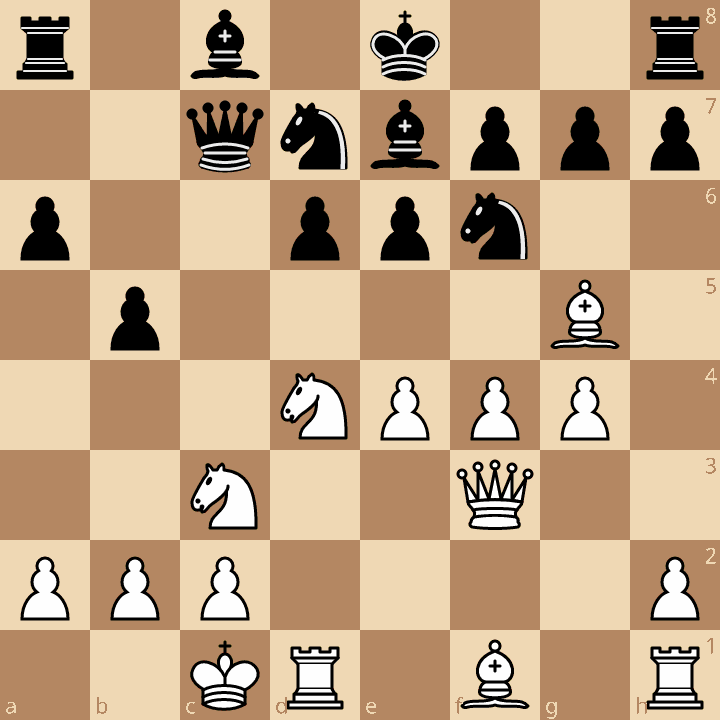
♘︎bd7 — Black develops the last minor piece flexibly. The knight on d7 supports ..b5, prepares ..♘︎c5 (attacking e4), and can reroute to e5 or b6 depending on White's setup. It also avoids ..♘︎c6 which would block the c-file. This reaches the official B99 tabiya — the Najdorf Main Line, one of the most deeply analyzed positions in all of chess.
Alternative Moves
White launches the kingside pawn storm! The g4 push threatens g5, driving away the ♘︎f6 defender and ripping open lines toward Black's king. This is White's most aggressive and popular plan, played by Karjakin, Radjabov, and Grischuk against the world's best. Black must counter-attack immediately — there's no time for passive defense.
Launch the queenside counter-attack — this is what ...a6 prepared!
The thematic queenside counter-punch! Black's ..b5 is the whole point of 5. ..a6 — it gains space on the queenside, opens lines toward White's king, and prepares ..♗︎b7 to activate the light-squared bishop. This is the critical moment of the Najdorf: both sides are committed to opposite-wing attacks. White pushes g5 to break through on the kingside; Black pushes ..b4 to attack the ♘︎c3 and expose the white king.
Alternative Moves
Key Takeaways
- 5...a6 is multi-purpose: prevents ♘︎b5, prepares ...b5, and keeps the bishop flexible
- The ...b5 queenside counter-attack is Black's main plan — it opens lines toward White's king
- Opposite-side castling means speed is everything — both sides race to attack first
- ♘︎bd7 (not ♘︎c6) keeps the c-file half-open for rook counterplay
- Fischer and Kasparov used the Najdorf extensively — it's the ultimate fighting weapon for Black
Now play it through
Step through every move on a real board, try the wrong ones, and ask Knighty why they fail.
Related Lessons
Summary
Ready to Practice?
Next in this opening family
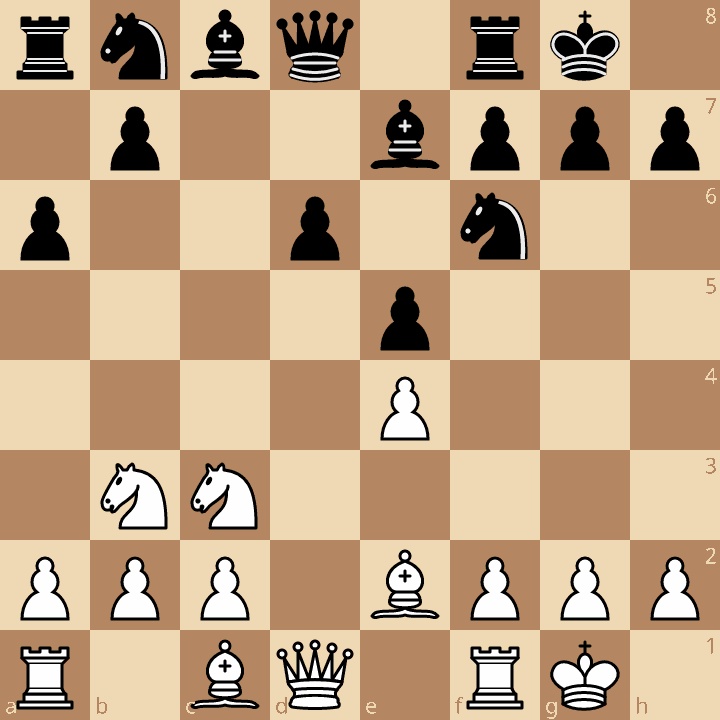
Sicilian Najdorf - Opocensky Variation
Take this lesson with you
Free account requiredWith every variation — opens in Lichess & ChessBase