
Sicilian Najdorf - Opocensky Variation
Learn the most popular response to 1.e4 from White's perspective
Try Interactive LessonIntroduction
Lesson Content
Start with the king pawn.
e4 — The King's Pawn opening — White claims the center and opens diagonals for the queen and kingside bishop. The most popular first move in chess. Black's main responses: - 1. ..e5 — Open Game, matching White's center - 1. ..c5 — Sicilian Defense, fighting for d4 asymmetrically - 1. ..e6 — French Defense, preparing ..d5 - 1. ..c6 — Caro-Kann, also preparing ..d5
Alternative Moves
The Sicilian Defense — Black's most popular and ambitious reply to 1. e4. Rather than matching White in the center with ..e5, Black fights for the d4 square asymmetrically. The Sicilian leads to unbalanced positions where both sides have chances. White typically gets a kingside attack; Black gets queenside counterplay and the c-file.
Alternative Moves
Develop a piece that prepares d4.
♘︎f3 — The Open Sicilian begins. White develops naturally and prepares d4, which will open the position. This is the most principled approach against the Sicilian. Black's main responses determine the specific variation: - 2. ..d6 — Najdorf, Dragon, Classical - 2. ..♘︎c6 — Sveshnikov, Kalashnikov, Classical - 2. ..e6 — Kan, Taimanov, Scheveningen
Alternative Moves
Black prepares ..♘︎f6 and controls the e5 square, preventing White from advancing e5 too early. This flexible move order can lead to several major variations. Black's 2. ..d6 systems: - 5. ..a6 — the ♘︎ajdorf, Black's most popular choice - 5. ..♘︎c6 — the Classical Sicilian - 5. ..g6 — the Dragon, fianchettoing the bishop
Strike in the center to open the position.
d4 — The Open Sicilian! White strikes in the center, gaining space and opening the position. This is the most principled and challenging approach against the Sicilian Defense. White gives up the d-pawn's central presence in exchange for a lead in development and open lines. The resulting positions are sharp and tactical.
Alternative Moves
Black captures — this trade is virtually forced, as leaving the tension gives White a dominant center. The trade creates the asymmetric pawn structure that defines the Sicilian. Black gains the semi-open c-file for future pressure, while White gets a central knight and development advantage.
Recapture with the knight to centralize it.
♘︎xd4 — Recapturing with the knight centralizes it powerfully on d4, where it controls key squares (c6, e6, f5, b5). White also keeps the d-file half-open for future rook activity. The knight on d4 is one of White's main assets in the Open Sicilian — it coordinates attacks on both flanks.
Alternative Moves
Black develops the knight to f6, attacking the e4 pawn and preparing kingside development. This is the most natural move, played in virtually all Sicilian variations. The ♘︎f6 forces White to defend e4, which will influence the next few moves — ♘︎c3 is the standard defender.
Develop a piece that defends your e4 pawn.
Defending e4 while developing the knight to its best square. The ♘︎c3 controls d5 — a critical square in the Sicilian — and supports a future e4-e5 advance. With both knights developed, White is ready to choose a plan. The next few moves determine the specific variation.
Alternative Moves
The ♘︎ajdorf Sicilian — the most popular and deeply analyzed Sicilian variation, favored by Fischer, Kasparov, and many modern GMs. The modest ..a6 prepares ..e5 and ..b5 expansion while preventing ♘︎b5 and ♗︎b5+. White's sixth move is a critical decision: - 6. ♗︎g5 — aggressive, pinning the ♘︎f6 - 6. ♗︎e2 — solid and flexible, the classical approach - 6. ♗︎c4 — the Fischer-Sozin, targeting f7 - 6. f3 — the English Attack, preparing g4
Alternative Moves
Develop your bishop to prepare castling.
Solid development, preparing to castle kingside. The ♗︎e2 approach is flexible and avoids early commitments — White keeps options for both kingside and queenside expansion. This is the classical choice against the ♘︎ajdorf, leading to rich strategic play. More aggressive alternatives like 6. ♗︎g5 or 6. ♗︎c4 lead to sharper, more theoretical battles.
Alternative Moves
Black stakes a claim in the center and kicks the ♘︎d4 — the key idea in the ♘︎ajdorf. The ..e5 pawn grabs space and limits White's central control, though it creates a backward d6 pawn. This is the most dynamic approach for Black, actively fighting for the initiative rather than playing passively.
Retreat the knight to a square where it remains useful.
The knight retreats to b3, where it remains actively placed — eyeing the c5 and a5 outposts. White preserves the option to reroute the knight via c1-d3 or support a future d4 reoccupation. The alternative ♘︎f3 is also played, but ♘︎b3 is more popular as the knight doesn't block the f-pawn and controls more queenside squares.
Alternative Moves
Black develops the bishop to e7, a solid square preparing to castle kingside. The bishop can later reroute to f6 or d8-c7 depending on the position. In some ♘︎ajdorf lines, Black plays ..♗︎e6 and ..♖︎c8 first, but ♗︎e7 + O-O is the most reliable approach in this setup.
Get your king to safety by castling.
O-O — Castling to safety. White's king is now secure, and the rook joins the potential action on the e-file or f-file. White's main plans from here: - f4 — attacking the e5 pawn, half-opening the f-file - ♗︎e3 + Qd2 — preparing queenside expansion - a4 — stopping Black's ..b5 expansion
Alternative Moves
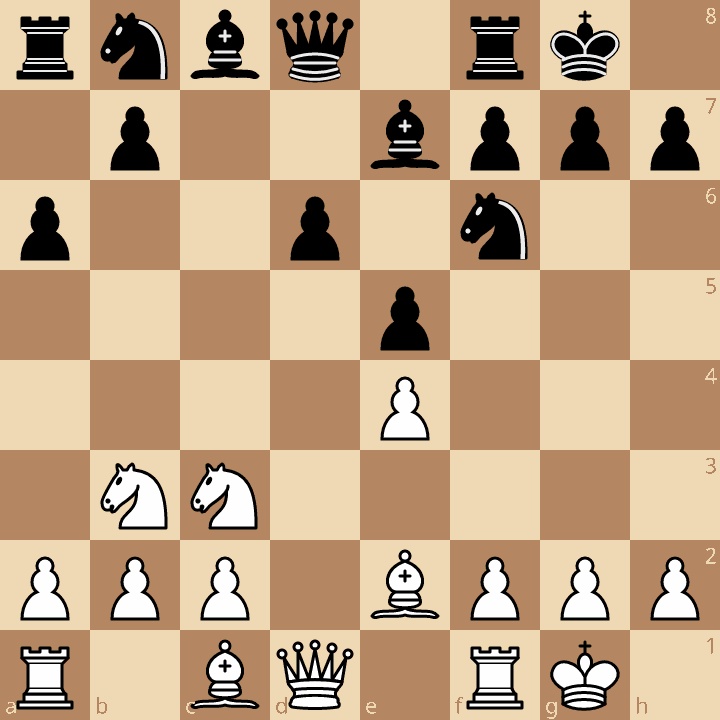
Both sides have castled kingside. The typical Sicilian battle begins — White seeks kingside attacking chances with f4 or piece maneuvers, while Black generates queenside counterplay with ..b5, ..♗︎b7, and pressure along the c-file. The position is rich in strategic and tactical possibilities, with chances for both sides.
Key Takeaways
- d4 opens the position—the Open Sicilian is the principled approach
- ♘︎xd4 gives White a central knight and half-open d-file
- Black gets the semi-open c-file for queenside play
- ♗︎e2 is solid; other options like ♗︎g5, ♗︎c4 are more aggressive but riskier
- The Sicilian leads to asymmetric, unbalanced positions
Now play it through
Step through every move on a real board, try the wrong ones, and ask Knighty why they fail.
Related Lessons
Summary
Ready to Practice?
Next in this opening family
Sicilian Najdorf - Main Line
Take this lesson with you
Free account requiredWith every variation — opens in Lichess & ChessBase