
Sicilian Wing Gambit
White sacrifices a flank pawn for rapid development and a powerful center against the Sicilian Defense.
Try Interactive LessonIntroduction
Lesson Content
The King's Pawn opening — White claims the center and opens diagonals for the queen and kingside bishop. The most popular first move in chess. Black's main responses: - 1. ..e5 — Open Game, matching White's center - 1. ..c5 — Sicilian Defense, fighting for d4 asymmetrically - 1. ..e6 — French Defense, preparing ..d5 - 1. ..c6 — Caro-Kann, also preparing ..d5
The Sicilian Defense — Black's most popular and ambitious reply to 1. e4. Rather than matching White in the center with ..e5, Black fights for the d4 square asymmetrically. The Sicilian leads to unbalanced positions where both sides have chances. White typically gets a kingside attack; Black gets queenside counterplay and the c-file.
The Wing Gambit! White immediately offers the b-pawn to disrupt Black's Sicilian setup. The idea is radical — sacrifice a flank pawn to dominate the center with d4 without the usual preparatory 2. Nf3. White's alternatives lead to very different games: - 2. Nf3 — the Open Sicilian, the main line - 2. c3 — the Alapin, preparing d4 without sacrificing material - 2. Nc3 — the Closed Sicilian, a positional approach
Alternative Moves
Black accepts the gambit, which is the most principled response. Taking the pawn wins material but opens the position — exactly what White wants. Black's alternatives: - 2. ..b5 — declining and holding the queenside, but passive - 2. ..e6 — declining, but White can still play 3. bxc5 with a pleasant game
Alternative Moves
The Marshall Variation — White offers a second pawn to rip open the queenside completely. The idea is that after ..bxa3, White recaptures with the knight, developing a piece while opening both the a- and b-files. This is more ambitious than simply developing: - 3. Nf3 — developing first, but Black holds the extra pawn more easily - 3. d4 — immediate central strike, but less forcing
Alternative Moves
The Carlsbad Variation — Black takes the second pawn, going two pawns up. This is greedy but logical. Black bets that the material advantage will outweigh White's development lead. Black's strongest alternative is 3. ..d5! — a counter-gambit that strikes the center immediately, considered the critical theoretical test of the Wing Gambit.
Alternative Moves
The whole point of the gambit! White establishes the ideal e4+d4 pawn center that Black's Sicilian was designed to prevent. With pawns on e4 and d4, White controls the key central squares and has a massive space advantage. White is down two pawns but has open lines, a strong center, and will develop rapidly. This is the classic gambit trade-off.
Alternative Moves
Black solidifies the position with a modest developing move. The pawn on e6 supports a future ..d5 break and opens the diagonal for the dark-squared bishop. Other options: - 4. ..d6 — Sicilian-style, but White's center is already established - 4. ..g6 — fianchetto approach, but slower to challenge the center
Alternative Moves
White recovers one of the sacrificed pawns while developing the knight! The Na3 is well-placed — it can reroute to c2 or jump to b5 to pressure Black's queenside. This is the beauty of the Wing Gambit concept: the pawn sacrifice on a3 was temporary, and White recaptures with a developing move.
Black prevents Nb5, which would threaten the d6 square and potentially land on c7 forking the rook and king. This prophylactic move is practically forced. Without ..a6, the Na3 would jump to b5 with dangerous threats against Black's undeveloped position.
White develops the second knight to its ideal square, controlling e5 and d4 while preparing kingside castling. White now has two pieces developed while Black has none. The development advantage is White's main compensation for the sacrificed pawn — every tempo counts in open positions.
Alternative Moves
Black finally develops a piece, and to the best square — the knight defends d4 and e5 and prepares ..Bb4+ or ..Be7. Black is still behind in development (one piece vs two), and the extra pawn provides little comfort in this open position.
The bishop fianchettoes to the powerful long diagonal, aiming straight at Black's kingside along the a1-h8 diagonal. This is a natural square in the Wing Gambit — the b-pawn was sacrificed, so the diagonal is wide open. The bishop on b2 defends the d4 pawn and will become a monster once the center opens further.
Alternative Moves
Black develops the knight to f6, attacking the e4 pawn and preparing to castle. This is natural but allows White's next move to gain space with tempo. The stronger 7. ..d5 challenges the center immediately, but after 8. e5 White still maintains a space advantage.
Alternative Moves
White pushes forward, gaining space and attacking the Nf6 with tempo! The e5 pawn cramps Black's entire kingside and takes away key squares from Black's pieces (especially f6 and d6). This advance is the payoff of White's gambit — a powerful pawn center supported by active pieces on the open diagonals.
The knight retreats to g4, the only reasonable square. From g4 it can potentially hop to e5 or h6, but it's awkwardly placed for now. Other retreats are worse: - 8. ..Nd5 blocks the d-file and gets hit by c4 - 8. ..Ng8 is a complete retreat, losing too much time
Alternative Moves
White develops the bishop to d3, aiming at the kingside and controlling the h7-b1 diagonal. The bishop is perfectly placed here — it supports the e5 pawn chain, prepares castling, and eyes potential kingside attacks. White now has three pieces developed and is ready to castle, while Black still struggles to coordinate.
Alternative Moves
Black prepares to fianchetto the bishop on g7, which is the best way to develop it given the cramped position. The bishop on g7 will pressure the d4 pawn and help defend the kingside. Black is trying to consolidate and castle, but White maintains a significant space and development advantage.
White reinforces the center and grabs even more space. The c4 pawn supports d5 in the future and restricts Black's pieces further. White's pawn chain (c4-d4-e5) dominates the entire board. White is only down one pawn but has a crushing space advantage and lead in development — the gambit has paid off handsomely.
Alternative Moves
Black completes the fianchetto. The bishop on g7 is well-placed, pressuring the d4 pawn through the e5 pawn. However, the e5 pawn blocks much of the bishop's potential. Black's position is solid but passive — the price of accepting both gambit pawns.
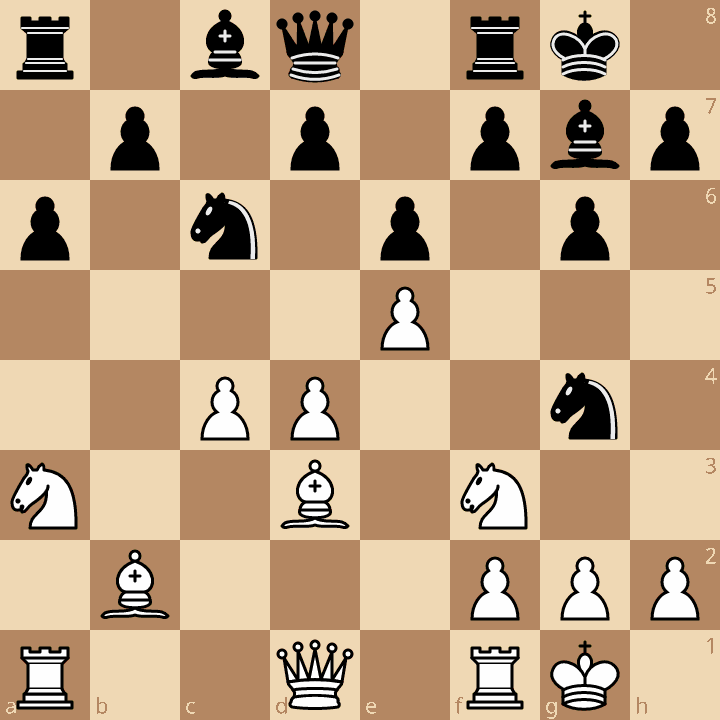
White castles, completing development. The king is safe on g1 and the rook connects with the other pieces. White has a dream position — a massive pawn center (c4-d4-e5), active pieces on open diagonals, and a lead in development. From here, White's typical plans include Nc2-d4 (rerouting the knight), Qe2 (connecting rooks), and eventually d5 or f4 to break through.
Black castles to safety. Both sides have castled, but the positions are vastly different — White has a powerful pawn center and active pieces, while Black is cramped with an extra pawn that provides little benefit. White's space advantage and piece activity fully compensate for the sacrificed pawn.
Key Takeaways
- The Wing Gambit sacrifices a flank pawn to seize the center with d4
- After 3.a3 bxa3, Nxa3 recovers a pawn while developing
- The Bb2 on the open long diagonal is a key attacking piece
- e5 gains space with tempo, cramping Black's entire position
- White's c4-d4-e5 pawn chain gives a crushing space advantage
Now play it through
Step through every move on a real board, try the wrong ones, and ask Knighty why they fail.
Summary
Ready to Practice?
Take this lesson with you
Free account requiredWith every variation — opens in Lichess & ChessBase