
Trompowsky Attack
Disrupt Black's structure early with 2.♗︎g5, trading bishop for knight to create lasting pawn imbalances.
Try Interactive LessonIntroduction
Lesson Content
Claim the center with your queen pawn.
d4 — The Queen's Pawn opening — White claims the center with the d-pawn, which is immediately defended by the queen. This tends to lead to more strategic, closed positions compared to 1. e4. Black's main responses: - 1. ..d5 — Queen's Gambit and Slav setups - 1. ..♘︎f6 — Indian Defenses (King's Indian, Nimzo-Indian, etc.) - 1. ..f5 — Dutch Defense
Alternative Moves
Black develops the knight and controls e4, preventing White from building the ideal e4+d4 center easily. This is the gateway to all Indian Defense systems. Black delays committing a pawn structure, staying flexible to choose between King's Indian, Nimzo-Indian, Queen's Indian, and more.
Pin the knight against the queen before it moves away.
♗︎g5 — The Trompowsky Attack! White pins the knight against the queen and develops the bishop to an active square before e3 blocks it in. This is the same principle as the London System (2. ♗︎f4) but more aggressive — White intends to trade the bishop for the knight, disrupting Black's pawn structure. Black's main responses: - 2. ..d5 — solid, the most popular at the top level - 2. ..♘︎e4 — immediately challenging the bishop - 2. ..e6 — Classical Defense, transposing to French-like structures
Alternative Moves
Black claims the center and prepares ..c5 to challenge d4. This is the most popular reply at the top level — Kramnik, Karjakin, So, and Caruana have all chosen this solid approach. Black ignores the pin for now, reasoning that White will have to declare intentions soon.
Alternative Moves
Support your center — your bishop is already developed.
White solidifies the center and prepares piece development. The bishop is already on g5 — had White played e3 first, the dark-squared bishop would be trapped behind the pawn chain. This sequencing (♗︎g5 before e3) is the defining idea of the Trompowsky. Now White waits for Black to commit with ..c5 before executing the trade on f6.
Alternative Moves
Black challenges d4 immediately, the most principled reaction. By striking at the center now, Black tries to open the position and exploit the bishop pair (which Black will get after White trades on f6). This was Kramnik's choice against Carlsen in their famous 2013 encounter.
Alternative Moves
Execute the trade to damage Black's pawn structure.
♗︎xf6 — The key trade! White gives up the bishop pair but permanently damages Black's kingside pawn structure. After ..gxf6, Black will have doubled f-pawns — a long-term weakness that's hard to repair. This is the fundamental Trompowsky bargain: structural advantage vs. the bishop pair.
Alternative Moves
Black recaptures toward the center, the overwhelming choice in master play. The doubled f-pawns are a structural concession, but Black gains the half-open g-file for the rook and the bishop pair as long-term compensation. The alternative 4. ..exf6 keeps a tidier structure but is far less popular.
Alternative Moves
Capture the c-pawn to open the position.
dxc5 — White captures the c5 pawn, opening the position. This looks like giving up the center, but White calculates that the temporary pawn gain and the half-open d-file will be useful. Black will regain the pawn with ..♗︎xc5, but White has already secured the structural advantage.
Alternative Moves
Black prepares to recapture the c5 pawn with the bishop. The pawn on e6 also supports the d5 pawn and opens the diagonal for the dark-squared bishop.
Alternative Moves
Develop your knight toward the center.
♘︎f3 — White develops the knight to its best square. From f3 it controls d4 and e5, supports the center, and prepares kingside castling. A natural, solid developing move before Black recovers the pawn.
Alternative Moves
Black recovers the pawn and develops the bishop to an active diagonal. The bishop on c5 eyes the f2 square and controls key central squares. Material is now equal, but the structural imbalance persists.
Develop your bishop to prepare castling.
A modest but effective developing move. The bishop on e2 prepares castling and supports future ideas like c4 to challenge Black's center. In this structure, ♗︎e2 is preferred over ♗︎d3 — the d3 square may be needed for the queen or knight. This is the overwhelming master choice.
Alternative Moves
Black develops the knight to its natural square, controlling d4 and e5. The knight also supports a future ..e5 or ..d4 push, both thematic for Black in this structure.
Castle to get your king to safety.
O-O — Castle to safety! White tucks the king away. The rook on f1 will find activity on the d-file or support a future f-pawn advance.
Black also castles. Both sides have completed basic development. Now the strategic battle begins — White will challenge d5 with c4, while Black aims to use the bishop pair and central mass.
Challenge the d5 pawn with the thematic pawn break.
The thematic pawn break! White challenges Black's d5 pawn, aiming to open lines for the pieces. This is the key positional idea — c4 creates tension in the center and forces Black to commit. Black must decide: push ..d4 (gaining space but fixing the pawn) or exchange ..dxc4 (simplifying but giving White the c-file).
Alternative Moves
Black pushes forward, gaining space and fixing the pawn on d4 where it restricts White's pieces. This is the most popular choice — Black's central pawn mass becomes a strength. The alternative ..dxc4 is also viable but gives White easy play on the open files.
Alternative Moves
Recapture to open lines for your pieces.
exd4 — White recaptures, reaching a key position. The new d4-pawn hits the bishop on c5, and the b1 knight can develop to c3. The position is dynamically balanced, with both sides having clear plans.
Alternative Moves
Key Takeaways
- ♗︎g5 before e3 — develop the bishop while it's still free
- Trade on f6 to saddle Black with doubled pawns — the core Trompowsky bargain
- c4 is the key positional pawn break to challenge Black's center
- White gets structural advantage; Black gets the bishop pair — both sides have chances
- Carlsen, Nakamura, and Mamedyarov all use this regularly at the highest level
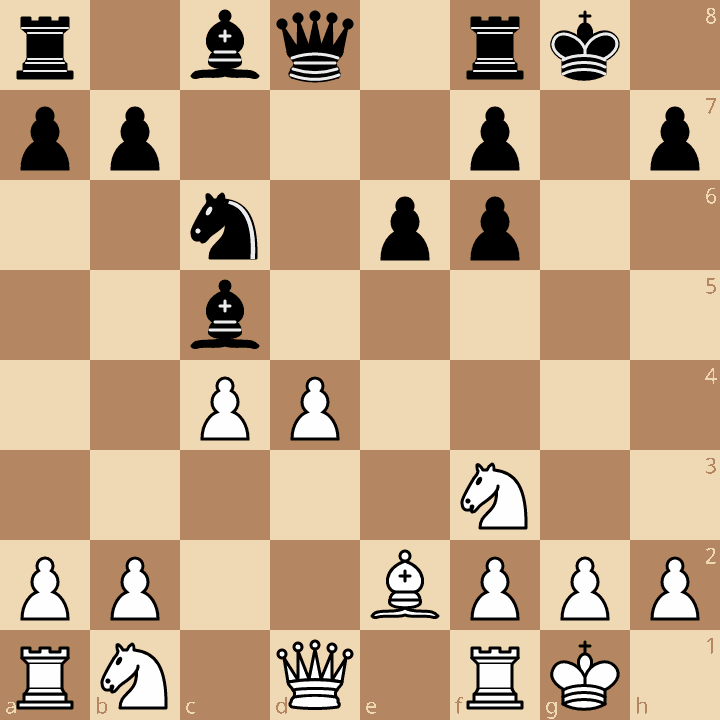
Now play it through
Step through every move on a real board, try the wrong ones, and ask Knighty why they fail.
Related Lessons
Summary
Ready to Practice?
Next in this opening family
Benko Gambit
Take this lesson with you
Free account requiredWith every variation — opens in Lichess & ChessBase