Danish Gambit
A bold double-pawn sacrifice for rapid development and powerful attacking bishops.
体验互动课程简介
课程内容
The King's Pawn opening — White claims the center and opens diagonals for the queen and kingside bishop. The most popular first move in chess. Black's main responses: - 1. ..e5 — Open Game, matching White's center - 1. ..c5 — Sicilian Defense, fighting for d4 asymmetrically - 1. ..e6 — French Defense, preparing ..d5 - 1. ..c6 — Caro-Kann, also preparing ..d5
Black mirrors White's central claim, establishing a symmetrical pawn center. This leads to the Open Games — the oldest and most classical family of openings. The e5 pawn controls d4 and f4, limiting White's expansion options.
White immediately challenges the center! Unlike 2. Nf3 which develops calmly, 2. d4 is direct and ambitious — if Black captures, White will use the open lines to develop rapidly. This is the starting point for the Center Game family, including the Danish Gambit after 3. c3.
替代走法
Black captures the d4 pawn. Declining with 2. ..d6 or 2. ..Nc6 is possible but passive — accepting is the most natural response, since ignoring a free pawn in the center is hard to justify. Now White's choice defines the opening: 3. Qxd4 is the Center Game, while 3. c3 launches the Danish Gambit.
The Danish Gambit begins! White offers a second pawn to accelerate development. The idea is brilliant in concept — after ..dxc3 and ..cxb2, White will recapture with the bishop, gaining two powerful bishops on open diagonals while Black wastes time capturing pawns. White's alternatives: - 3. Qxd4 — the Center Game, recapturing immediately - 3. Nf3 — the Scotch transposition, calmer
替代走法
Black accepts the first gambit pawn. The alternative 3. ..d5 (the Sörensen Defense) declines the gambit and is a solid choice. Accepting is riskier but tests White's compensation directly. After 3. ..dxc3, the pawn threatens to capture on b2, winning a third pawn — but White has a plan.
替代走法
White develops the bishop to its most aggressive square, targeting f7 — and lets Black capture a third pawn on b2! This is the heart of the Danish Gambit: White invests material for a massive development lead. The bishop on c4 will work in tandem with the bishop coming to b2, creating devastating dual-diagonal pressure.
替代走法
Black grabs the second gambit pawn, going all-in on material. Black is now up two full pawns — but has spent three moves capturing pawns while White has developed a bishop to an aggressive post. Declining with 4. ..d5 is a safer alternative, immediately returning material for development.
替代走法
The dark-squared bishop recaptures, completing the gambit setup. White is down two pawns but has a dream position: the Bc4 targets f7, the Bb2 rakes the long diagonal toward g7, and the center is wide open for rapid piece deployment. White's plan: develop Nf3, O-O, and launch a kingside attack before Black can consolidate.
The Schlechter Defense — Black's most famous response. By pushing ..d5, Black returns one pawn to break White's grip on the center and free the light-squared bishop. This is considered the most principled defense. Black's alternatives: - 5. ..Nf6 — the Classical Defense, developing but leaving the center intact - 5. ..Bb4+ — disrupting White's coordination with a check
替代走法
Capturing with the bishop keeps it active on the powerful d5 outpost. From here it eyes both the queenside (a8) and kingside (f7/g8). White is now down only one pawn and retains excellent piece activity. The alternative 6. exd5 is playable but blocks the Bb2's diagonal temporarily.
替代走法
Black develops the knight, attacking both the Bd5 and the e4 pawn. This is the Classical Defense continuation — natural development, but it walks into a spectacular tactical sequence. The stronger 6. ..Nd7 avoids the coming tactic by not blocking the queen's defense of d8, though it develops less actively.
替代走法
A stunning bishop sacrifice! White gives up the bishop to rip open Black's king position. After Kxf7 (forced), the d-file opens completely — and White's queen has a direct line to Black's queen on d8. This is the key tactical motif of the Danish Gambit: the combination of open lines and piece activity turns material sacrifices into concrete threats.
The king captures the bishop — while Ke7 is technically legal, it leaves the bishop alive and Black's position in shambles. Now Black's king is exposed on f7, having lost the right to castle. More critically, the d-file is completely open, and Black's queen on d8 is vulnerable.
White captures Black's queen! The d-file was cleared by the bishop sacrifice, allowing this devastating strike. White sacrificed a bishop but won the queen — a huge material swing. The position now favors White decisively, despite being down two pawns from the original gambit.
Black gives an intermezzo check with the bishop, trying to disrupt White's coordination before the position becomes hopeless. The check forces White to deal with it before consolidating.
Blocking the check while developing the knight to a strong central square. This is much stronger than 9. Qd2, which would allow Black to trade queens and reduce White's advantage. With the knight on c3, White has excellent development and remains up a queen for a bishop.
替代走法
Black develops the knight and attacks the White queen on d8. With the king exposed and down a queen for a bishop, Black is in serious trouble but tries to activate pieces.
The queen retreats from the attack while capturing another pawn with check! The queen on c7 attacks the king along the 7th rank and picks up material. White's lead is now overwhelming.
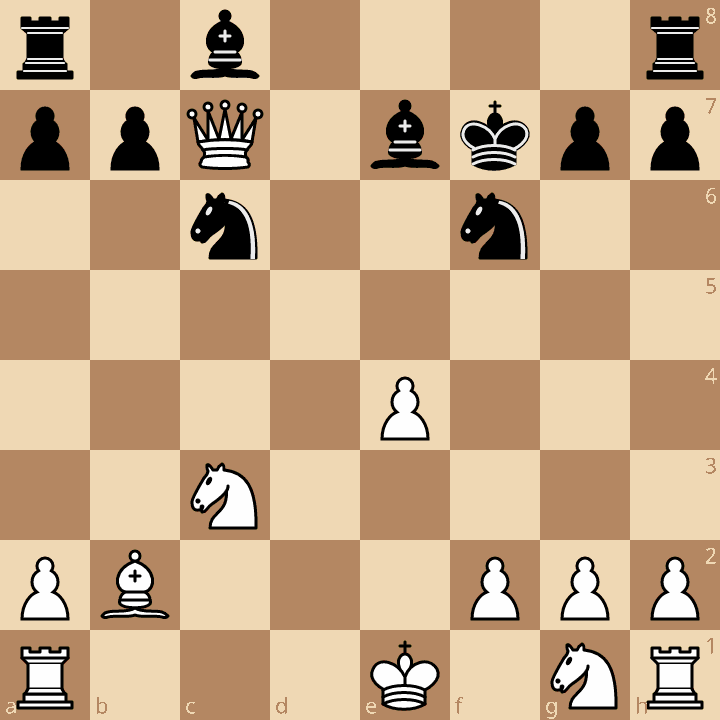
Black blocks the check with the bishop. White has a winning advantage — up a queen and a pawn for two bishops, with a better-developed position. The Danish Gambit's tactical power has been fully demonstrated.
要点总结
- The Danish Gambit sacrifices two pawns for rapid bishop development
- The Bc4 + Bb2 bishop pair creates dual-diagonal pressure on f7 and g7
- 5...d5 (Schlechter Defense) is Black's best response — returning material to equalize
- After 6...Nf6, the Bxf7+ sacrifice wins the queen via the open d-file
- In gambit play, development and open lines can outweigh material