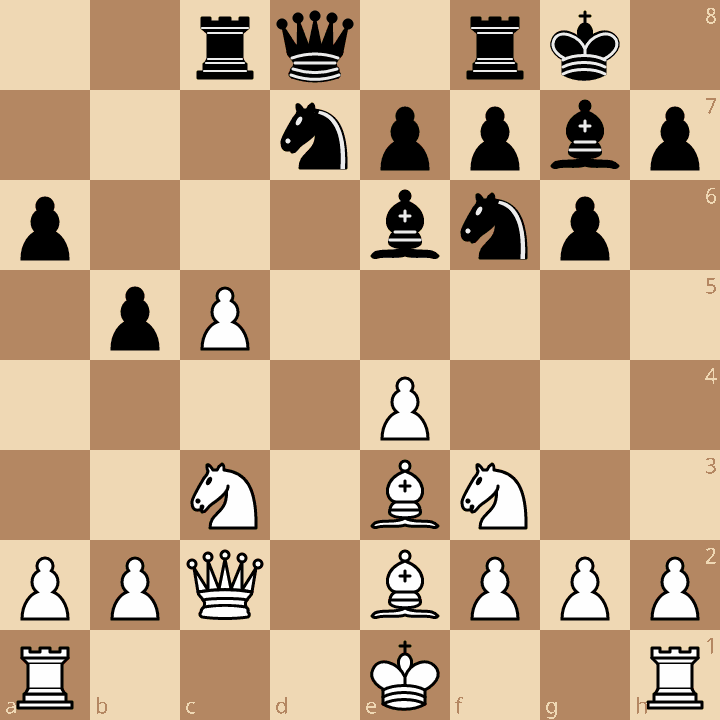
Grunfeld Defense - Russian System
White's queen actively pressures d5, but Black counters with ...dxc4, ...a6, ...b5, and ...c5 to undermine the center
体验互动课程简介
课程内容
The Queen's Pawn opening — White claims the center with the d-pawn, which is immediately defended by the queen. This tends to lead to more strategic, closed positions compared to 1. e4. Black's main responses: - 1. ..d5 — Queen's Gambit and Slav setups - 1. ..Nf6 — Indian Defenses (King's Indian, Nimzo-Indian, etc.) - 1. ..f5 — Dutch Defense
Black develops the knight and controls e4, preventing White from building the ideal e4+d4 center easily. This is the gateway to all Indian Defense systems. Black delays committing a pawn structure, staying flexible to choose between King's Indian, Nimzo-Indian, Queen's Indian, and more.
White reinforces control of d5 and grabs more space. Combined with d4, the two pawns dominate the center. Now Black's response determines the opening system: - 2. ..e6 — Nimzo-Indian (after 3. Nc3 Bb4) or Queen's Indian - 2. ..g6 — King's Indian or Grunfeld - 2. ..c5 — Benoni structures - 2. ..e5 — Budapest Gambit
Black prepares to fianchetto the bishop on g7, leading to either the King's Indian Defense (..d6, ..Bg7) or the Grunfeld Defense (..d5, ..Bg7). Both are hypermodern — Black allows White a big center, then attacks it. The choice between King's Indian and Grunfeld typically comes on move 3 or 4.
White develops the knight to its natural square, reinforcing control of d5 and e4. Now Black must commit: 3. ..d5 enters the Grunfeld, immediately challenging the center, while 3. ..Bg7 followed by ..d6 leads to the King's Indian, a slower buildup.
The Grunfeld Defense! Black strikes at the center immediately rather than fianchettoing first. This is the key difference from the King's Indian — Black challenges White's center head-on, inviting complications rather than allowing White to build unchallenged.
替代走法
The Three Knights Variation — White develops naturally before committing to a plan against the Grunfeld. This is a flexible move that keeps several systems available. White's alternatives define different variations: - 4. cxd5 — Exchange Variation, the most critical - 4. Bf4 — less common, keeping the center fluid - 4. Bg5 — a provocative pin
替代走法
The bishop takes its place on the long diagonal, aiming at d4. This is the soul of the Grunfeld — the Bg7 will pressure White's center for the entire game. Combined with the coming ..c5, the bishop becomes a dominant force.
The Russian System! White's queen leaps to b3, putting direct pressure on the d5 pawn and the b7 square. This is more aggressive than quiet approaches like 5. Bg5 or 5. e3 — the queen actively participates in the fight for the center. White's alternatives lead to different systems: - 5. cxd5 Nxd5 6.e4 — late Exchange Variation - 5. Bg5 — a positional approach - 5. e3 — solid but passive
替代走法
Black gives up the center pawn — but this is a strategic decision, not a concession. By forcing the queen to recapture on c4, Black gains time and prepares the queenside expansion with ..a6 and ..b5. The queen on c4 will become a target.
替代走法
Forced recapture. The queen on c4 is actively placed but exposed — Black will harass it with ..a6 and ..b5, gaining tempo while expanding on the queenside. This queen dance is a defining feature of the Russian System.
Black castles to safety before launching the queenside offensive. The king is secure on g8, the rook activates on f8, and the Bg7 gains additional protection. Now Black is ready for ..a6 and ..b5.
White seizes the full center with d4+e4, gaining significant space. This imposing pawn duo looks threatening, but Black has a concrete plan to undermine it. White's center is powerful but also a target.
The Hungarian Variation — Black prepares the key ..b5 expansion with tempo. The a6 pawn takes away the b5 square from White's pieces and sets up the queenside pawn advance that will push the White queen around. This is the main line of the Russian System, played extensively at the highest level by Kasparov and Carlsen.
替代走法
The queen retreats to b3, maintaining pressure on the b-file and eyeing b7. From b3, the queen supports e4 indirectly and stays connected to White's plans. But Black's next move will continue the queenside expansion.
The queenside expansion begins! The b5 pawn grabs space and prepares the critical ..c5 break. Black's plan is clear: advance the queenside pawns to undermine White's center from the flank — classic Grunfeld strategy.
White develops the bishop to a safe square, preparing to castle kingside. Be2 is a solid choice — it doesn't block any pieces and connects with the plan of completing development. White's alternative: - 9. e5 — aggressive but premature, giving Black counterplay with ..b4
The thematic central counter-strike! Combined with the Bg7 on the long diagonal, this attacks d4 with overwhelming force. Black's queenside pawns (a6, b5) and the ..c5 break work together to tear apart White's center — the Grunfeld at its finest.
White captures, winning a pawn temporarily. But the c5 pawn is hard to hold — Black will target it with ..Be6, ..Nbd7, and ..Rc8. White's center has been cracked open, which benefits Black's fianchettoed bishop enormously.
The bishop develops to an active square, eyeing the c4 square and preparing to recover the c5 pawn. The Be6 also connects with the plan of ..Nbd7 followed by ..Nxc5 or ..Rc8 to pile up pressure on the c-file.
替代走法
The queen retreats to c2, defending the e4 pawn and keeping an eye on the c-file. From c2, the queen supports White's center while avoiding harassment. White still hasn't castled — a sign of the complexity of this position.
The knight develops toward c5, preparing to recover the pawn. From d7, the knight can also reroute to e5 or b6. Black is fully mobilized — both bishops are active, both knights developed, and the c-file is about to open.
White develops the last minor piece, defending the c5 pawn and preparing to castle. The Be3 supports d4 ideas and controls key dark squares. White is close to completing development but still under pressure.
The rook swings to the open c-file, piling up pressure on the c5 pawn. Black's position is a model of Grunfeld activity: the Bg7 dominates the long diagonal, Be6 eyes c4, Nbd7 targets c5, and now the rook joins the attack. White must defend precisely to hold the extra pawn.
要点总结
- 5.Qb3 is the Russian System — White's queen actively pressures d5 and b7
- 5...dxc4 is the key response — surrender the center temporarily to gain time and queenside activity
- ...a6 and ...b5 drive the queen away while preparing the critical ...c5 break
- The Bg7 is the soul of the Grunfeld — it pressures d4 and dominates once the center opens
- ...c5 combined with piece pressure on the c-file gives Black dynamic compensation