
Caro-Kann Defense - 2.Bc4 (Hillbilly Attack)
When White brings the bishop to c4 on move 2, ...d5 hits it at once. Black gains time against the wandering bishop and gets an easy, comfortable game.
Try Interactive LessonIntroduction
Lesson Content
The King's Pawn opening — White claims the center and opens diagonals for the queen and kingside bishop. The most popular first move in chess. Black's main responses: - 1. ..e5 — Open Game, matching White's center - 1. ..c5 — Sicilian Defense, fighting for d4 asymmetrically - 1. ..e6 — French Defense, preparing ..d5 - 1. ..c6 — Caro-Kann, also preparing ..d5
Prepare ...d5 while keeping your light-squared bishop free.
c6 — The Caro-Kann Defense. Like the French, Black prepares ..d5, but via c6 instead of e6. The key advantage: the light-squared bishop stays unblocked. The c6 pawn will support a pawn on d5, so Black can challenge e4 next move without losing the d-pawn.
White develops the bishop toward f7, as in the Italian Game. Against 1. ..e5 this is a fine square, but against the Caro-Kann the bishop stands in the path of Black's planned ..d5. The main moves here are 2. d4 (the main line), 2. ♘︎c3 and 2. ♘︎f3. With the bishop on c4, Black's next pawn move will come with a threat.
Alternative Moves
Push the pawn your first move prepared, so it attacks both the bishop and the undefended e4 pawn.
d5 — The pawn attacks two things at once: the bishop on c4 and the e4 pawn, which nothing defends. White must react at once, or lose one of them. What White can do: - 3. exd5 — the best answer, taking the attacker away - 3. ♗︎b3 — saves the bishop, but after 3. ..dxe4 Black wins the e4 pawn - 3. d4?? — loses the bishop to 3. ..dxc4
Alternative Moves
White trades the e4 pawn for the attacker on d5. This solves both problems for one move: the bishop is no longer attacked, and the e4 pawn is not lost for nothing.
Alternative Moves
Recapture so that the bishop on c4 is attacked again.
cxd5 — Black recaptures toward the center and the new d5 pawn attacks the bishop on c4 again. White must move the bishop again, while Black is ready to develop. This gives Black a solid pawn on d5 and a half-open c-file for a rook later.
Alternative Moves
White moves the bishop with check. The engine rates it about the same as 4. ♗︎b3 and 4. ♗︎e2: it forces Black to answer the check and offers to trade the bishop, so White does not lose more time with it later. Other bishop moves: - 4. ♗︎b3 — keeps the bishop, but after 4. ..♗︎f5 Black's light-squared bishop develops outside the pawn chain - 4. ♗︎e2 — a quiet retreat
Alternative Moves
Block the check with a piece that offers a trade of bishops.
♗︎d7 — Black blocks the check with the light-squared bishop and offers a trade. If White takes, the bishop disappears on its third move, and Black recaptures with a developing move. Blocking with a piece that develops costs Black nothing; it uses the check to bring the bishop out.
Alternative Moves
White trades the bishops with check. Count the moves: the bishop went f1-c4-b5-d7, and after Black recaptures it is gone and White has no piece developed.
Alternative Moves
Recapture with a minor piece, so it develops as it takes.
♘︎xd7 — Black takes back with the queen knight and develops it with the same move. Material is equal, but Black now has a knight out and a pawn on d5, while White has nothing developed. From d7 the knight covers e5 and c5 and can later go to f6 or b6.
Alternative Moves
White puts a pawn on d4 to claim central squares and open the diagonal for the c1 bishop. The pawn structure is now the same as in the Exchange Caro-Kann, with one big difference: the light-squared bishops are already off.
Support your d5 pawn and open a diagonal for your dark-squared bishop.
e6 — The pawn supports d5 and opens the way for the f8 bishop. In many Caro-Kann lines Black must first get the light-squared bishop out before this pawn move; here that bishop is already traded, so e6 shuts nothing in.
Alternative Moves
White develops the king knight and prepares to castle. The knight also covers e5, a square Black's pieces would like to use.
Develop the dark-squared bishop to its most active square, aiming at White's kingside.
♗︎d6 — The bishop develops to its most active square. From d6 it points along the diagonal toward h2, where White's king will castle, and it covers e5.
Alternative Moves
White castles. The king is safe, and the rook on f1 can come to e1, where it faces the e6 pawn on the e-file.
Develop your last knight to a square where it does not block the f-pawn.
♘︎e7 — The king knight develops to e7 instead of f6. The d7 knight already covers f6, and from e7 this knight can go to f5, g6 or c6. On e7 it also does not block the f-pawn. Now Black only needs to castle to finish development.
Alternative Moves
White develops the queen to e2, on the e-file facing the e6 pawn. This also clears d1 for a rook. White's next idea is ♗︎g5, pinning the e7 knight to the queen on d8.
Take a square away from White's dark-squared bishop so it cannot attack your e7 knight.
h6 — A small move with a clear purpose. It takes the g5 square from White's bishop: if it goes to g5 to pin the e7 knight to the queen on d8, hxg5 wins the bishop for a pawn. The pawn also gives Black's king an escape square after castling, so a back-rank check cannot become mate.
Alternative Moves
White supports the d4 pawn with another pawn. Now Black's pieces cannot win d4 easily, and White can develop the b1 knight to d2.
Get your king to safety.
O-O — Black castles and the king is safe behind the f7, g7 and h6 pawns. All Black's minor pieces are out, while White's b1 knight and c1 bishop are still at home.
Alternative Moves
White finally develops the queen knight. It goes to d2 because the c3 pawn takes its usual square.
Develop your queen to a square where it connects your rooks and lines up with your dark-squared bishop.
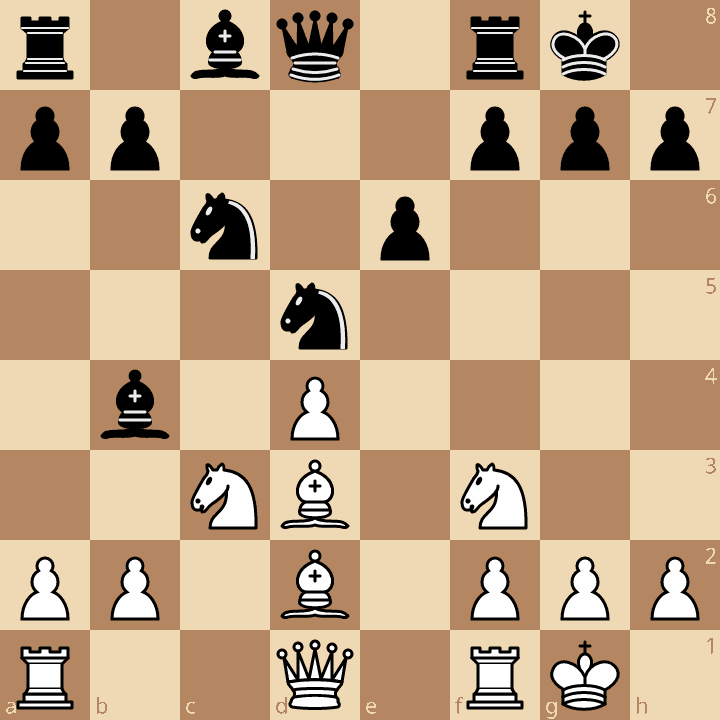
♕︎c7 — The queen joins the bishop on the diagonal toward h2, and it watches the c-file toward the c3 pawn. Leaving d8 also connects Black's rooks, so a rook can come to c8 next. Black has finished development and stands at least equal. Typical plans: ..♖︎ac8 for pressure on the c-file, and ..♘︎g6 or ..♘︎f5 to bring the e7 knight toward White's kingside.
Alternative Moves
Key Takeaways
- On c4 the bishop stands in front of ...d5, so ...d5 attacks it with tempo
- 2...d5 attacks both the bishop and the undefended e4 pawn
- After 3.exd5 cxd5 the bishop is attacked again — White keeps losing time with it
- Block the check with ...♗︎d7 and recapture with a developing piece
- Once the light-squared bishops are off, ...e6 shuts nothing in
- ...h6 stops ♗︎g5 from pinning the e7 knight to the queen

Now play it through
Step through every move on a real board, try the wrong ones, and ask Knighty why they fail.
Related Lessons
Summary
Ready to Practice?
Next in this opening family
Caro-Kann - Panov-Botvinnik Attack
Take this lesson with you
Free account requiredWith every variation — opens in Lichess & ChessBase