
Caro-Kann Defense - 2.Nf3 with 3.e5 Bg4
When White plays 2.♘︎f3 before d4, Black can pin that knight with ...♗︎g4, trade it off, and then attack the d4 pawn with every piece.
Try Interactive LessonIntroduction
Lesson Content
The King's Pawn opening — White claims the center and opens diagonals for the queen and kingside bishop. The most popular first move in chess. Black's main responses: - 1. ..e5 — Open Game, matching White's center - 1. ..c5 — Sicilian Defense, fighting for d4 asymmetrically - 1. ..e6 — French Defense, preparing ..d5 - 1. ..c6 — Caro-Kann, also preparing ..d5
Prepare ...d5 while keeping your light-squared bishop free.
c6 — The Caro-Kann Defense. Like the French, Black prepares ..d5, but via c6 instead of e6. The key advantage: the light-squared bishop stays unblocked. The Caro-Kann is considered one of the most solid defenses to the king's pawn opening, favored by players who want a reliable, low-risk structure.
White develops the knight first and keeps the d-pawn at home for now. This avoids the big theoretical lines after 2. d4 d5 and keeps options open: White can still play d4 later, or set up with d3. The drawback: with the knight on f3 and no pawn on d4, the knight becomes a target for Black's light-squared bishop on g4.
Alternative Moves
Strike at the center pawn your first move prepared to challenge.
d5 — Black strikes at e4 exactly as planned. The c6 pawn supports d5, and the e4 pawn is now attacked once and defended zero times, so White must decide right away: defend it, push it, or trade it.
White pushes past d5 and gains space, taking the f6 square from Black's king knight. But compare it with the normal Advance (2. d4 d5 3. e5): here there is no pawn on d4, so the e5 pawn is protected only by the knight on f3. White's other options at move 3: - 3. ♘︎c3 — the Two Knights Variation, keeping the tension - 3. exd5 cxd5 — an open structure where Black's pawns are comfortable - 3. d3 — a quiet King's Indian Attack setup
Alternative Moves
Develop your light-squared bishop to a square where it pins the knight that guards e5.
♗︎g4 — The point of Black's play when White develops the king knight before the d-pawn. The bishop pins the knight to the queen on d1: if the knight moves away, White loses the queen. And that knight is the only piece protecting e5, so Black is already threatening to take it with the bishop and leave the e5 pawn without a defender. The bishop also develops outside the pawn chain before ..e6, the usual Caro-Kann idea.
Alternative Moves
White asks the bishop at once: retreat or take. This is the most common choice at club level, because players dislike the pin. The engine prefers quiet development such as 4. ♗︎e2 or 4. d4, which keeps the knight and simply defends the center.
Alternative Moves
Answer the challenge to your bishop by removing the only defender of e5.
♗︎xf3 — Black gives the bishop for the knight. The e5 pawn loses its only defender, so White will want d4 to keep it protected. Black's light-squared bishop is the piece that usually becomes bad after ..e6; trading it now means the pawns can go to light squares without blocking anything.
Alternative Moves
White recaptures with the queen and keeps a healthy pawn structure. The queen on f3 looks along the diagonal at d5 and along the f-file at f7, but both are well covered.
Alternative Moves
Back up d5 with a second pawn and open a path for your dark-squared bishop.
e6 — Black backs up d5 with a second pawn, so the queen on f3 can never win it, and opens the diagonal for the dark-squared bishop. With the light-squared bishop already traded, this pawn locks in nothing.
Alternative Moves
White defends e5 with a pawn and builds the d4-e5 chain of the Advance Variation. The difference from the main Advance is that Black has already traded the light-squared bishop for a knight — one less piece for White to protect d4 with.
Attack the base of White’s pawn chain with a pawn.
c5 — The thematic break against every Advance chain: attack its base. If d4 falls or has to be traded, the e5 pawn loses its pawn support and becomes a weakness.
Alternative Moves
White gives a check with the bishop. After the natural block with the knight, the knight on c6 is pinned to the king on e8 and cannot take on d4 yet.
Alternative Moves
Block the check with a piece that develops toward d4.
♘︎c6 — Black blocks the check and develops at the same time. The knight is pinned for now, but it already eyes d4, and once the pin is gone it joins the attack on that pawn.
Alternative Moves
White supports d4 with the c-pawn, the standard way to hold the chain. Without it, Black would take on d4 and White's center would start to fall apart.
Open the c-file and leave d4 without pawn support.
cxd4 — Black trades pawns and opens the c-file. After White recaptures with the c-pawn, no white pawn can protect d4 any more, so every attack on it must be met by a piece.
Alternative Moves
White recaptures toward the center. The d4 pawn now stands alone — from here on only pieces can defend it — and Black's whole plan is to attack it more times than White can defend it.
Alternative Moves
Start your king knight toward a square from which it attacks d4.
♘︎e7 — The king knight cannot go to f6 because the e5 pawn covers that square, so it takes the route e7-f5. From f5 it will attack d4. On e7 it also protects the knight on c6, so ♗︎xc6+ no longer spoils Black's pawns: Black recaptures with the knight.
Alternative Moves
White castles, getting the king to safety and bringing the rook toward the center.
Bring the knight to a square where it attacks the d4 pawn.
♘︎f5 — The knight arrives on its best square and attacks d4. White has no piece guarding d4 right now, so Black threatens to win the pawn. White has to spend the next move defending it.
Alternative Moves
White's queen defends d4 and also protects the bishop on b5. It keeps White's pawn structure intact; ♗︎e3 also defends d4, but ♕︎d3 is slightly better.
Alternative Moves
Add a second attacker to the d4 pawn.
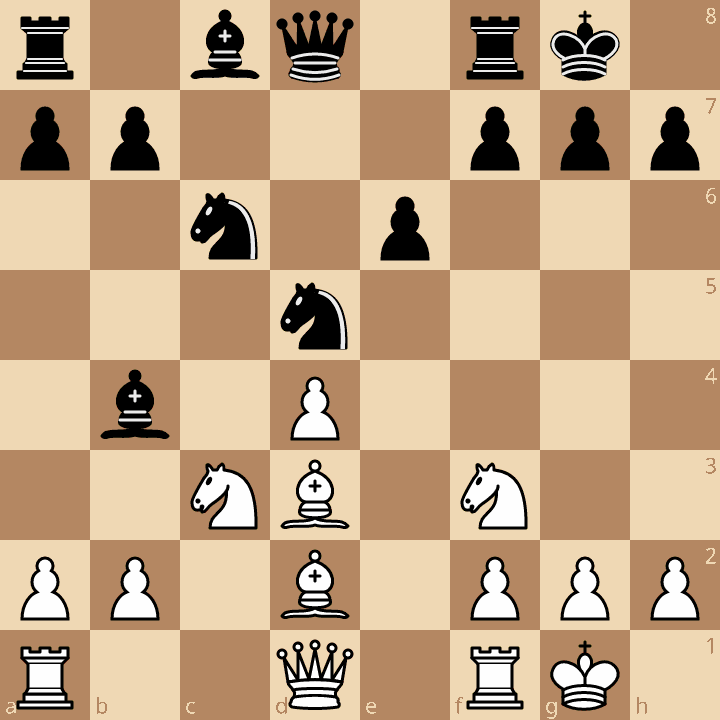
♕︎b6 — Now the knight on f5 and the queen both attack d4, and only the queen on d3 defends it, so Black again threatens to win the pawn. White must bring yet another piece to defend it, usually ♗︎e3. Black then finishes development with ..♗︎e7 and ...O-O, with an easy, comfortable position.
Alternative Moves
Key Takeaways
- Without a pawn on d4, the e5 pawn is defended only by the knight on f3 — ...♗︎g4 attacks that defender
- Trading the light-squared bishop for the knight removes the piece that usually becomes passive after ...e6
- ...c5 attacks the base of the d4-e5 chain; after ...cxd4 the d4 pawn can only be defended by pieces
- The king knight goes e7-f5 because e5 takes f6 from it
- Knights on c6 and f5 plus the queen on b6 keep White busy defending d4

Now play it through
Step through every move on a real board, try the wrong ones, and ask Knighty why they fail.
Related Lessons
Summary
Ready to Practice?
Next in this opening family
Caro-Kann - Panov-Botvinnik Attack
Take this lesson with you
Free account requiredWith every variation — opens in Lichess & ChessBase