
Caro-Kann Fantasy Variation
A bold pawn sacrifice idea where White plays f3 to build a massive center after dxe4 fxe4.
Try Interactive LessonIntroduction
Lesson Content
The King's Pawn opening — White claims the center and opens diagonals for the queen and kingside bishop. The most popular first move in chess. Black's main responses: - 1. ..e5 — Open Game, matching White's center - 1. ..c5 — Sicilian Defense, fighting for d4 asymmetrically - 1. ..e6 — French Defense, preparing ..d5 - 1. ..c6 — Caro-Kann, also preparing ..d5
Alternative Moves
The Caro-Kann Defense — like the French, Black prepares ..d5, but via c6 instead of e6. The key advantage: the light-squared bishop stays unblocked. The Caro-Kann is considered one of the most solid defenses to 1. e4, favored by players who want a reliable, low-risk structure.
White builds the full pawn center. After 2. ..d5, White must decide how to handle the tension: - 3. Nc3 or 3. Nd2 — maintain the tension - 3. e5 — Advance Variation, gaining space - 3. exd5 cxd5 — Exchange, leading to symmetrical pawn structure - 3. f3 — the Fantasy Variation!
Alternative Moves
Black challenges the e4 pawn as planned. Unlike the French (1. ..e6 2. ..d5), the c6 pawn supports d5 while leaving the light-squared bishop free to develop actively.
The Fantasy Variation! White boldly supports e4 with the f-pawn instead of a knight. The idea is ambitious: if Black captures with 3. ..dxe4 4. fxe4, White gains a dominating e4+d4 center and opens the f-file for the rook. This is riskier than 3. Nc3 or 3. e5 since it weakens the kingside slightly and delays development, but it creates immediate practical problems for Black.
Alternative Moves
Black accepts the challenge and captures the e4 pawn. This is the most principled response — taking the pawn forces White to recapture with the f-pawn, which is the whole point of the Fantasy. The alternative 3. ..e6 is more cautious, keeping the tension, but allows White to achieve the big center without giving up the f-pawn's protection of g3.
White recaptures, achieving the dream center: pawns on e4 and d4 control all four central squares. The f-file is now half-open, which will become a powerful attacking asset once White castles kingside. The key trade-off: White has a space advantage and attacking chances, but the king is slightly exposed with no f-pawn shield.
Alternative Moves
Black immediately challenges White's center before it becomes too strong. This counter-strike is critical — without it, White's e4+d4 pawns would dominate the board. The pawn on e5 also opens the diagonal for the dark-squared bishop and creates tension in the center that Black can exploit.
White develops the knight to its most natural square, defending d4 and preparing to castle. The knight also eyes e5 if Black later exchanges pawns. Developing quickly is essential — White traded a structural weakness (no f-pawn) for a big center, so piece activity must compensate.
Alternative Moves
Black develops the light-squared bishop to an active square, pinning the Nf3 against the queen. This is the main benefit of the Caro-Kann structure — unlike the French, this bishop is free to be active. The pin on the knight indirectly pressures the d4 pawn and makes it harder for White to maintain the center.
White develops the bishop to its most active diagonal, targeting the f7 square and preparing to castle. The bishop on c4 also supports potential tactics along the a2-g8 diagonal. With both bishops developed aggressively, White aims for rapid kingside castling to connect the rooks and activate the f-file.
Alternative Moves
Black develops the knight to d7, keeping options flexible. From d7, the knight can go to f6 (attacking e4), e5 (challenging the center), or b6 (hitting c4). This is more flexible than the immediate ..Nf6, which could be met by e5 pushing the knight away.
White reinforces the d4 pawn — the anchor of the center. With c3, the d4 pawn is solidly supported, and White can focus on completing development and castling. This also prepares Nbd2 without blocking the c-pawn, maintaining a flexible pawn structure.
Alternative Moves
Black places the bishop on its best diagonal, pointing toward the kingside. The bishop on d6 supports e5, defends the king, and can become a powerful attacking piece if lines open toward h2. With ..Bd6 and ..Bg4, Black's bishops are both actively placed — a key Caro-Kann theme.
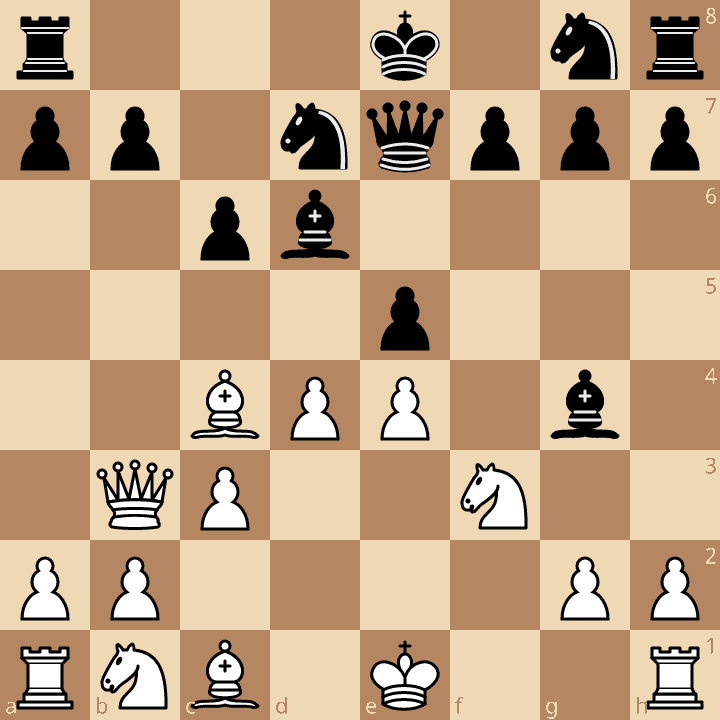
A multi-purpose queen move hitting both the b7 pawn and adding pressure along the a2-g8 diagonal in tandem with the Bc4. Black must respond to the b7 threat, which restricts defensive options. The queen on b3 also eyes f7 in some tactical lines, creating a powerful battery with the bishop on c4.
Alternative Moves
Black defends the b7 pawn while keeping the option to castle either side. The queen on e7 connects the defense and supports ..Ngf6 development. The position is dynamically balanced: White has the center and f-file, while Black has active bishops and solid coordination.
Key Takeaways
- The Fantasy Variation (3.f3) aims for a powerful e4+d4 center at the cost of weakening the kingside
- After 4.fxe4, White gets the open f-file as a bonus attacking resource
- Black's key counter-strike is 4...e5, challenging the center before it becomes overwhelming
- Development tempo is critical — White must activate pieces quickly to justify the structural concession
- Black's Caro-Kann bishops (Bg4 and Bd6) are naturally active, unlike in the French Defense
Now play it through
Step through every move on a real board, try the wrong ones, and ask Knighty why they fail.
Summary
Ready to Practice?
Take this lesson with you
Free account requiredWith every variation — opens in Lichess & ChessBase