
French Defense - 2.Nf3 Variation
White develops the knight before pushing the d-pawn. Black uses that delay to grab the d4 square first and turn the French bishop into an active piece.
Try Interactive LessonIntroduction
Lesson Content
1. e4 — the King's Pawn opening. White claims the center and opens diagonals for the queen and the light-squared bishop.
Prepare to challenge the e4 pawn with your d-pawn next move.
1. ..e6 — the French Defense. Black prepares ..d5 to challenge the e4 pawn next move. The cost is that the e6 pawn shuts in Black's light-squared bishop on c8 — keep an eye on that bishop, because this lesson is about freeing it.
Alternative Moves
2. ♘︎f3 develops a piece and prepares castling, but it does not put a pawn on d4. In the main French lines (2. d4) White builds a big pawn center at once. That empty d4 square is what Black will aim at in this lesson.
Challenge White's e4 pawn head-on.
2. ..d5 — the French plan as usual: the pawn hits e4, so White must decide what to do with it. White's main third moves: - 3. e5 — gains space; this lesson - 3. exd5 exd5 4.d4 — the same position as the French Exchange - 3. ♘︎c3 — the Two Knights line, defending e4 - 3. d3 — a ♔︎ing's Indian Attack setup
Alternative Moves
3. e5 pushes past Black's d5 pawn and gains space. The e5 pawn takes the f6 square from Black's g8 knight, so that knight will usually develop to e7 instead. The difference from the Advance Variation: there is no white pawn on d4 to support e5. If White cannot get one there, the e5 pawn stands alone.
White's d-pawn has not moved yet — take control of the square in front of it.
3. ..c5 takes control of d4 before White's d-pawn gets there. Now 4. d4 is still possible, but it only reaches the Advance Variation, where Black is fine. White's other tries: - 4. c3 — prepares d4 and is the main line - 4. b4 — the Wing Gambit, a pawn sacrifice to deflect the c5 pawn - 4. d4 — the Advance Variation
Alternative Moves
4. c3 prepares d4. If White gets the d-pawn there with c3 behind it, White has the full Advance pawn chain and the e5 pawn is safe.
White wants a pawn chain through the center — occupy the key square before White's d-pawn can.
4. ..d4! — this is the move White's early knight development allows. Black's pawn takes the d4 square itself, so White can never build the c3–d4–e5 chain. The pawn is safe: the c5 pawn and the d8 queen protect it, so ♘︎xd4 would just lose the knight to ..cxd4. Now the e5 pawn has no pawn behind it, and it will become a target for Black's pieces.
Alternative Moves
5. d3 gives up on d4 and plays a King's Indian-style setup: g3, the bishop to g2 and castling. The d3 pawn also protects the e4 square for a white knight. The drawback: no white pawn can ever protect the d3 pawn, so once Black aims pieces at it, White must guard it with pieces.
Develop a knight that guards your advanced pawn and attacks e5.
5. ..♘︎c6 develops and adds a third defender to the d4 pawn. The knight also attacks the e5 pawn, which no white pawn protects — only the f3 knight holds it for now.
Alternative Moves
6. g3 prepares ♗︎g2. The bishop will aim down the long diagonal toward the c6 knight, and once ..b6 is played the a8 rook behind it — something Black must keep in mind for the next moves.
Release the tension so White's d-pawn is left alone on a half-open file.
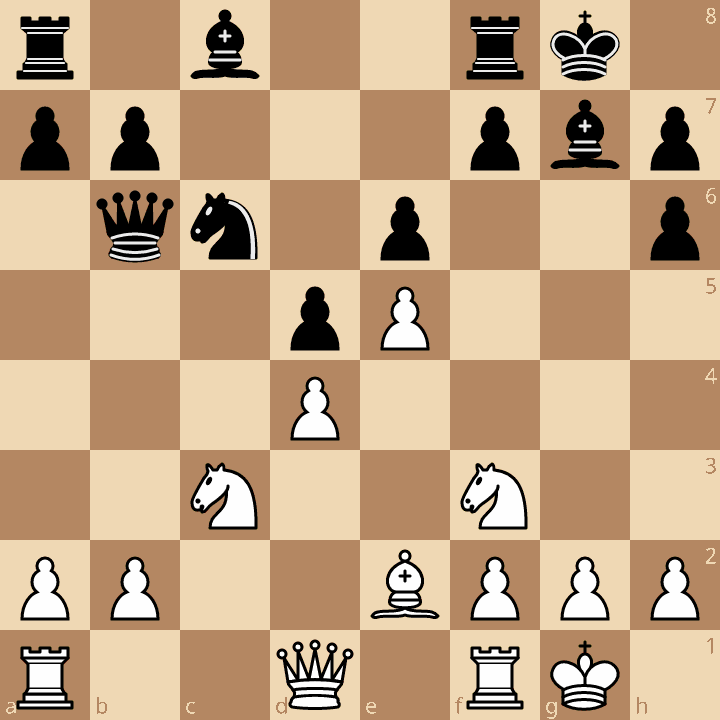
6. ..dxc3 trades the advanced pawn. Black gives up some space, but after White recaptures, the d3 pawn stands alone on the d-file with no black pawn in front of it — a target for Black's queen and rooks. The trade also takes away White's option of cxd4.
Alternative Moves
7. bxc3 recaptures toward the center: the c3 pawn guards d4, so White keeps the option of d3–d4 later. The cost is that the a2 pawn has no pawn beside it, and the d3 pawn stands on a half-open file in front of Black's queen. 7. ♘︎xc3 is also possible, but then no c-pawn supports d4, and the d3 pawn stays stuck as a target.
Open a road for your light-squared bishop that goes around your own pawns.
7. ..b6 opens two roads for the light-squared bishop: a6, aimed at the d3 pawn, and b7, on the long diagonal. This is the key idea — the French bishop leaves the pawn chain through the queenside instead of staying stuck behind e6.
Alternative Moves
8. ♗︎g2 completes the fianchetto. The bishop now looks along the long diagonal; only White's own f3 knight stands between it and the c6 knight. If that knight moves away, the bishop hits c6 — and the a8 rook behind it.
Protect your c6 knight and line up a heavy piece against the d3 pawn.
8. ..♕︎d7 does two jobs. The queen protects the c6 knight, so 9. ♘︎d4 no longer works — Black simply takes the knight with ..cxd4. The queen also lines up on the half-open d-file against the d3 pawn.
Alternative Moves
9.O-O brings White's king to safety. White's next ideas are ♕︎a4, attacking along the a4–e8 diagonal, or ♘︎a3 heading for b5 or c4.
Bring your light-squared bishop to the diagonal that points at d3.
9. ..♗︎a6 — the French bishop has its best diagonal. Together with the d7 queen it attacks the d3 pawn twice, and only White's queen protects it. Taking on d3 is not automatic: after 10. ♕︎a4, taking on d3 loses a piece, because 11. ♘︎e1 attacks the bishop and opens the g2 bishop onto the c6 knight. But from now on White must spend moves to keep the d3 pawn.
Alternative Moves
10. ♕︎a4 is White's most active reply. The queen attacks the a6 bishop, which nothing protects, and it also attacks the c6 knight. Black must save the bishop, or White simply takes it.
Your bishop is attacked and so is your c6 knight — solve both with one move.
10. ..♗︎b7 solves both problems with one move: the bishop escapes the attack and adds a second defender to the c6 knight. On b7 it stands on the long diagonal, facing White's g2 bishop. White's queen on a4 is now far from the kingside and will need another move to find a better square.
Alternative Moves
11. ♘︎a3 develops the last white knight. From a3 it can jump to b5 or c4 and join the fight on the queenside.
Develop your kingside knight so it also guards the c6 knight.
11. ..♘︎ge7 develops the kingside knight. It protects the c6 knight a third time and can go on to g6, where it attacks the e5 pawn, or to f5. Once the knight moves on, the f8 bishop comes out to e7 and Black castles. Black has a solid, playable position: an active light-squared bishop, a target on d3 and a lonely pawn on e5.
Alternative Moves
Key Takeaways
- 2.♘︎f3 leaves d4 empty — ...c5 and ...d4 take that square before White can
- Without a pawn on d4, the e5 pawn has no pawn support and becomes a target
- ...dxc3 leaves White's d3 pawn alone on the half-open d-file
- ...b6 frees the French light-squared bishop via a6 or b7
- Watch the g2 bishop's long diagonal: keep the c6 knight protected (...♕︎d7)

Now play it through
Step through every move on a real board, try the wrong ones, and ask Knighty why they fail.
Related Lessons
Summary
Ready to Practice?
Next in this opening family
French Defense - Advance Variation
Take this lesson with you
Free account requiredWith every variation — opens in Lichess & ChessBase