
Queen's Gambit - Marshall Defence
Black answers the Queen's Gambit with 2...♘︎f6 and leaves d5 without pawn support. Learn how White trades on d5 and chases Black's pieces around.
Try Interactive LessonIntroduction
Lesson Content
Claim the center with your queen pawn.
d4 — the Queen's Pawn opening. White claims the center with the d-pawn, which the queen already defends. The game tends to become more strategic than after 1. e4.
Black answers d5 and takes an equal share of the center. White's most popular reply is 2. c4 — the ♕︎ueen's Gambit.
Attack Black's central pawn with a pawn from the queenside.
c4 — the ♕︎ueen's Gambit. The c-pawn attacks d5 and asks Black how to hold the center. Black's healthy choices: - 2. ..e6 — Queen's Gambit Declined, d5 backed by a pawn - 2. ..c6 — Slav Defence, d5 backed by a pawn - 2. ..dxc4 — Queen's Gambit Accepted
Alternative Moves
The Marshall Defence. ♘︎f6 develops a piece, but it does not give d5 pawn support. If White trades on d5, Black has no pawn to take back with — only a piece can recapture, and a piece in the center becomes a target for White's pawns. This is why 2. ..♘︎f6 counts as dubious: Black skips the one thing the Queen's Gambit asks for.
Alternative Moves
Trade pawns in the center so that Black cannot recapture with a pawn.
cxd5 exposes the flaw at once. Black has no c- or e-pawn ready to recapture, so only a piece can win the pawn back on d5 — and White gets a central pawn majority, two center pawns (d and e) against one.
Alternative Moves
Black recaptures ♘︎xd5. The knight stands well for now, but it can be hit by a white pawn on e4 later, and every retreat costs Black a move.
Alternative Moves
Develop a knight so that Black cannot free the game with a central pawn break.
♘︎f3 develops and covers e5, so Black cannot free the position with ..e5 — that pawn would simply be lost. White keeps the plan of pushing e4 later, with the knight on d5 as its target.
Alternative Moves
♗︎f5 is Black's best try: the bishop watches e4 and stops White's e-pawn from advancing easily. The cost: the bishop has left c8, where it guarded the b7 pawn — now nothing defends b7.
Alternative Moves
Develop a knight that supports a pawn attack on two black pieces.
♘︎bd2 guards e4, where the bishop on f5 is aiming, and threatens e4 next — a pawn attack on the knight on d5 and the bishop on f5 at the same time. Black can't move both pieces in one turn, so Black must reorganize now. The knight goes to d2, not c3: ♘︎c3 would also guard e4, but there ..♘︎xc3 can remove that knight.
Alternative Moves
The knight retreats ♘︎f6 and covers e4 again. Now e4 is no longer a threat: the knight on f6 and the bishop on f5 attack e4 twice, and only the knight on d2 defends it. But Black has spent another move on the same knight.
Find a queen move that attacks the pawn the bishop stopped guarding.
♕︎b3 attacks the b7 pawn, which lost its defender when the bishop went to f5. If Black ignores it, ♕︎xb7 wins a pawn and attacks the rook on a8 next.
Alternative Moves
♕︎c8 defends b7, but the queen is passive on c8 — it now stands on the bishop's old square.
Alternative Moves
Prepare a pawn advance that will chase the bishop off its diagonal.
h3 prepares g4, a pawn push that will chase the bishop off f5. With the h-pawn on h3, the g-pawn is protected on g4 and Black cannot take it for free.
Alternative Moves
h6 makes room for the bishop on h7, so after g4 it can retreat and stay on the b1-h7 diagonal.
Kick the bishop with a pawn and gain space.
g4 attacks the bishop on f5 and gains space on the kingside. Black must move the bishop again — another move spent on a piece that has already moved.
Alternative Moves
♗︎e6 retreats with a hit on the queen on b3, along the e6-b3 diagonal. But the bishop now blocks Black's e-pawn, and the bishop on f8 stays shut in behind the pawns on e7 and g7 — Black is still far from castling.
Alternative Moves
Move your attacked queen to a safe square that keeps an eye on the center.
♕︎c2 steps out of the attack and still eyes e4 through d3, so White can push the e-pawn later.
Alternative Moves
c5 is Black's main counterplay: the pawn attacks d4 and tries to open the c-file, where Black's queen on c8 faces White's queen on c2.
Finish your kingside development and get ready to castle.
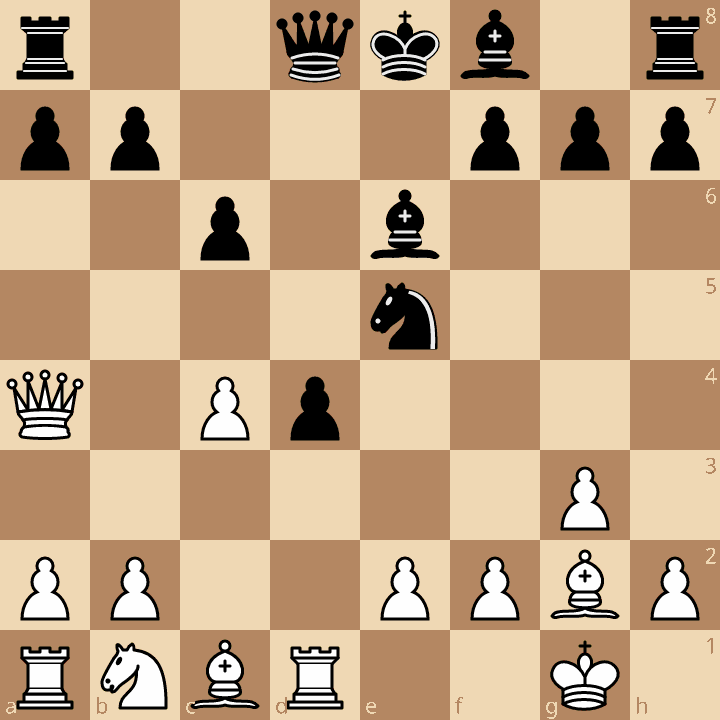
♗︎g2 develops the kingside bishop and gets White ready to castle. The bishop also guards f3 and h3, the squares that g4 weakened. White is ahead in development and has more space; Black's king is still in the center and the f8 bishop has not moved. Next White can take on c5 or bring the d2 knight to b3 to attack the c5 pawn.
Alternative Moves
Key Takeaways
- After 2...♘︎f6, trade on d5 at once: Black has no pawn to recapture with
- ♘︎f3 stops ...e5, and ♘︎bd2 prepares e4 to attack the knight on d5
- When the c8 bishop leaves early, b7 is undefended — ♕︎b3 attacks it
- Chase a developed bishop with pawns (h3, g4) to gain time and space
- As Black, support d5 with ...e6 or ...c6 instead — that is what the Queen's Gambit asks for

Now play it through
Step through every move on a real board, try the wrong ones, and ask Knighty why they fail.
Related Lessons
Summary
Ready to Practice?
Next in this opening family
Albin Counter-Gambit - Fianchetto Line
Take this lesson with you
Free account requiredWith every variation — opens in Lichess & ChessBase