
Reti Opening - Neo-Catalan Declined
Master the double-fianchetto Reti system with delayed central tension and the thematic cxd5 exchange
Try Interactive LessonIntroduction
Lesson Content
Develop flexibly without committing your pawn structure.
♘︎f3 — The Reti Opening — White develops a piece and controls e5/d4 without committing any pawns. This is the ultimate flexible opening, keeping all options open. Can transpose into the English, Queen's Gambit, King's Indian Attack, or remain in pure Reti territory with a fianchetto setup.
Alternative Moves
Black's most natural response — occupying the center with the d-pawn. This is the most popular reply among masters, leading to the classical Reti complex (ECO A06-A09). Black's alternatives: - 1. ..♘︎f6 — Indian Defense setups, the most popular overall - 1. ..c5 — Sicilian Invitation - 1. ..f5 — Dutch Defense
Challenge the center from the flank — the Reti way.
c4 — The defining move of the Reti Opening (ECO A09)! White challenges d5 from the flank rather than with d4. This is the hypermodern philosophy — attack the center with pieces and flank pawns rather than occupying it directly. Black must decide how to handle the tension: - 2. ..d4 — Advance Variation, grabbing space - 2. ..e6 — reinforcing d5, classical approach - 2. ..c6 — Slav-like, also solid
Alternative Moves
Black reinforces d5 solidly, similar to the Queen's Gambit Declined structure. The downside: the light-squared bishop gets locked behind the e6 pawn. This leads to the Agincourt Defense (ECO A13). Black's alternatives: - 2. ..d4 — the Advance Variation, sharper - 2. ..c6 — Slav-like, keeping the bishop free - 2. ..dxc4 — Reti Accepted, giving up the center
Prepare your fianchetto to pressure d5 from distance.
g3 — White prepares the kingside fianchetto — the bishop on g2 will become a powerful long-range piece pressuring the d5 pawn and the entire a8-h1 diagonal. This is the signature setup of the Reti.
Alternative Moves
Black develops the kingside knight naturally, entering the ♘︎eo-Catalan (ECO A13). The knight controls e4 and d5 while preparing kingside castling. This is by far the most popular choice at master level. Black's alternatives: - 3. ..dxc4 — capturing immediately, sharper - 3. ..c6 — Kurajica Defense, maintaining the center - 3. ..c5 — Catalan Defense, more ambitious
Complete the fianchetto to activate your bishop.
♗︎g2 — White completes the kingside fianchetto. The bishop on g2 is a monster — it pressures d5, eyes the a8 corner, and will become even stronger once the center opens. This is the first of White's two fianchettoed bishops in the double-fianchetto system.
Alternative Moves
The ♘︎eo-Catalan Declined (ECO A14) — Black develops the bishop solidly to e7, declining to create early tension. This is the most popular choice, played by Carlsen, Kramnik, and Anand. Black's alternatives: - 4. ..dxc4 — Neo-Catalan Accepted, more dynamic - 4. ..d4 — advancing in the center - 4. ..c5 — expanding on the queenside
Secure your king before expanding.
O-O — White castles, securing the king behind the fianchettoed bishop. The rook on f1 also gains access to the center. White has developed efficiently — two pieces and castling in five moves, all without committing a single central pawn.
Alternative Moves
Black mirrors with castling. Both kings are now safe. The middlegame struggle will center on how White breaks the central tension — White's choice between b3 (double fianchetto) and d4 (Catalan transposition) is the critical decision.
Prepare the second fianchetto for the double-bishop setup.
b3 — The key move that defines the double-fianchetto Reti! White prepares ♗︎b2, creating a second fianchettoed bishop. The two bishops on b2 and g2 will form a devastating pair, controlling both long diagonals and exerting pressure across the entire board. White's alternative: - 6. d4 — transposes to the Catalan, a perfectly good choice but different strategic character
Alternative Moves
Black fights for central and queenside space, establishing a pawn on c5 to contest d4 and limit White's central expansion. This is the most popular continuation, creating a balanced position with chances for both sides. Black's alternatives: - 6. ..b6 — preparing a double fianchetto of their own - 6. ..d4 — advancing aggressively, locking the center - 6. ..a5 — preventing b4 and fighting for queenside space
Complete the double fianchetto.
The double fianchetto is complete! White's bishops on b2 and g2 form a fearsome pair — the ♗︎g2 pressures the a8-h1 diagonal while the ♗︎b2 controls the a1-h8 diagonal. Together they survey the entire board. This is the hallmark position of the Reti system. Featured in Ivanchuk vs Carlsen (2008) and ♔︎ramnik vs Anand (2016).
Alternative Moves
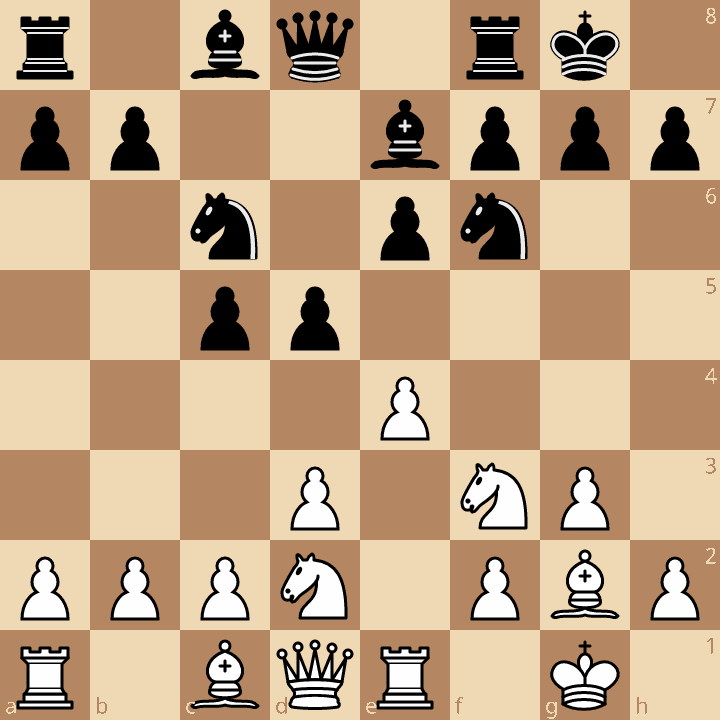
Black develops the queen's knight, reinforcing d4 and e5 control. Both sides are nearly developed — the question is how to resolve the central tension. Black's alternatives: - 7. ..d4 — closing the center, gaining space and blunting White's ♗︎b2 - 7. ..b6 — preparing a queenside fianchetto
Support the center flexibly without committing.
A subtle, flexible move that supports a future d4 without committing to it immediately. White keeps the tension in the center while improving the pawn structure. The e3 pawn also guards d4 and f4, giving White a solid foundation. This is the most popular master choice, played by Caruana, Giri, So, and Kramnik.
Alternative Moves
Black prepares to fianchetto the light-squared bishop on b7. Both sides will now have fianchettoed bishops — a rare and strategically rich formation. The ♗︎b7 will contest the a8-h1 diagonal against White's ♗︎g2. Black's alternatives: - 8. ..d4 — advancing, but weakening the c5 pawn - 8. ..dxc4 — exchanging, giving White free development
Complete your development with the last minor piece.
White develops the last minor piece to its ideal square. The ♘︎c3 reinforces control over d5 and e4, and prepares the thematic cxd5 exchange. All of White's pieces are now perfectly coordinated. This is by far the most popular at master level.
Black completes the fianchetto — a striking mirror image of White's ♗︎b2! Both sides now have bishops on the long diagonals, creating a fascinating strategic battle. The ♗︎b7 sits behind the c6 knight on the long diagonal, ready to challenge White's ♗︎g2. The position features three fianchettoed bishops — an uncommon and visually distinctive formation.
Resolve the central tension at the optimal moment.
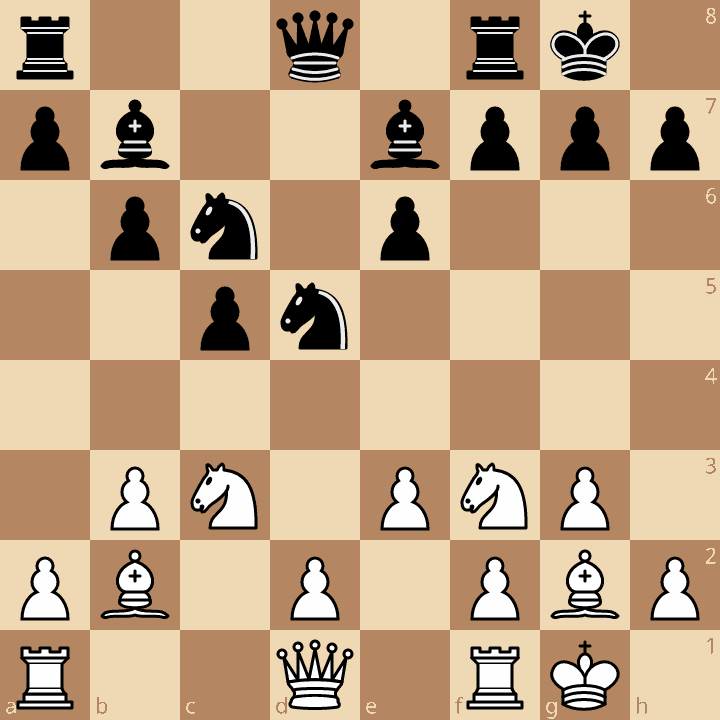
cxd5 — The thematic central exchange! White finally resolves the tension, capturing on d5. This is the moment the Reti has been building toward — with all pieces developed and well-placed, the trade on d5 favors White. After the recapture, White will have a slight but lasting positional advantage with the more active piece placement and pressure along both long diagonals. Played in So vs Dominguez (2017) and ♔︎ramnik vs Radjabov (2011).
Alternative Moves
Black recaptures with the knight, the most popular choice. This keeps the pawn structure flexible and places the knight centrally. After ♘︎xd5, White typically continues with ♘︎xd5 exd5, reaching a position where White has a comfortable edge thanks to the powerful bishops and better pawn structure. The alternative 10. ..exd5 leaves Black's c5 and d5 pawns exposed, giving White clear targets.
Key Takeaways
- The Reti (1.♘︎f3 d5 2.c4) challenges the center from the flank — the hypermodern approach
- The double fianchetto (g3+♗︎g2 and b3+♗︎b2) is the hallmark of this system
- Delay d4 — develop all pieces first, then resolve tension with cxd5
- White's two fianchettoed bishops exert long-range pressure across the entire board
- The cxd5 exchange should come when all pieces are optimally placed, typically around move 10
Now play it through
Step through every move on a real board, try the wrong ones, and ask Knighty why they fail.
Related Lessons
Summary
Ready to Practice?
Next in this opening family
King's Indian Attack
Take this lesson with you
Free account requiredWith every variation — opens in Lichess & ChessBase