
Scandinavian Defense - Modern 2...Nf6
Play the Scandinavian without an early queen move: Black develops the knight first and wins the d5 pawn back with ...♘︎xd5.
Try Interactive LessonIntroduction
Lesson Content
e4 — the King's Pawn opening. White takes space in the center and opens lines for the queen and the light-squared bishop.
Strike at White's e4 pawn right away with a central pawn.
d5 — the Scandinavian Defense. Black hits the e4 pawn at once. If White ignores it, Black takes on e4 and gets a pawn in the center for free.
Alternative Moves
exd5 — White takes the pawn. This is by far the most common answer; after 2. e5 or 2. ♘︎c3 Black already has a comfortable share of the center.
Develop a kingside piece that also attacks the pawn on d5.
♘︎f6 — the Modern Scandinavian. Black develops a piece and attacks the d5 pawn instead of taking it with the queen. The point: when Black takes back next move with the knight, White has no ♘︎c3 that hits the queen and gains time. This is a different lesson from the main Scandinavian with 2. ..♕︎xd5, where the queen comes out early and has to retreat.
Alternative Moves
d4 — the main line. White does not try to hold the extra pawn. Instead White takes the center and lets Black win it back. White's other tries, and what Black does against them: - 3. c4 — White defends d5 with a pawn. Black answers 3. ..c6, ready to take back on d5 with a pawn. After 4. d4 cxd5 the game reaches the Caro-Kann Panov Attack. - 3. ♗︎b5+ — a check to slow Black down. Black blocks with 3. ..♗︎d7 and wins the pawn back soon (after 4. ♗︎xd7+ ♕︎xd7, with the queen). - 3. ♘︎f3 — usually just comes back to this line after 3. ..♘︎xd5 4. d4.
Win back the pawn you gave up on the first move.
♘︎xd5 — Black wins the pawn back, so material is level again. The knight stands in the center, and the queen has not moved at all. White can kick the knight with c4 later, but that pawn move is also useful for White, so Black does not lose real time.
Alternative Moves
♘︎f3 — White develops the knight, guards d4 and gets ready to castle. The more ambitious 4. c4, which kicks the knight from d5 at once, is the other main try.
Get your light-squared bishop out before your e-pawn blocks it in.
♗︎f5 — the same idea as in every Scandinavian: the light-squared bishop comes out before ..e6 closes its diagonal. From f5 it watches the c2 pawn. The bishop on c8 now has a job. After ..e6 it would have stayed locked behind the pawn, like the bishop in the French Defense.
Alternative Moves
♗︎d3 — White offers to trade light-squared bishops. White's bishop is a strong attacker aiming at h7, so trading it for Black's bishop is a fair deal for both sides.
White offers a bishop trade — decide what to do with your bishop.
♗︎xd3 — Black accepts the trade. White's most dangerous attacking bishop is gone, so a later attack against Black's castled king loses its main piece. White's queen comes to d3, but there a black knight on b4 can attack it later, so Black can gain time against it.
Alternative Moves
♕︎xd3 — White takes back with the queen and keeps a healthy pawn structure. Taking with the c-pawn would give White doubled d-pawns.
Open a path for your dark-squared bishop and add support to your centralized knight.
e6 — with the light-squared bishop already traded, this pawn move costs Black nothing. It supports the knight on d5 and opens the f8–a3 diagonal so the dark-squared bishop can come out and Black can castle.
Alternative Moves
O-O — White castles the king to safety and connects the rooks. White now plans c4 to push the knight away from d5.
Build the second half of your pawn wall and cover the squares around your knight.
c6 — Black completes the solid pawn wall c6–e6. The pawn covers the d5 and b5 squares, so the knight on d5 gets a second pawn guard and White's queen cannot check from b5. Black's structure has no weak pawn — this is the same healthy setup as in the Caro-Kann.
Alternative Moves
c4 — White kicks the knight from d5 and takes space. White now has pawns on c4 and d4; Black will later aim at them with ..c5 or with pieces.
Your knight is attacked — retreat it to a square where it guards your future castled king.
♘︎f6 — the knight retreats toward the kingside, where it guards h7 and the king after Black castles. It also watches e4, the square in front of White's pawns.
Alternative Moves
♘︎c3 — White develops the last knight, adds a guard to d5 and covers e4.
Develop your last kingside piece so you can castle next move.
♗︎e7 — a modest but safe square for the bishop. It clears the way for castling, and on e7 it is hard for White to attack.
Alternative Moves
♗︎f4 — White develops the dark-squared bishop to an active diagonal and prepares to bring the rooks to the center.
Get your king out of the center before White's pieces aim at it.
O-O — Black castles. The king is safe behind the f7, g7 and h7 pawns, and White's attacking light-squared bishop is already gone.
Alternative Moves
h3 — a useful waiting move. It keeps Black's knight off g4 and gives the bishop the h2 square to retreat to if ..♘︎h5 attacks it.
Develop your last minor piece behind your pawns.
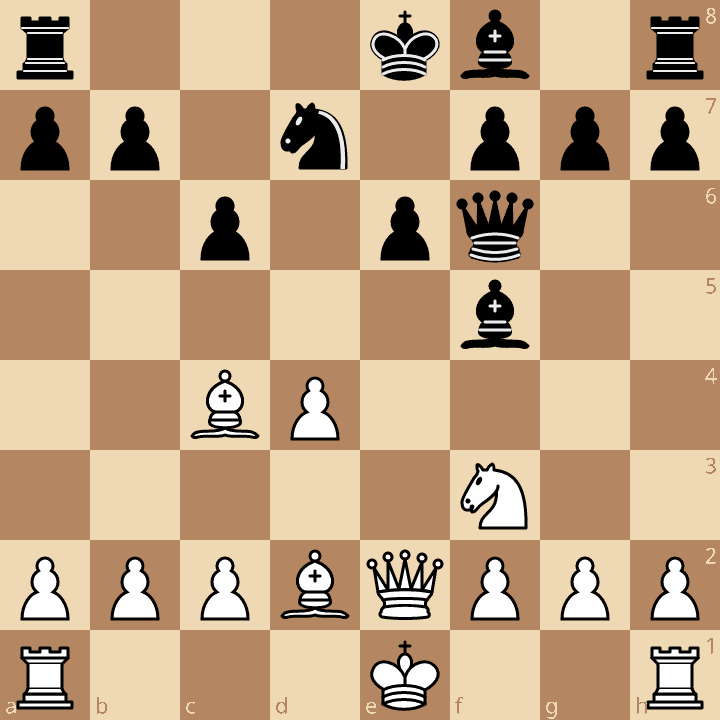
♘︎bd7 — Black develops the last minor piece. All Black's pieces are out, the king is safe, and there are no weak pawns. Next Black plays moves like ..♕︎a5, ..♖︎e8 or ..♖︎c8 and prepares the ..c5 break against White's c4 and d4 pawns.
Alternative Moves
Key Takeaways
- 2...♘︎f6 develops first and wins the pawn back with ...♘︎xd5 — no early queen moves
- Against 3.c4 play 3...c6; against 3.♗︎b5+ block with 3...♗︎d7, then take on d5
- Bring the light-squared bishop to f5 BEFORE playing ...e6
- Trading on d3 removes White's best attacking bishop
- The c6–e6 pawn wall gives Black a solid Caro-Kann-like position with no weak pawns

Now play it through
Step through every move on a real board, try the wrong ones, and ask Knighty why they fail.
Related Lessons
Summary
Ready to Practice?
Next in this opening family
Scandinavian Defense - Main Line
Take this lesson with you
Free account requiredWith every variation — opens in Lichess & ChessBase