
Sicilian Sveshnikov
A combative Sicilian where Black accepts structural weaknesses for dynamic piece play and counterattacking chances.
Try Interactive LessonIntroduction
Lesson Content
The King's Pawn opening — White claims the center and opens diagonals for the queen and kingside bishop. The most popular first move in chess. Black's main responses: - 1. ..e5 — Open Game, matching White's center - 1. ..c5 — Sicilian Defense, fighting for d4 asymmetrically - 1. ..e6 — French Defense, preparing ..d5 - 1. ..c6 — Caro-Kann, also preparing ..d5
The Sicilian Defense — Black's most popular and ambitious reply to 1. e4. Rather than matching White in the center with ..e5, Black fights for the d4 square asymmetrically. The Sicilian leads to unbalanced positions where both sides have chances. White typically gets a kingside attack; Black gets queenside counterplay and the c-file.
The Open Sicilian begins. White develops naturally and prepares d4, which will open the position. This is the most principled approach against the Sicilian. Black's main responses determine the specific variation: - 2. ..d6 — Najdorf, Dragon, Classical - 2. ..Nc6 — Sveshnikov, Kalashnikov, Classical - 2. ..e6 — Kan, Taimanov, Scheveningen
Black develops the knight to its most natural square, controlling d4 and e5. This move order keeps Black flexible — after 3. d4 cxd4 4. Nxd4 Nf6 5. Nc3, Black can choose between 5. ..e5 (Sveshnikov), 5. ..d6 (Classical), or 5. ..e6 (Taimanov).
Alternative Moves
White opens the center immediately. This is the defining move of the Open Sicilian — after the exchange on d4, White gets a half-open d-file and central control, while Black gets the semi-open c-file.
Black captures, opening the c-file for future rook pressure. The asymmetric pawn structure is the hallmark of the Open Sicilian — White has a 2-to-1 central majority (e4 vs nothing), while Black has a queenside majority.
White recaptures with the knight, centralizing powerfully on d4. The knight controls key squares (b5, c6, e6, f5) and can jump to various outposts depending on Black's setup.
Black develops the knight attacking e4, gaining tempo. This is the most popular move, preparing 5. ..e5 (Sveshnikov) after White plays Nc3. Black's alternatives here lead to different systems: - 4. ..e6 — Taimanov/Kan structures - 4. ..g6 — Accelerated Dragon
Alternative Moves
White defends e4 and develops toward the center. This is the main line, though White can also try 5. f3 (transposing to anti-Sveshnikov systems) to avoid the Sveshnikov entirely.
The Sveshnikov move! Black aggressively pushes the knight away from d4, gaining space but creating a permanent weakness on d5 and a backward pawn on d6. This bold decision defines the character of the entire opening. Black accepts static weaknesses for dynamic advantages: the bishop pair, open g-file after ..gxf6, and active piece play.
Alternative Moves
White's only critical response. The knight jumps to b5 targeting the d6 weakness and the c7 square. White aims to exploit the d5 hole created by Black's ..e5.
Forced but natural — Black defends against Nd6+ and supports the e5 pawn. The backward d6 pawn looks like a weakness, but Black's dynamic piece play will compensate.
White pins the Nf6 — the key defender of d5. The strategic idea is clear: if White can eliminate the Nf6, the d5 square becomes a permanent outpost for a White knight. White's alternative: - 7. Nd5 — also strong, immediately occupying the outpost, but Bg5 is the classical main line with more pressure
A key move in the Sveshnikov — Black kicks the Nb5, gaining tempo and preparing the thematic ..b5 advance. White's knight must retreat to the awkward a3 square, where it temporarily sits out of play.
Alternative Moves
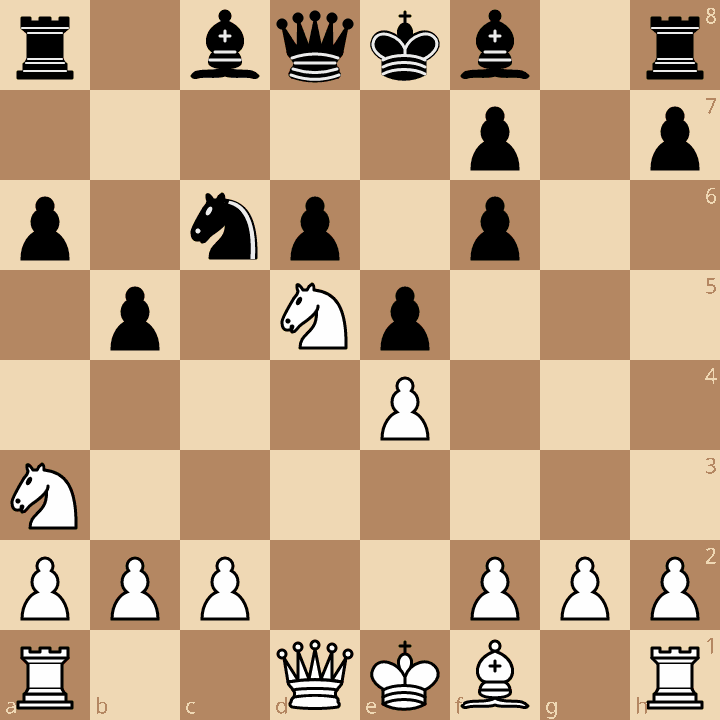
The knight retreats to the rim — temporarily awkward but heading for c4 (via c2) or staying on a3 to support c4. This is the price White pays for the Bg5 plan: a misplaced knight.
The signature Sveshnikov advance! Black seizes queenside space, blocks the Na3 from reaching c4 via b5, and prepares to develop the bishop. This is the move that gives the whole system its aggressive character. After ..b5, Black has real queenside counterplay and the bishop pair is coming alive.
Alternative Moves
White executes the strategic plan — eliminating the Nf6 defender of d5. This is virtually forced now, as Black was threatening ..Be7 followed by ...O-O with a comfortable position.
Black recaptures toward the center, opening the g-file for the rook. The doubled f-pawns look ugly but serve important functions: f6 controls e5, and the open g-file creates kingside attacking chances. Black keeps the bishop pair and dynamic play — the classic Sveshnikov trade-off.
White occupies the dream outpost on d5. The knight is powerfully centralized and cannot be challenged by a pawn. From here, the two main continuations are: - 10. ..f5 — the classical Sveshnikov, immediately challenging e4 - 10. ..Bg7 — the Novosibirsk Variation, developing first
Key Takeaways
- 5...e5 is the defining move — accepting structural weaknesses for dynamic play
- The d5 hole is real but compensated by the bishop pair and piece activity
- ...a6 and ...b5 gain space and drive the White knight to the awkward a3 square
- After Bxf6 gxf6, the open g-file gives Black kingside attacking chances
- This opening was championed by Kasparov and used by Carlsen in the 2018 World Championship
Now play it through
Step through every move on a real board, try the wrong ones, and ask Knighty why they fail.
Summary
Ready to Practice?
Take this lesson with you
Free account requiredWith every variation — opens in Lichess & ChessBase