
Sicilian Taimanov - English Attack
Black's most flexible Sicilian with ...Nc6 and ...Qc7, meeting White's aggressive English Attack.
Try Interactive LessonIntroduction
Lesson Content
The King's Pawn opening — White claims the center and opens diagonals for the queen and kingside bishop. The most popular first move in chess. Black's main responses: - 1. ..e5 — Open Game, matching White's center - 1. ..c5 — Sicilian Defense, fighting for d4 asymmetrically - 1. ..e6 — French Defense, preparing ..d5 - 1. ..c6 — Caro-Kann, also preparing ..d5
The Sicilian Defense — Black's most popular and ambitious reply to 1. e4. Rather than matching White in the center with ..e5, Black fights for the d4 square asymmetrically. The Sicilian leads to unbalanced positions where both sides have chances. White typically gets a kingside attack; Black gets queenside counterplay and the c-file.
The Open Sicilian begins. White develops naturally and prepares d4, which will open the position. This is the most principled approach against the Sicilian. Black's main responses determine the specific variation: - 2. ..d6 — Najdorf, Dragon, Classical - 2. ..Nc6 — Sveshnikov, Kalashnikov, Classical - 2. ..e6 — Kan, Taimanov, Scheveningen
Black prepares ..d5 or ..Nc6 while keeping the position flexible. Unlike 2. ..d6 (Najdorf/Dragon) or 2. ..Nc6 (Sveshnikov), the pawn on e6 supports a future ..d5 break and opens the diagonal for the dark-squared bishop. This move is the gateway to the Taimanov, Kan, and Scheveningen systems — three of the most respected Sicilian variations.
Alternative Moves
White strikes at the center, opening the position. This is the defining move of the Open Sicilian — by trading pawns on d4, White aims to develop pieces actively and seize the initiative. White's alternatives avoid the Open Sicilian entirely: - 3. c3 — the Alapin, a solid but less ambitious system - 3. Nc3 — delaying d4, transposing to some closed systems - 3. d3 — a slower positional approach
Black captures, opening the c-file for future rook activity. This is virtually forced — declining the exchange gives White a dominant center.
White recaptures with the knight, centralizing it powerfully on d4. The knight controls key squares (c6, b5, f5, e6) and will influence the entire middlegame.
The Taimanov Variation! Black develops the knight to c6, challenging White's centralized Nd4 and controlling d4/e5. This is more flexible than 4. ..a6 (Kan) because the knight actively contests the center. Black's alternatives lead to different systems: - 4. ..a6 — the Kan Variation, even more flexible but slightly passive - 4. ..Nf6 — can transpose to many systems depending on White's reply
Alternative Moves
White develops the knight, defending e4 and preparing to push for central or kingside expansion. The most natural and popular response.
The Bastrikov Variation — Black's queen takes up its ideal post on c7. This is the signature move of the Taimanov system, a multi-purpose gem: - Supports a future ..b5 queenside expansion - Vacates d8 for rook centralization (..Rd8) - Controls the c-file and prepares ..d5 or ..d6 - Avoids committing the dark-squared bishop prematurely
Alternative Moves
The English Attack begins! White develops the bishop to e3 before it gets blocked by f3. This aggressive system features Be3, Qd2, O-O-O, and f3, setting up a kingside pawn storm with g4-g5. White's alternatives lead to calmer positions: - 6. Be2 — classical development, less aggressive - 6. g3 — fianchetto approach - 6. f4 — direct kingside expansion
A key prophylactic move — Black prevents Nb5 (which would harass the queen and threaten Nd6+) and prepares the thematic ..b5 queenside expansion. Nearly every Taimanov features ..a6 at some point.
Alternative Moves
The queen centralizes on d2, connecting with Be3 and preparing O-O-O. After castling queenside, White will launch a kingside attack with f3, g4, and h4.
Black develops the knight to its natural square, attacking e4 and preparing to castle. The knight on f6 is a key defensive piece, controlling d5 and g4.
Alternative Moves
White castles queenside, completing the English Attack setup. The position now features opposite-side castling, which means both sides will attack the other's king — creating a razor-sharp, dynamic battle. The rook immediately eyes the d-file, supporting potential Nd4 maneuvers.
The key Taimanov idea! The bishop pins the Nc3, creating immediate tactical pressure. Black threatens ..Bxc3, doubling White's pawns and weakening the queenside pawn structure around the castled king. This is stronger than 8. ..Be7, which is passive. The pin forces White to react and slows down the kingside attack.
Alternative Moves
White reinforces e4 and prepares the g4-g5 pawn storm. The pawn on f3 also takes away the g4 square from Black's knight, which is a key positional consideration.
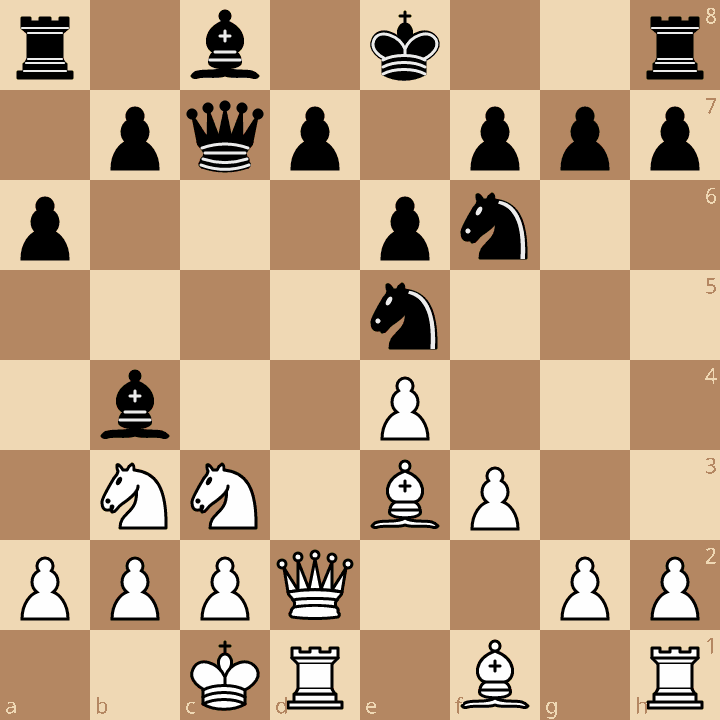
The knight reroutes to e5 — a powerful outpost in the center. From e5, the knight eyes c4 (pressuring the queenside), d3 (if allowed), and controls key squares. The knight was doing little on c6 after ..Bb4 broke the pin theme. This is the most popular continuation, played in Kasparov-Ye Jiangchuan 2002 and Morozevich-Anand 2001.
Alternative Moves
White retreats the knight from d4 to b3, clearing the d-file and preparing to maneuver the knight to d4 via c1 or a5 later. The position is dynamically balanced — White has the kingside pawn storm, Black has piece activity and queenside counterplay.
Key Takeaways
- 5...Qc7 is the signature Taimanov move — flexible, multi-purpose, controls the c-file
- ...a6 is essential prophylaxis, preventing Nb5 and enabling ...b5 expansion
- ...Bb4 pins the Nc3, creating pressure on White's castled queenside
- ...Ne5 reroutes the knight to a powerful central outpost
- Opposite-side castling leads to mutual attacks — tempo is critical
Now play it through
Step through every move on a real board, try the wrong ones, and ask Knighty why they fail.
Summary
Ready to Practice?
Take this lesson with you
Free account requiredWith every variation — opens in Lichess & ChessBase