
Tarrasch Defense
Black challenges the center with ...c5, accepting an isolated d-pawn for active piece play.
Try Interactive LessonIntroduction
Lesson Content
The Queen's Pawn opening — White claims the center and opens lines for the dark-squared bishop. The d4 pawn is immediately defended by the queen, leading to more strategic positions than 1. e4.
Mirror White and claim your share of the center.
d5 — Black matches White in the center, leading to the Queen's Pawn Game. The symmetrical center typically results in strategic maneuvering rather than immediate tactical battles. White's most popular continuation is 2. c4 — the Queen's Gambit.
The Queen's Gambit — White offers a pawn to lure Black's d5 pawn away from the center. It's not a true gambit since Black can't hold the pawn long-term. Black's main choices: - 2. ..e6 — Queen's Gambit Declined, solid and classical - 2. ..c6 — Slav Defense, supporting d5 while keeping the bishop free - 2. ..dxc4 — Queen's Gambit Accepted, giving up the center temporarily
Support d5 and prepare ...c5.
Black reinforces d5 while preparing the Tarrasch plan: ..c5 on the next move. Unlike the standard Queen's Gambit Declined where Black plays solidly, the Tarrasch uses e6 as a stepping stone to the dynamic ..c5 break.
Alternative Moves
White develops the knight to its natural square, supporting e4 and putting pressure on d5. Now Black reveals the Tarrasch plan with 3. ..c5, challenging White's center immediately.
Alternative Moves
Challenge the d4 pawn — accept the IQP for active play!
c5 — The Tarrasch Defense! Black challenges White's d4 pawn immediately, refusing to defend passively. After the central exchange, Black will accept an isolated d-pawn — but gains open lines, active pieces, and dynamic play in return. This move defines the Tarrasch philosophy: activity over structure.
Alternative Moves
White exchanges on d5, the most common response. After Black recaptures with ..exd5, the isolated d5 pawn becomes the central strategic element of the game. White plans to blockade and pressure it; Black plans to use it as a battering ram.
Alternative Moves
Recapture to maintain your central pawn.
exd5 — Black recaptures with the e-pawn, creating the characteristic Tarrasch pawn structure. The d5 pawn is now isolated — no neighboring pawn can support it — but Black gets the half-open e-file and free piece development as compensation.
White develops the knight to its best square, preparing to fianchetto with g3 and ♗︎g2. The bishop on g2 will aim directly at the isolated d5 pawn, creating long-term pressure along the long diagonal.
Develop the knight to support the center.
♘︎c6 — Black develops the knight to its natural square, backing up a later ..d4 push and supporting the center. The knight on c6 also controls e5, an important outpost square in IQP positions.
Alternative Moves
White prepares the Rubinstein/Schlechter fianchetto system. The bishop on g2 will be a long-term asset, targeting Black's isolated d5 pawn through the center. This is the most popular setup against the Tarrasch.
Alternative Moves
Develop the knight to defend d5 and prepare castling.
♘︎f6 — Black develops the kingside knight, defending d5 and preparing to castle. The knight on f6 is a key defender of the isolated pawn and also supports a potential ..d4 advance.
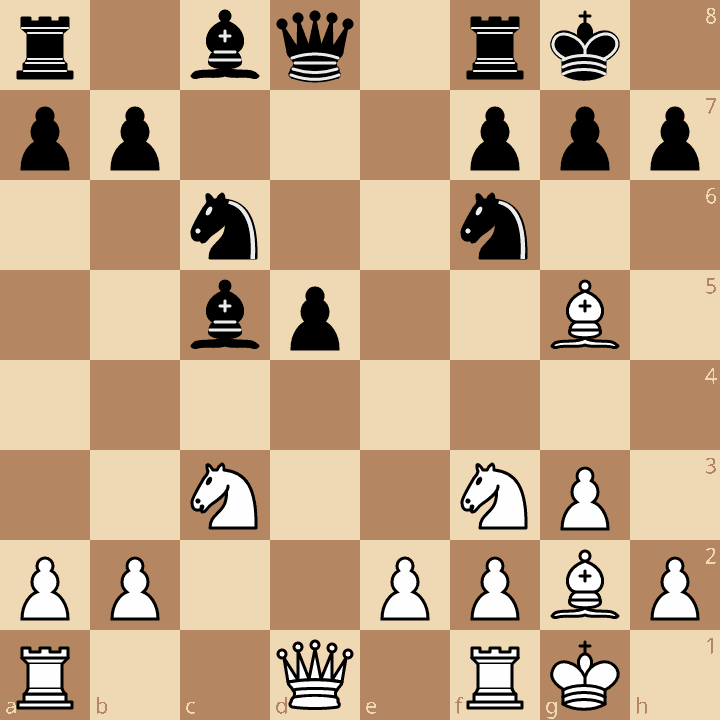
The fianchettoed bishop completes its development, exerting powerful long-diagonal pressure through d5. This bishop is White's most important piece in the Tarrasch — it constantly pressures the isolated pawn.
Develop the bishop and prepare to castle.
Black develops the bishop to a solid square, preparing to castle kingside. While less aggressive than ..♗︎c5 or ..♗︎d6, ♗︎e7 is the most reliable choice — it keeps options open.
White castles to safety. Both sides are nearing full development — the battle around the isolated d5 pawn is about to begin.
Castle to safety.
O-O — Black castles, completing kingside development. With both sides castled and developed, the middlegame struggle begins. Black's plan is to use piece activity and the potential ..d4 advance to create attacking chances.
White captures on c5, resolving the central tension. This is the most common approach — by eliminating the c5 pawn, White isolates the d5 pawn permanently. Now Black must prove that active piece play compensates for the structural weakness.
Alternative Moves
Recapture with the bishop to an active diagonal.
♗︎xc5 — Black recaptures with the bishop, which lands on an excellent diagonal aiming at f2. The isolated d5 pawn is now exposed, but Black has superb piece activity — the bishop on c5 is aggressive, both rooks will find open files, and the ..d4 advance remains a constant threat.
White pins the ♘︎f6 against the queen, attacking the key defender of d5. This is a typical anti-IQP strategy — remove the defenders of the isolated pawn. Black must navigate this pressure while maintaining the dynamic compensation that defines the Tarrasch.
Key Takeaways
- 3...c5 is the Tarrasch move — challenging d4 and accepting the IQP for activity
- The isolated d5 pawn is a weakness AND a strength — it controls key central squares
- Black's compensation: open files, active bishops, and the ...d4 advance threat
- White fianchettoes with g3/♗︎g2 to pressure d5 along the long diagonal
- Piece activity is the key — as long as Black keeps pieces active, the IQP is not a liability
Now play it through
Step through every move on a real board, try the wrong ones, and ask Knighty why they fail.
Related Lessons
Summary
Ready to Practice?
Next in this opening family
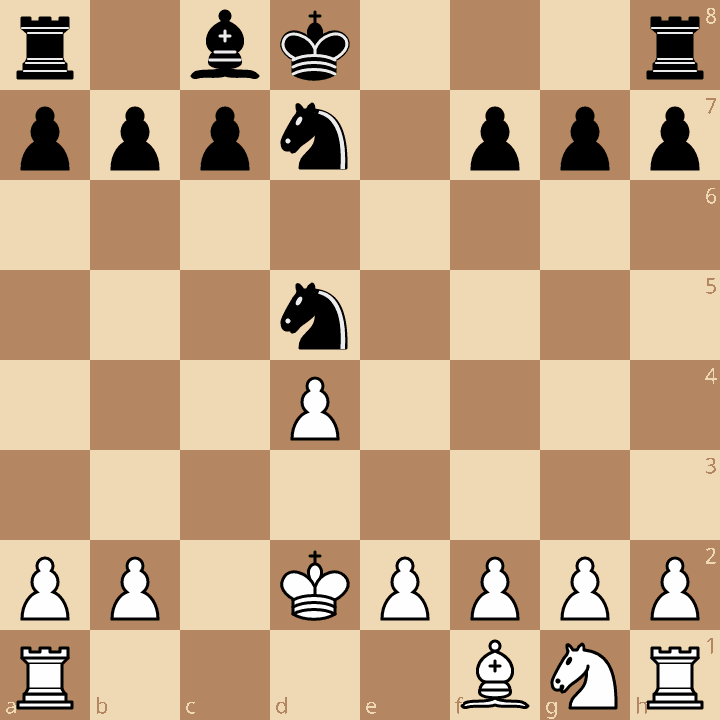
Elephant Trap
Take this lesson with you
Free account requiredWith every variation — opens in Lichess & ChessBase